When I was running FACE Prep, one of the things that kept me up at night wasn’t student acquisition or even retention. It was the content team.
Every hire who joined at full productivity had spent six to eight weeks learning how to write questions that were pedagogically sound, assessment-valid, and stylistically consistent with the rest of the catalog. That ramp wasn’t wasted time. It was unavoidable. But it meant that every time demand spiked (new course, new exam season, a partnership with a college), the bottleneck was the same: qualified human writers, working as fast as humans can work.
That’s the structural problem AI solves best in EdTech. Not the problems that make for good conference keynotes. The ones that compound quietly in the background while you’re focused on growth.
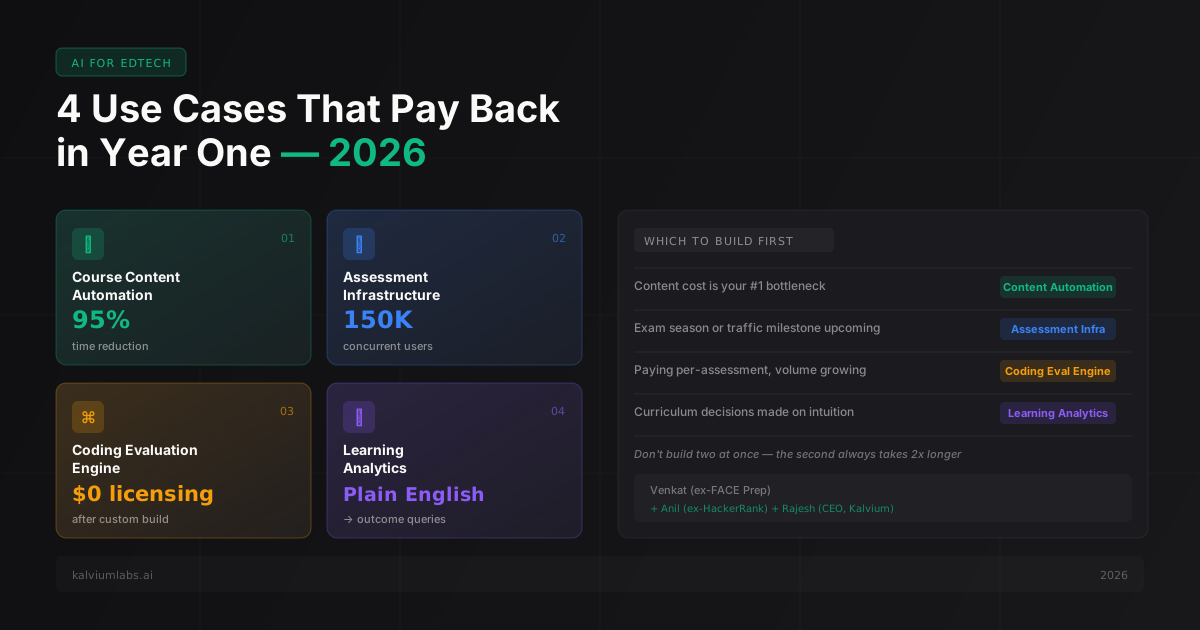
Four use cases have emerged in 2026 where EdTech platforms see return in the first year. Not theoretical return. Dollar-and-hour return you can measure against what you spent to build. I’ll walk through all four, with the numbers where we have them, and a framework at the end for figuring out which one fits your stage.
For more on this, read our guide on AI for Startups.
Course Content Automation: From 4 Weeks to 1 Day
The use case most EdTech founders reach for first is also the one where the ROI story is cleanest.
A structured AI content pipeline (not just “GPT writes the course” but a generation-then-review workflow) cuts course production time by 90-95%. One EdTech provider we built for went from 3-4 weeks per module to a single day. The content team didn’t shrink; the job changed. Subject matter experts moved from drafting to reviewing, which turns out to be a better use of their time.
Three architectural decisions make the difference between a pipeline that helps and one that creates new problems. We’ve learned each of these the hard way across multiple builds:
Generate at the outline stage, not just at the final draft. Most teams reach for AI at the end of the process (“write this lesson”). The quality ceiling is much higher when AI generates an outline first, a human reviews the structure, then AI fills in sections. This staged approach is why first-pass accuracy is high enough for review, not rewriting.
Build the rubric before you build the pipeline. “AI consistency” means the AI applies your rubric consistently, not that the AI decides what good looks like. The rubric has to come from your human experts first. Vague rubrics produce inconsistent output regardless of model quality.
Version and score every generation run. You’ll want to know which prompt version produced the best ratio of accepted-to-revised outputs. Without logging, you’re tuning blindly. A simple scoring schema (five to ten criteria rated pass/fail by reviewers) tells you within a week whether your latest prompt change improved anything.
This isn’t the right fit if your courses are highly bespoke, requiring deep subject-matter expertise that varies per paragraph. AI works best on structured, repeatable content: practice questions, explanations, assessments, module summaries. We’ve written the full architecture breakdown here for founders who want to go deeper on the implementation.
Assessment Infrastructure That Doesn’t Break on Exam Day
If you’ve run an EdTech platform, you’ve probably experienced the exam-day traffic problem. Demand is perfectly predictable: you know when the next national test is, when the semester ends, when the cohort starts. You still get caught. Systems that handled 5,000 concurrent users in testing behave differently at 50,000.
We built a K-12 assessment platform that went from MVP to handling 150,000 concurrent users in three weeks. The architectural choices that made that possible aren’t exotic. They’re about making AI-specific decisions early so they don’t become expensive rebuild decisions later. I’ve seen this particular mistake (bolt AI onto an existing assessment architecture) cost founders twice what the original build cost to fix.
The specific choices that matter:
Question generation and grading run asynchronously. AI-generated questions and AI-assisted grading don’t happen at the moment a student submits an answer. They happen in a queue. This means your grading pipeline can absorb 10x traffic spikes without the API latency hitting the user experience directly.
Separate the scoring model from the content model. The model that generates practice questions should not be the same model, or the same prompt, that grades a live exam response. Grading has a different quality bar. It’s consequential in a way that practice question generation isn’t. Using the same setup for both is one of the most common architecture mistakes we see in EdTech AI builds.
Human-in-the-loop isn’t optional for high-stakes assessment. Any assessment that affects real decisions (admissions, certifications, promotions) needs a review layer that isn’t purely AI. The AI grades at scale; a human reviews flagged edge cases. This isn’t a failure of AI capability. It’s the right architecture for the stakes involved. Here’s how we built a complete AI-powered assessment platform if you want to see the full decision trail.
The return here is less dramatic than course automation but more defensible over time. Platforms that build assessment infrastructure correctly spend less on emergency scaling, lose fewer users on exam day, and pay lower API bills because they’ve designed the grading workflow efficiently rather than bolting AI onto an existing process.
Coding Evaluation Without Per-Assessment Licensing
Most EdTech platforms that run coding assessments today are paying a third-party service for code execution. That’s fine at small scale. At 50,000 assessments a month, the numbers change.
Our CTO Anil built coding-evaluation infrastructure at HackerRank. That’s exactly the problem space you’re dealing with when you’re trying to decide whether to build or continue paying per-assessment. His take: the build threshold is lower than most EdTech founders assume, and the ongoing cost difference compounds over three to four years.
The core of a coding evaluation engine is a sandboxed execution environment: code runs in isolation, with memory and time limits, against test cases, and the output gets scored. Open-source execution engines like Judge0 give you the runtime layer without building from scratch. What you’re building on top of that is the assessment workflow: test case management, candidate experience, result formatting, and the AI layer that generates problems and evaluates explanations.
The AI-specific additions that make a custom coding evaluator worth building over a licensed solution:
Problem generation at scale. Generating 500 coding problems across difficulty levels, language variants, and topic clusters takes a content team months. With a structured generation pipeline, it takes days. The quality bar is higher than content automation (code must execute correctly, test cases must be deterministic) but the approach is the same: generate, validate programmatically, then human-review.
Explanation quality scoring. Many coding assessments only check if the code runs. The more defensible assessment checks whether the candidate understands what they built. AI can score explanation quality, not with a simple rubric, but by checking whether the explanation aligns with the actual code. This is a differentiated feature that licensed tools don’t offer.
Anti-cheating pattern detection. Not the kind that accuses candidates falsely. The kind that flags statistical anomalies: identical submissions, suspicious timing patterns, copy-paste fingerprints for human review. This is the one area where building custom beats third-party tools, because your anti-cheating rules need to match your assessment context, not a generic policy.
Plain-English Learning Analytics
This one surprises most EdTech founders because it sounds less impressive than the first three. It’s also the one I find myself recommending most often to early-stage platforms.
Here’s the actual problem it solves: your curriculum team has outcome data they can’t use. Completion rates by module, assessment scores by demographic, time-on-task patterns, repeat-attempt correlations with eventual pass rates. The data is sitting in your database. Your data analyst can pull it when they have time. Your curriculum team wants to know whether reducing the number of practice questions before a mid-module quiz improves final assessment scores.
They can’t query that themselves. So they don’t. They rely on intuition and on the reports the analyst has time to build.
A plain-English analytics layer changes this. The curriculum team types the question. The AI constructs the query, runs it, and returns a chart. Non-technical staff get real access to outcome data they need to make curriculum decisions. The underlying approach follows the same patterns as the xAPI specification for learning activity tracking, but without requiring your curriculum team to learn query syntax.
We’ve built this pattern for fintech analytics (TradeLab), where the stakes around query correctness are much higher than in a typical EdTech context. The architecture translates well: the model generates SQL from natural language, the SQL is validated before execution, and the result is formatted into something readable rather than raw data. For learning analytics specifically, the query types are narrower and more predictable than in financial contexts, which makes validation easier and accuracy higher.
The return isn’t dramatic in year one. It’s compounding. Curriculum teams that can actually use outcome data make better decisions about which content to update, which modules to cut, and where to spend production budget. That pays back in content quality over 12-24 months, not on a spreadsheet in week eight.
Which One Should You Build First?
Frameworks for prioritization are only useful when they’re specific enough to give you an answer. Here’s how I’d think about the four use cases above given your current stage:
If your biggest cost is content production time: Start with course content automation. The ROI is fastest and the risk is lowest. You’re not changing the student-facing experience at all in the first version. The failure mode (AI output that needs heavy revision) is recoverable. The success mode (90%+ reduction in production time) is immediately visible.
If you’re approaching an exam season or a traffic milestone you’re worried about: Start with assessment infrastructure. This is the one where the cost of not building is measured in outages and churn, not just money. I’ve seen founders lose 20-30% of active users in a single bad exam-day incident.
If you’re paying per-assessment to a third-party and volume is growing: Run the math on build vs. license. If your monthly assessment count is above 20,000 and growing, the build cost typically recovers in 12-18 months. Below that, licensing usually wins.
If your curriculum team is making decisions based on intuition rather than data: Learning analytics is the lowest build cost of the four and often the one with the clearest internal champion. Start small: one analyst query interface, three or four query types your curriculum team actually asks. Add more patterns as you see what they reach for.
The mistake most EdTech founders make isn’t choosing the wrong use case. It’s trying to build two of these at once. The second one always takes longer than the first because the team is split and neither gets the focus it needs. I’ve seen this pattern extend a 3-month timeline to 7 months with both builds ending up incomplete.
FAQ
How much does it cost to build AI features into an EdTech platform?
The range is wide because the complexity varies. Course content automation is typically $15,000-$30,000 for a functional first version (pipeline, rubric, review workflow, logging). A custom assessment engine with AI grading is $25,000-$50,000 depending on the complexity of your question types. Coding evaluation infrastructure ranges from $20,000-$40,000. Learning analytics is often $10,000-$20,000 for an initial implementation covering the most common query patterns. These are build costs, not licensing costs. You own what you build, and the ongoing cost is API usage at scale.
How long does it take to go from decision to live feature?
For course content automation, a working internal pipeline typically takes 3-5 weeks. For assessment infrastructure at scale, 4-8 weeks depending on your current stack and the complexity of your grading logic. Coding evaluation is 6-10 weeks if you’re building from a clean slate (including test case management and problem generation). Learning analytics is often 3-4 weeks because the query patterns are constrained and the integration point is a read-only database connection. These timelines assume you have access to your own historical data and a clear definition of what “done” looks like for the first version.
When should an EdTech company build AI features rather than buy off-the-shelf tools?
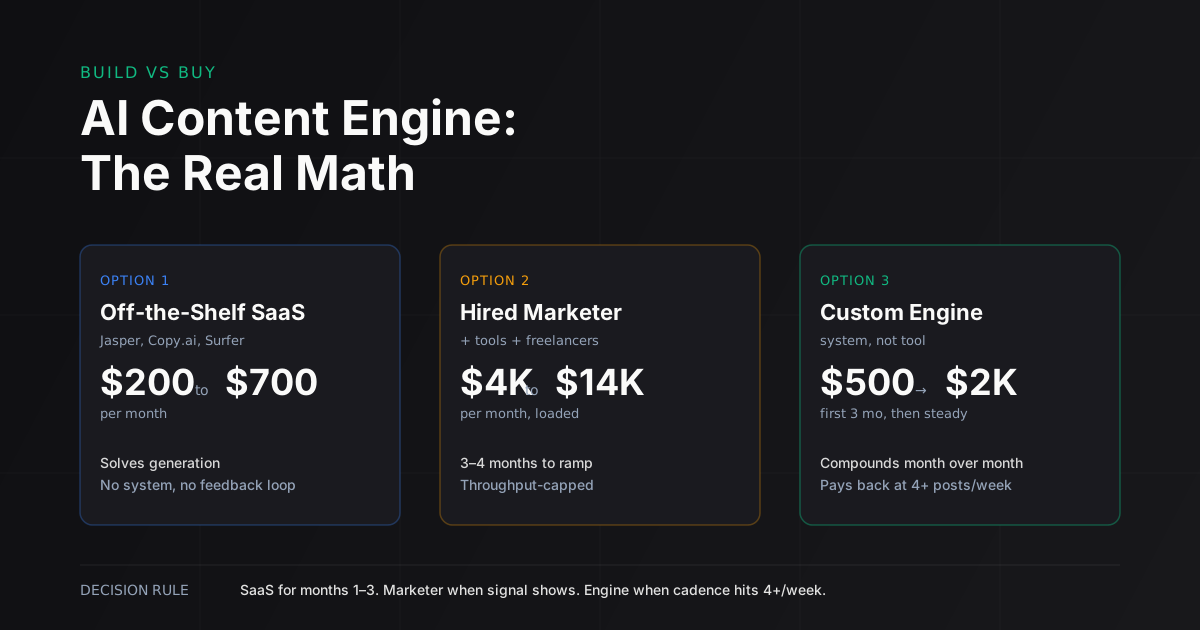
Build when two conditions are both true: your workflow is specific enough that no off-the-shelf tool maps to it without significant workarounds, and your volume is high enough that licensing costs at scale exceed build cost amortized over two years. Buy when your use case is standard (generic quizzing, basic LMS features), your volume is low, or you need something live in less than four weeks. The middle case is hybrid: use an off-the-shelf tool to validate demand, then build custom when the licensing bill becomes the bottleneck.
What data does an EdTech platform need to build AI grading?
For auto-grading of written responses, you need historical examples with human grades attached, ideally 500+ graded samples per assessment type before you start training or calibrating a grading model. For coding assessment, you need correct reference solutions and a deterministic test case suite. For AI-generated rubric scoring (rather than binary right/wrong), you need examples of high, medium, and low-quality responses that your SMEs have rated consistently. If you don’t have this data yet, the first build should prioritize generating and labeling it, not grading automatically.
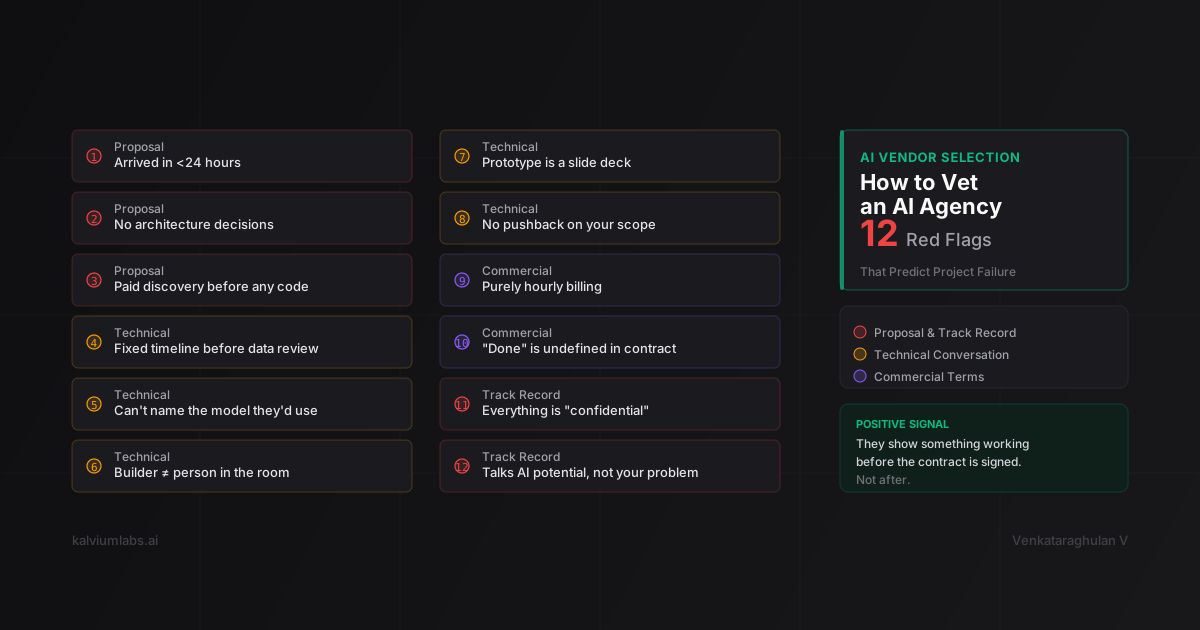
How do I evaluate an AI development partner for an EdTech build?
Ask specifically whether they’ve built assessment infrastructure, course generation pipelines, or similar education technology before, not just “AI projects.” EdTech has specific constraints (exam-day traffic spikes, grading accuracy standards, content quality rubrics) that generic AI experience doesn’t cover. Ask to see the grading or generation pipeline they built for a prior client, even if anonymized. Ask how they handle the review-and-correction workflow. Most teams underestimate how much human judgment has to stay in the loop on educational content. If they can’t describe your problem back to you with specificity, they’re selling you general AI capability, not EdTech AI expertise.
Kalvium Labs has built assessment platforms, course generation pipelines, and coding evaluation infrastructure for EdTech founders at seed through Series B. Our co-founders bring EdTech operator backgrounds: Venkat from FACE Prep, Anil from HackerRank, Rajesh from Kalvium. If you’re evaluating where to start, book a 30-minute call and we’ll tell you which of these four fits your current stage and data situation.