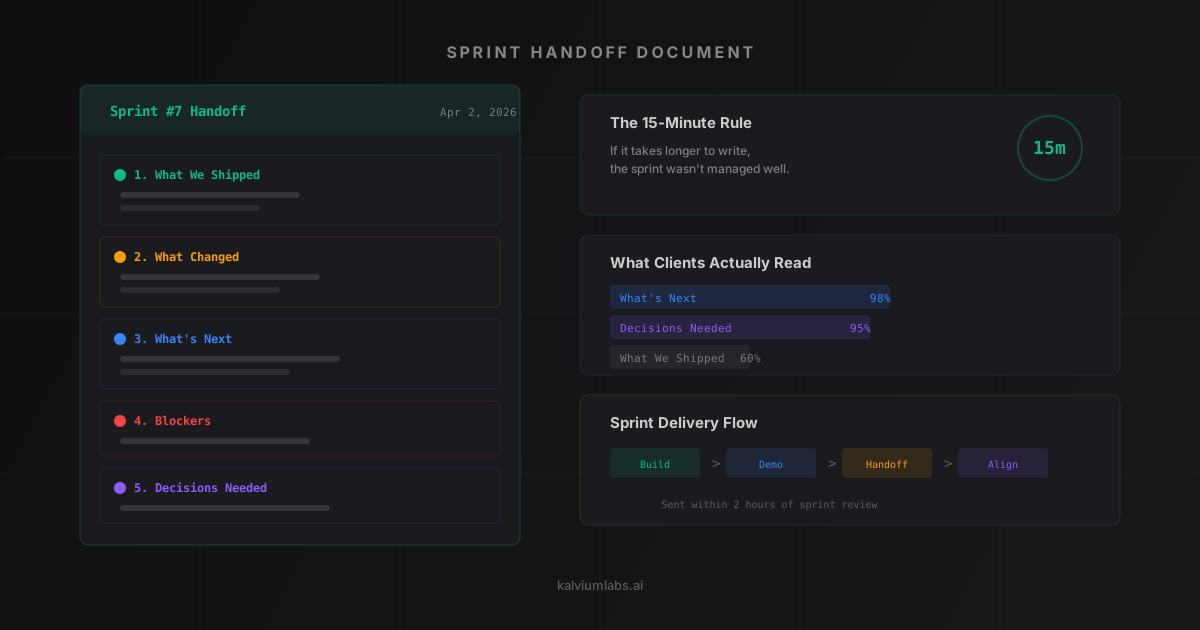
There’s a moment at the end of every sprint that tells me whether a project is healthy. It’s not the demo. It’s whether I can write the handoff document in under 15 minutes.
If I can’t, something went wrong during the sprint, not after it.
I’ve written this document more than 60 times across AI development services projects. The format has changed over time. The purpose hasn’t: give the client exactly what they need to stay oriented, without making them log into a project tool they didn’t ask for.
Why I Started Writing Handoffs
Not because someone told me to. A project taught me the hard way.
Sprint four of a build for an early-stage fintech startup. We’d shipped solid work: a document parsing pipeline, an LLM integration over their contract data using GPT-4o, a basic review UI. The demo went well. The founder was satisfied.
Two days later, he came back with a list of six items he thought were still in scope. Four of them weren’t. They’d been explicitly deprioritized in a planning call three weeks earlier, but that call wasn’t documented anywhere the founder could reference. I had notes. He had memory. Memory is a poor source of truth for scope.
The disagreement wasn’t hostile. Resolving it still cost four hours. We had to re-scope two sprint items and reset expectations on a third. Across a full project, that kind of quiet drift accumulates. By the time it surfaces as a real conflict, you’re three sprints behind where everyone thought you were.
I started writing handoffs the following sprint. One document, five sections, sent within two hours of the sprint review. That fintech project ran three more sprints without a single scope conversation that wasn’t grounded in shared documentation.
The handoff didn’t prevent disagreement. It moved disagreements to the right moment: before engineering started, not after.
The Five Sections We Always Include
The structure doesn’t change sprint to sprint. What goes inside it changes every time.
1. What we shipped
Not a ticket list. A plain-English summary of what the sprint produced and its current state. This is where I’m honest about known limitations, not just the headline result.
“The retrieval pipeline is live on staging. It handles queries against the client’s 4,200-document corpus with a median latency of 1.8 seconds. Known limitation: queries referencing dates before 2019 return lower-confidence results because the older documents weren’t indexed in the same format as the rest.”
That last sentence matters. Shipping something doesn’t mean it’s perfect. The client needs to know the edges of what works, not just that work happened. The Scrum Guide describes a sprint review as an inspection of the actual increment in its current state, not a polished version of it. I hold the handoff to the same standard.
2. What changed from the original plan
Every sprint has at least one thing that didn’t go as planned. This section names it directly: what we planned, what we did instead, and why.
“We planned to integrate the Slack notifications layer this sprint. We deprioritized it after discovering the webhook endpoint on the client’s side wasn’t ready. We used the time to bring retrieval accuracy from 71% to 84% on the test set.”
Clients don’t mind changes. They mind discovering them by accident. Writing it down converts a potential surprise into a shared fact.
3. What’s next
This is the most-read section. One paragraph on what the next sprint covers, in plain English. Not a full backlog dump. Not a list of ticket IDs.
Three goals for the coming sprint, stated as outcomes rather than tasks. “By end of next sprint, a logged-in user will be able to export their results as a PDF with proper citations.” That framing is deliberate. Outcome-first language makes it obvious whether we’re on track.
4. Blockers
Anything waiting on someone else. Formatted as a short list, each item with a name and a date.
“AWS IAM permissions: waiting on client to grant access. Needed by Tuesday for Sprint 5 to start on schedule.”
Blockers left undocumented become emergencies. Documented ones become to-do items. When a client is the named blocker and hasn’t responded, I gently follow up with the specific consequence attached: “If we don’t have access by Tuesday afternoon, Wednesday’s sprint start slips and I’ll need to let you know how that affects the delivery date.”
5. Decisions needed
I write this section last and clients read it first. Specific questions, each with a deadline and a consequence.
“Decision needed by Thursday: do we add voice input to the search UI in Sprint 5, or keep it text-only? Voice input means allocating two additional engineering days and pushing the compliance report feature to Sprint 6.”
No vague asks. Every question includes what changes depending on the answer.
What an Actual Handoff Looks Like
Here’s a simplified version from a real project, details anonymized. The client was an education provider building an AI-assisted content creation workflow. This was after sprint three of a seven-sprint engagement.
Sprint 3 Handoff: [EdTech Client] Sent: end of sprint review day
What we shipped
The content generation API is live in staging. It accepts a curriculum topic and returns a structured 5-section learning module in under 12 seconds, down from 34 seconds in Sprint 2. We’ve connected it to the client’s CMS via webhook. Editors can now trigger generation directly from the CMS draft view.
Known limitation: output format doesn’t yet match the house style for assessment questions. That’s in scope for Sprint 4.
What changed
We planned to build the review dashboard UI this sprint. After seeing the generation quality, the client asked us to prioritize CMS integration so their team could start testing end-to-end. We agreed. Dashboard moves to Sprint 4.
What’s next (Sprint 4)
Three goals: (1) assessment question formatting matching house style, (2) review dashboard for editors to approve/reject/edit AI output before publication, (3) basic usage analytics showing which topics are generated most.
Blockers
None active. If we don’t receive the updated house style guide by Wednesday, assessment formatting slips to Sprint 5.
Decisions needed
Should the review workflow require two approvals before publication, or one? Two approvals means building a second approval state in Sprint 4 and the staging link goes out Thursday instead of Tuesday. One approval means the dashboard ships Wednesday.
That document took 11 minutes to write. The client responded within 90 minutes with answers to both the explicit question and two she’d spotted on her own. Sprint 4 started clean. The AI education content creator case study covers the full arc of that engagement, including what the CMS integration eventually produced.
How This Differs from a Standard Sprint Report
Sprint reports are historical. Handoffs are operational.
A sprint report answers: what happened? A handoff answers: what happens next, and what do you need to do?
Sprint reports are typically written for stakeholders who weren’t in the room, formatted for a monthly review, archived in Confluence or a shared drive. They’re thorough. They’re rarely read between the meeting that produced them and the meeting that references them. A handoff lands in a specific person’s inbox and is designed to be read in three minutes.
The Agile Alliance describes a sprint review as an inspection of the increment and a discussion about what comes next. That’s useful. But a sprint review is a conversation. The handoff is the document that survives the conversation. If the conversation doesn’t leave a written record, scope drift starts immediately, quietly, in the space between what each person remembers.
The other difference is framing. A sprint report is a document about the team’s work. A handoff is a document for the client. Small distinction, large effect. “We completed the API integration” becomes “you now have a working API endpoint for your team to connect to.” “The team addressed retrieval latency” becomes “search results now load in under 2 seconds instead of 8.”
Some teams send sprint reports as a formality. Nobody reads them, nobody responds, and silence gets treated as confirmation that everything is fine. That’s a quiet way to let misalignment grow. The handoff asks for a response. If I don’t hear back within 24 hours, I follow up with one specific question. Silence isn’t alignment.
How the Handoff Prevents Scope Creep
Scope creep doesn’t start with a big request. It starts with assumptions that never get written down.
A client says “can we also add a filter?” during a demo call. The engineer nods. Nobody writes it down. Next sprint, the filter is half-built but the original priority got pushed. The client asks “what happened to the export feature?” and now you’re having a scope conversation that should have happened two weeks ago.
The handoff document prevents this because the “What Changed” and “Decisions Needed” sections make every adjustment visible. When I write “Scope adjustment: added filtering per client request, moved export to Sprint 5,” there’s a written record. Both sides see the trade-off. Both sides confirm it. No surprises.
For AI development projects where requirements evolve as the AI’s capabilities become clearer, this visibility is particularly important. A client might see the prototype, realize the model can handle a use case they hadn’t considered, and want to pivot. That’s fine. The handoff captures the pivot so the next sprint starts from shared understanding, not separate assumptions.
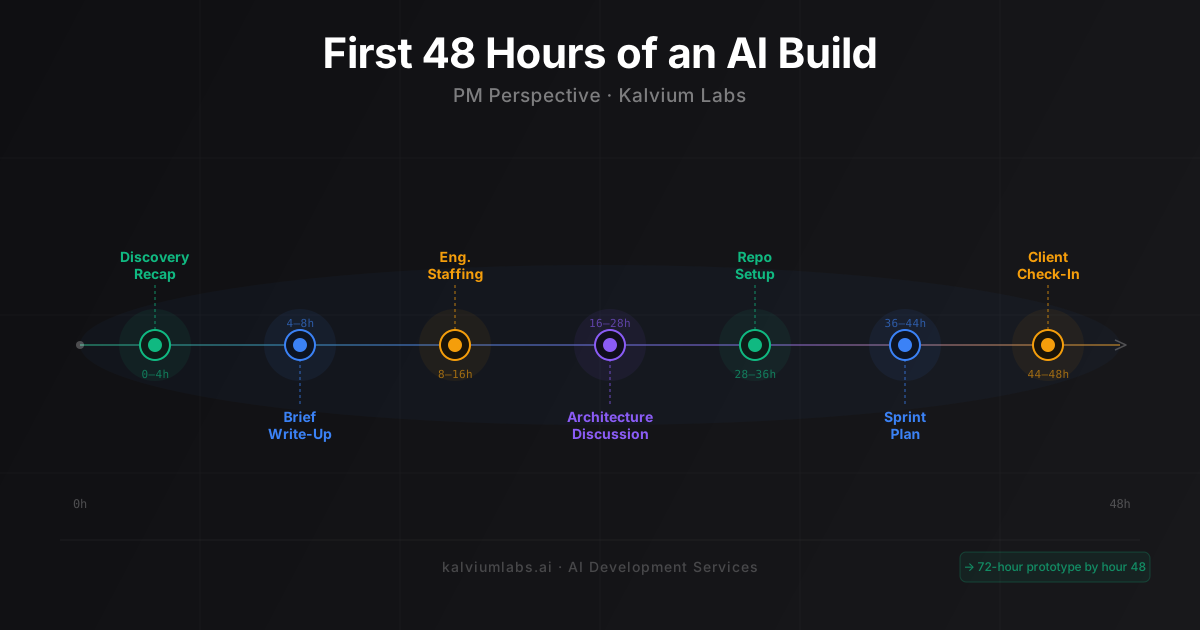
The same principle applies during the first 48 hours of a build, where I write the brief and sprint plan before engineering starts. The handoff is that same discipline applied at the end of every sprint, not just the beginning.
FAQ
Do we still need a sprint handoff if we’re already doing sprint reviews?
Yes. A sprint review is a conversation. Conversations fade. Two days after a review call, the client remembers the demo but not the specific trade-offs discussed or the decisions they agreed to. The handoff is the written record that survives the meeting. It takes 15 minutes to write and prevents the kind of “I thought we agreed on X” conversations that derail the next sprint.
How is a sprint handoff different from a sprint retrospective?
A retrospective is an internal team exercise focused on process improvement. A handoff is a client-facing document focused on project status and next steps. Retrospectives ask “how did we work?” Handoffs ask “where are we, and what do you need to decide?” Both matter, but they serve different audiences and purposes.
How long should a sprint handoff document take to write?
If the sprint was well-managed, 15 minutes or less. The information should already be in your head from running the sprint. If writing the handoff takes 45 minutes of digging through tickets and Slack threads, that’s a signal the sprint lacked structure, not that the document is too detailed.
Do clients actually read sprint handoff documents?
The “What’s Next” and “Decisions Needed” sections get read nearly every time because they’re actionable. Clients skim “What We Shipped” unless something unexpected appears. The key is keeping the document short enough (one page) that reading it feels faster than ignoring it and asking questions later.
How do you handle sprint handoffs for AI projects where outcomes are uncertain?
AI projects often produce results that need interpretation, not just acceptance. The handoff for an AI sprint includes a “What Changed” section that captures any shift in approach (switched from fine-tuning to RAG, adjusted the evaluation threshold from 0.85 to 0.78 based on test results). Uncertainty gets documented as a decision point, not hidden as an assumption.
Want to see how we run AI development projects from prototype to production? Book a 30-minute call and I’ll walk you through our process, including what the first handoff looks like.