The Question Every Client Asks First
When I get on a discovery call with a startup founder, there’s almost always a moment in the first ten minutes where they ask: “So how many people would actually be working on my project?”
It’s a fair question. And it’s one that needs a careful answer.
The honest version: it depends on scope. For a focused build, you might have 2-3 engineers on your work. For a larger one, that grows. But what’s different about Kalvium Labs as an AI development company isn’t the headcount on any single project. It’s how fast we can put the right people on your project, and then sustain momentum without the delays that typically stall AI development.
That’s what 200 engineers actually changes.
What 200 Engineers Doesn’t Mean
Let me start with the wrong picture, because the number can create one.
We’re not putting 200 engineers on your AI product. We’re not running parallel teams building the same feature in different ways to see which approach wins. And we’re not a marketplace where you post a requirement and pick from a list.
200 engineers is a capacity number, not a project number.
What it means in practice: when a new project starts, I don’t spend three weeks posting job listings, reviewing CVs, and scheduling interviews to find someone who knows enough about RAG pipelines to be useful. That AI development team already exists. I’m assembling it from engineers who’ve built similar systems before.
That difference sounds minor. It isn’t.
Sourcing, interviewing, and hiring a specialized AI engineer typically takes 4-8 weeks, based on what founders tell me when they come to us after trying to hire directly. That’s just the hiring part. Add onboarding, codebase orientation, and the 2-3 week ramp before a new hire is contributing at full speed, and you’re looking at 2-3 months before anyone is actually productive on your project.
We don’t have that problem. When you’re ready to start, we’re ready to staff.
The 6,000 Hours: What the Number Actually Means
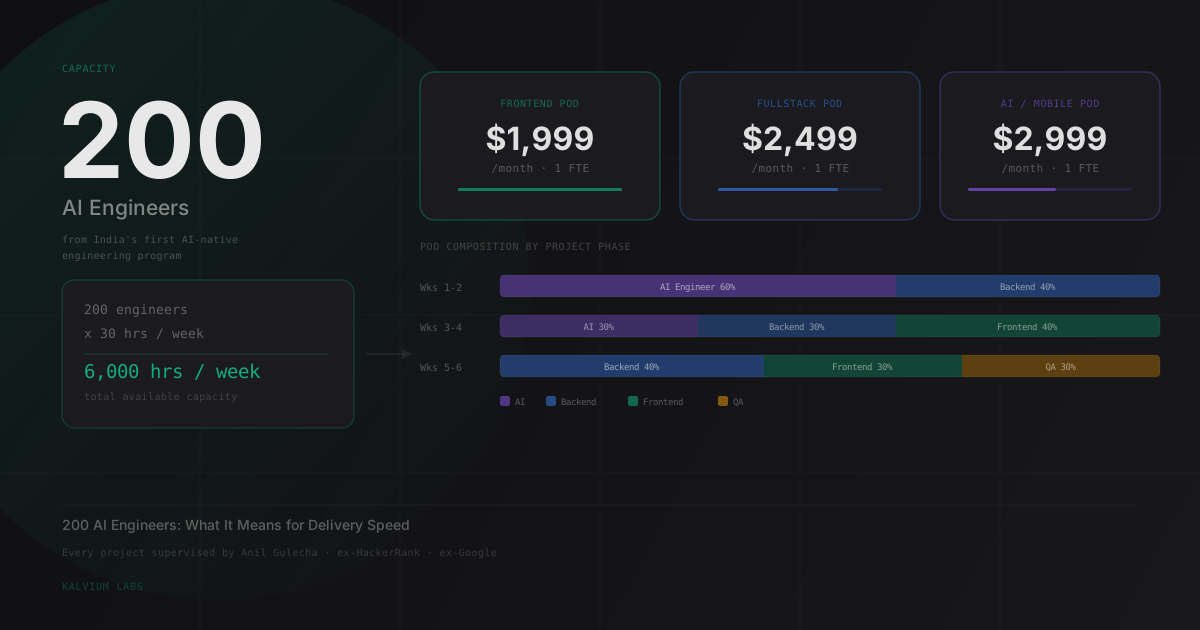
Here’s the number that matters in practice: 6,000 engineering hours per week.
The math is straightforward. 200 engineers, each working 30 hours per week, distributed across all active projects. That’s total capacity at any point.
But the useful question isn’t “how many hours exist?” It’s: “how many hours can I get on my project, right now, when I need them?”
Here’s how that works. At any given point, engineers are distributed across projects of different sizes and phases. A project in active development gets more hours allocated. A project wrapping up gets fewer. When a new project comes in, I look at current allocations, identify engineers whose skills match what you need, and staff accordingly.
What this means for you: we can start in days, not months. There’s no recruiting bottleneck. There’s no “we don’t have anyone with LangGraph experience right now” delay. Engineers who’ve built agentic pipelines, multi-step RAG systems, and production retrieval systems using pgvector already work here.
The 6,000 hours is the pool. Your project draws from it based on scope and phase.
How Pods Work
We organize delivery around pods. A pod is one full-time equivalent of engineering capacity.
It’s worth being precise about what that means, because it’s not always one person.
A single pod might be one dedicated engineer focused entirely on your project. Or it might be fractional: one-third AI engineer, one-third frontend engineer, one-third backend engineer, all contributing to your work. Every pod includes fractional PM time, which is where I come in. You get the engineering hours, and you get someone managing them toward your actual outcome.
The pod structure exists because most AI projects don’t need the same type of engineer at every phase. In week one, you need heavy AI engineering work: getting the model pipeline right, prompt architecture, RAG configuration. In week three, you need frontend to build the interface. In week five, you need infrastructure and QA to get it to production.
If I staffed your project with a single generalist from start to finish, I’d either be picking someone who does all of it adequately (which limits depth) or picking the specialist you need most right now and hoping the other disciplines can wait.
Pods let me staff by phase. The total hours stay consistent. The skills inside those hours flex.
Here’s what a typical pod allocation looks like across a 6-week build:
Weeks 1-2 (Architecture and Core AI): AI engineer (60%), backend engineer (40%)
Weeks 3-4 (Integration and UI): AI engineer (30%), backend engineer (30%), frontend engineer (40%)
Weeks 5-6 (Testing and Deploy): Backend engineer (40%), frontend engineer (30%), QA (30%)
Your project gets the right specialist at the right stage. You’re not paying a frontend engineer to watch an AI engineer tune prompts for two weeks.
The Talent Pipeline: Why It Changes Delivery Math
The engineers at Kalvium Labs come from India’s first AI-native engineering program. They’re AI engineers trained in LLMs, RAG, agentic systems, and full-stack development from day one, not as an add-on track after foundational software engineering.
This matters for delivery in a specific way that shows up on every project.
When I’m working with engineers who’ve been building AI systems from the start of their careers, the “what should we use for this?” conversations are shorter. The time between “here’s the problem” and “here’s a working implementation” compresses.
A typical AI feature that might take a general software engineer 5 days to build (because 2 of those days involve researching unfamiliar APIs and tooling) takes an AI-native engineer 2-3 days. Not because they work faster, but because they’re already fluent in the domain.
Across a 3-month project, those saved days accumulate into meaningfully earlier delivery. That’s the math behind the pipeline advantage. It’s what I see in sprint velocity across projects, not a marketing claim.
Every Project Has a Supervisor
One thing I want to be transparent about, because it affects the risk profile of working with us.
Every project at Kalvium Labs is supervised by Anil Gulecha. He’s the CTO and co-founder, ex-HackerRank and ex-Google, with experience building production AI systems at scale. He reviews architecture decisions, signs off on major technical choices, and is the escalation point when something complex needs a senior eye.
This matters for a specific reason. When you’re working with a smaller AI development company, you’re often betting on the quality of whoever you happen to hire. You might get a strong engineer. You might get someone who builds something that works in demos but doesn’t hold up in production.
Having Anil review the architecture means the decisions that matter most don’t get made without experienced oversight. Day-to-day engineering is handled by the project team. Anil catches the kinds of issues that aren’t visible in week two but cause real problems in week ten.
That’s a different risk profile from hoping the engineers you hired are as good as their portfolio suggests.
The Trade-offs: The Honest Version
I’d rather be direct about the trade-offs now than have you discover them mid-project.
Your engineers work across multiple projects. Unless you’ve purchased dedicated pod capacity with explicit single-project commitment, your engineers are likely working across 2-3 projects at the same time. If you have a question at 2pm on a Tuesday, the answer might come back in 3-4 hours rather than immediately.
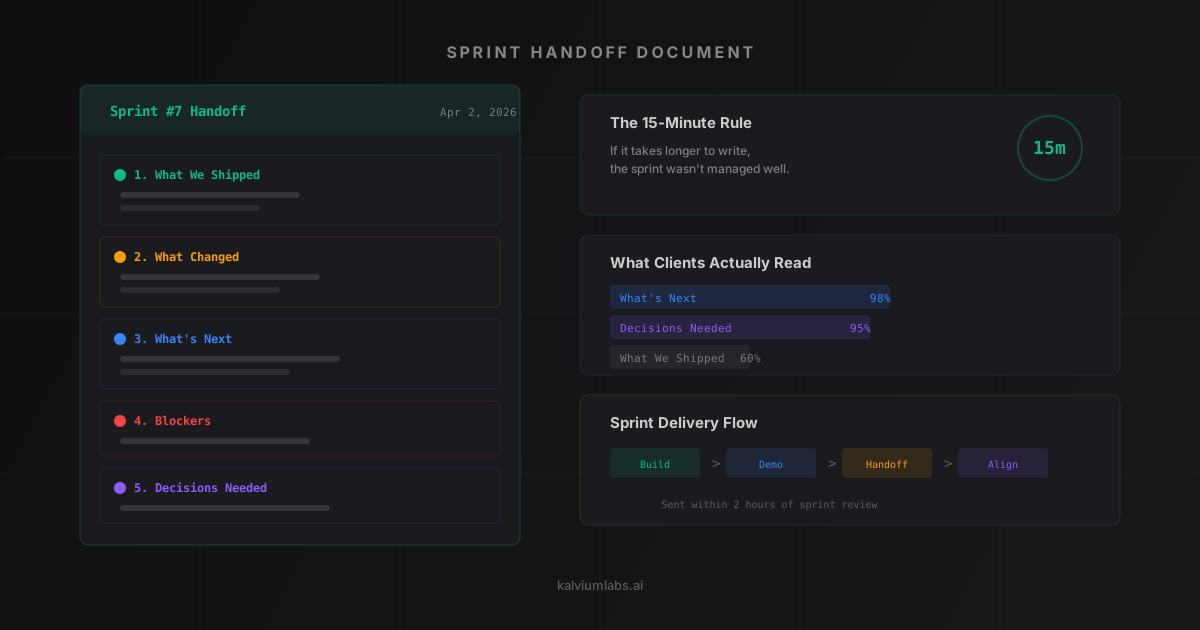
For most projects, this isn’t a problem. We run clear async processes: daily standups, a shared Slack channel, documented decisions, written sprint reviews. Anything urgent and blocking gets treated as urgent. But if you need someone who stops everything the moment you have a question, that’s a different engagement model, and I’ll tell you so upfront.
Ramp-up still takes time, just less of it. We can staff a project in days, but the first few days on any project involve getting familiar with your specific context: your data, your existing systems, your edge cases. That’s not a talent problem, it’s a fundamental reality of software. The question is whether that ramp is days (our model) or months (hiring your own team). It’s days. But it isn’t zero.
Not every specialist is available right now. 200 engineers doesn’t mean 200 people sitting idle waiting for your project. Some are mid-sprint on other work. When I tell you we can start on a specific date, I’m doing real allocation checks, not assuming capacity is infinite. Occasionally a particular specialist is booked for a few weeks. I’ll tell you that rather than overpromise.
These aren’t deal-breakers. They’re the honest version of how this model works.
What This Looks Like as a Timeline
Here’s a concrete example. Say you need an AI document processing tool: extract structured data from contracts, run classification, and output results in a format your team can act on.
Hiring your own AI development team:
- 4-8 weeks to source and hire an AI engineer
- 2-3 weeks to onboard and ramp
- Week 10-11: first working prototype
- Ongoing: management overhead, compensation, benefits
Working with a typical agency:
- 1-2 week scoping and proposal cycle
- Assigned to whoever is available, not necessarily someone who’s built this before
- Week 4-5: first working version
Working with us:
- Day 0: scoping call
- Day 1: engineers assigned from people who’ve built similar pipelines
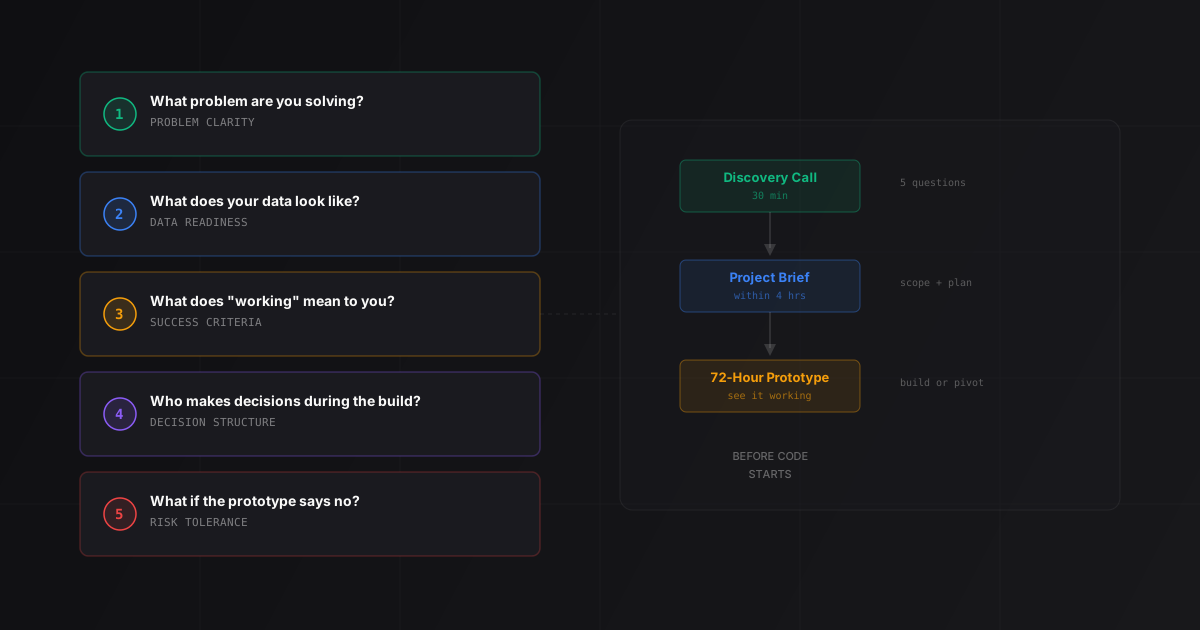
- Day 3-4: first working prototype (the 72-hour Prototype First methodology covers how this works in detail)
- Weeks 3-4: production-ready version
The delta between those timelines matters when you’re trying to validate an idea or beat a competitor to a feature.
If you’re weighing whether to build an in-house team or work with an AI development company, the timeline comparison above covers the main factors to weigh.
The PM Piece
I want to close on something that often gets lost in the engineering conversation.
200 engineers is only useful if the right people are doing the right work, in the right sequence, with someone tracking whether the output actually matches what you need. That’s what I spend most of my time on.
Not just assembling the pod. Managing it through the sprint: making sure engineers understand your requirements, not just the tickets; surfacing blockers early rather than discovering them at a deadline; making sure you know what’s happening and what’s coming next. For a concrete look at what this PM work actually looks like inside the first two days of a project — the sequencing decisions, early blockers, and coordination across engineering roles — the PM perspective on the first 48 hours of an AI build gets into the specifics.
The delivery speed that comes from the talent pipeline is real. But talent without process is just fast chaos. What we’re pairing is a capable AI development team with a PM layer that keeps things pointed in the right direction.
Those two things together are what actually produces the delivery speed we promise clients. Neither one alone gets you there.
FAQ
Does having 200 engineers mean my project moves faster automatically?
Not automatically, no. The number of engineers on your project is set by scope and pod configuration, not by the total team size. What 200 engineers means is that when your project needs a specific skill set, that person already works here and can be allocated in days rather than months. The bottleneck that usually slows AI builds (finding the right people) is removed. Speed still depends on scope clarity, data availability, and how quickly decisions get made on your side.
How much does working with Kalvium Labs as an AI development company cost?
Pod pricing starts at $1,999 per month for a frontend pod, $2,499 per month for a full-stack pod, and $2,999 per month for a mobile or AI-focused pod. All pods include fractional PM time. For fixed-bid projects, small builds (2-4 weeks) run $5,000 to $8,000, and medium builds (1-3 months) run $15,000 to $25,000. All pricing is in USD.
What does “30 hours per week” mean practically for my project?
Each engineer works 30 hours per week across their active projects. A single pod allocation means roughly 30 hours of focused work on your project each week. Two pods means 60 hours. The hours are real and tracked: you’ll see output in daily standups and weekly sprint reviews. If work is getting blocked, it surfaces in the standup, not in a post-mortem three weeks later.
Who reviews the technical decisions on my AI project?
Every project is supervised by Anil Gulecha, co-founder and CTO, ex-HackerRank and ex-Google. Architecture decisions, major technical choices, and complex problems go to him for review. Your day-to-day engineering is handled by the project team. Anil’s role is oversight: the technical decisions that matter most don’t get made without a senior eye on them.
How is Kalvium Labs different from hiring through a freelance marketplace?
A marketplace puts you in the position of sourcing, evaluating, and managing individual engineers yourself, with no shared accountability for outcomes. At Kalvium Labs, you’re working with a team under PM oversight and technical supervision from senior leadership. The engineers come from a single AI-native program with a consistent baseline in LLMs, RAG, and agentic systems, rather than a mix of backgrounds you have to assess individually. The differences in accountability, oversight, and technical consistency are the main factors to weigh when choosing between the two models.
Want to know what pod configuration makes sense for your project? Book a 30-minute call. I’ll look at what you’re building and give you a realistic timeline before you spend anything.