Real estate technology has been through several rounds of “AI will transform this industry.” The AVM wave in the early 2010s. Chatbots for lead capture in 2018-2019. And now, following GPT-4, everything at once.
What’s different about the current wave is that the tools are genuinely useful for day-to-day work, and usage is widespread enough that we can see which implementations are delivering ROI and which aren’t. The signal-to-noise ratio has improved significantly from eighteen months ago, and the patterns are clearer now.
When real estate founders and brokerage operators come to us, the question usually isn’t “should we use AI?” It’s closer to: “we’re already using three or four AI tools and considering building something ourselves. How do we know if the custom build is worth it?” That’s the right question. And it has a clearer answer than most people expect.
The Real Estate AI Stack in 2026 (What’s Now Commodity)
Several AI capabilities are table stakes across serious real estate operations. If your brokerage isn’t using these, the conversation should start here rather than with custom builds.
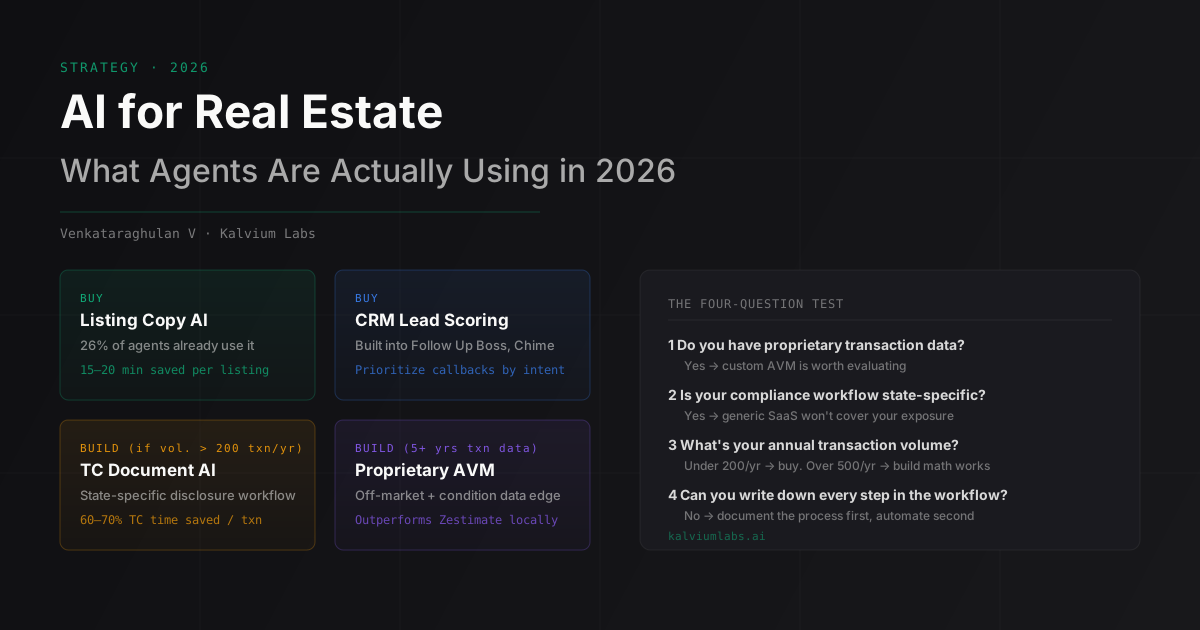
Listing description generation. The most widespread use case in the industry. According to NAR’s 2024 Technology Survey, roughly 26% of agents now use AI for marketing copy. The range runs from generic LLM prompting (a structured ChatGPT workflow with your listing data) to purpose-built products like Listing Copy AI and Wise Agent’s AI writing features. Time savings are real: a listing description that used to take 20-40 minutes now takes 5-10 minutes with AI plus a review pass. This is not an area for custom builds unless you’re running a brokerage at scale and need consistent brand voice across hundreds of agents.
Lead scoring and prioritization. The major real estate CRMs (Follow Up Boss, Sierra Interactive, Chime) all have some version of AI lead scoring now. The premise: agents should call back leads in the order most likely to convert, not in the order they arrived. Even basic behavioral scoring (time on site, pages viewed, repeat visits, listing saves) outperforms chronological follow-up. For most brokerages, buying this feature inside an existing CRM is the right call. We haven’t seen a case yet where a brokerage needed to build lead scoring from scratch at this stage.
Automated valuation models. AVMs aren’t new, but the current generation is meaningfully more accurate than models from five years ago. Zillow’s Zestimate, Redfin Estimate, HouseCanary, and CoreLogic all use ML trained on tens of millions of transactions. For a buyer doing initial research or an agent running a quick sanity check on list price, they’re good enough. They’re commodity.
The question worth asking: is any of this producing a durable competitive advantage? In most cases, the answer is no. If every agent in your market has access to the same AI listing tool and the same AVM, those features have become baseline expectations, not differentiators. The conversation shifts to what’s genuinely proprietary.
Where Custom AI Builds Are Worth Considering
The interesting cases start where off-the-shelf tools reach their limits. These are the builds our discovery calls increasingly center on.
Document processing for transaction coordination.
Transaction coordination involves a predictable but document-heavy workflow: purchase agreement review, disclosure packet processing, title commitment analysis, earnest money handling, inspection contingency tracking. A TC at a busy brokerage handles 10-20 active transactions simultaneously, each requiring review of 50-100 pages of documents. From discovery conversations with TCs and brokerage operators, administrative work typically runs 10-15 hours per transaction, with roughly 60-70% of that being document-related.
AI document processing can handle the routing, extraction, and flagging that currently consumes most of a TC’s time. At 200 transactions per year for a mid-size brokerage, that’s 1,200-2,100 hours of work that’s largely automatable.
The complication: real estate disclosure requirements vary significantly by state. A California residential purchase agreement has disclosure requirements that don’t map onto a Texas contract. Any AI document workflow needs to understand the state context and apply the right checklist. That’s a custom build problem, not something generic SaaS handles cleanly.
We haven’t built this specifically for real estate, but we’ve built the same architecture for financial compliance monitoring: 94% agreement with human reviewers on a multi-point compliance rubric, deployed in two weeks. The pattern transfers directly. The state-specific disclosure layer adds two to three weeks of scope for a market entry build.
Proprietary AVM for brokerages with deep transaction history.
Public AVMs are trained on broad public data: county records, MLS comps, tax assessments, and public sales history. They’re reasonably accurate for standard properties in active markets. They’re notably less accurate for properties with unusual features, in thin markets, or in areas where significant sales happened off-MLS.
A brokerage that’s been operating in a specific submarket for 10+ years, has closed 2,000+ transactions, and has internal records of off-market sales, negotiated concessions, and actual condition assessments has a dataset no public AVM can access. A custom model built on that data can outperform Zillow’s estimate by a meaningful margin for properties in that market. That’s a real competitive advantage: pricing listings with higher accuracy and defending that pricing with proprietary analysis.
Our experience: most brokerages don’t have their historical transaction data in a shape that’s useful for model training without significant cleaning. The data preparation phase tends to run longer and cost more than the model training itself. Don’t underestimate it. We’ve seen data prep take three months on a project that the brokerage thought had “clean records.”
Buyer-facing lead routing intelligence.
Large portals (Zillow, Realtor.com, Redfin) have been building personalized recommendation engines for years. Independent brokerages generally haven’t, because the traffic volume needed to train a recommendation model doesn’t exist at individual brokerage scale.
There’s a simpler version worth building: use buyer behavior signals (search history, saved listings, inquiry patterns, price range shifts) to route high-intent buyers to the right agent, with a brief on what that buyer is actually looking for. Not a full recommendation system, just a lead routing intelligence layer. This doesn’t require millions of users. It requires consistent behavioral tracking and a scoring model. That’s a 2-4 week build for most brokerages, and the output is higher agent-to-buyer match quality and fewer leads that stall because they landed with the wrong person.
Where AI Consistently Runs Into Walls in Real Estate
Real estate has a few characteristics that make AI implementations harder than in most industries. Worth being honest about these before committing to a build, because we’ve seen teams underestimate all three.
Local market context is irreducibly local. An AI tool can tell you that comparable 3-bedroom homes in a given zip code sold at a median of $X over the last 90 days. It can’t tell you that the specific block between the elementary school and the freeway on-ramp has a price penalty that doesn’t appear in the comps. Or that the new restaurant opening three blocks away has already shifted buyer sentiment in ways that won’t show in closed sales data for another 60 days. Experienced local agents carry this context. AI doesn’t have it. There’s no clean data source to train it on.
Negotiation dynamics don’t have a rubric. The compliance monitoring use case works because there’s a defined standard to apply. Real estate negotiation doesn’t work that way. Successful negotiators are reading signals: how motivated is the other party, what are their actual constraints, where is there room that isn’t reflected in stated terms. AI can surface useful information here. Public data on seller tenure, price reduction history, and days on market can inform the conversation. But the judgment layer is still human, and will be for a while.
MLS data quality is inconsistent across systems. According to RESO’s published industry data, there are over 580 MLS systems in the US. Fields, naming conventions, and data completeness vary significantly between them. Anything built to aggregate or analyze across MLS data hits data cleaning problems immediately. This is a real constraint on real estate AI project timelines, and it surprises teams that come from industries with more standardized data infrastructure.
A Framework for Real Estate AI Decisions
Before any technology decision, four questions cut through most of the evaluation quickly. We use these to scope every real estate AI conversation we have.
Question 1: Do we have data that’s genuinely different from what’s publicly available?
If yes, custom AI may be worth building. Your proprietary transaction data, historical off-market deals, and client relationship signals are assets no SaaS product can replicate. If your data is essentially what any MLS subscriber can access, off-the-shelf tools are almost certainly the better bet.
Question 2: Is our compliance workflow state-specific or proprietary?
Generic compliance tooling works for generic standards. If your state has specific disclosure requirements, or your brokerage has internal compliance policies that differ from standard practice, generic tools may not cover your exposure. Custom builds handle proprietary standards cleanly; generic SaaS tools don’t.
Question 3: What’s our transaction volume?
The economics of custom AI development require enough transaction volume to justify the maintenance overhead. At 50 transactions per year, a $20,000 document processing build is hard to justify. At 500 transactions per year, the math often works inside 12 months. Volume threshold varies by use case, but it’s a real constraint.
Question 4: Is this a workflow problem or a technology problem?
The clearest sign a workflow isn’t ready for AI automation: nobody can write down all the steps. If your TC process is undocumented institutional knowledge that works differently depending on who handles the client, AI can’t replicate it. Document the workflow first. The automatable parts become obvious once you can see them. This is the same test that applies to any automation build, not just real estate.
| Scenario | Recommendation |
|---|---|
| Need listing descriptions faster | Buy (Listing Copy AI, ChatGPT workflow, or similar) |
| Need basic lead scoring | Buy (inside your CRM; most major RE CRMs include it) |
| Need AVMs for buyer/seller CMAs | Buy (HouseCanary, CoreLogic, or MLS-integrated tools) |
| Have 5+ years of proprietary transaction data | Evaluate custom AVM |
| Have state-specific disclosure workflow | Evaluate custom document processing |
| Need 24/7 lead capture chatbot | Buy (Structurely, Ylopo, or similar RE-specific tools) |
| Need better buyer-to-agent lead routing | Consider custom build (3-4 weeks) |
What a Realistic Real Estate AI Build Looks Like
For the use cases where a custom build makes sense, here’s what our scoping conversations typically land on for scope and timeline.
Document processing for a single-state TC workflow: 4-6 weeks, $12,000-20,000. Covers document intake, field extraction, state-specific disclosure checklist validation, and exception routing to a human coordinator. The target outcome is 60-70% reduction in TC administrative time on each transaction.
Proprietary AVM for a market-specific brokerage: 8-12 weeks of build time, $25,000-40,000, with a 3-4 month data preparation phase before model training starts. Accuracy improvement over public AVMs depends on data quality and market characteristics. Don’t sign up for this without an honest assessment of your data first.
Lead routing intelligence layer: 2-4 weeks, $8,000-15,000. Behavioral tracking, scoring, and agent-matching logic. Doesn’t replace a CRM but routes high-intent buyers to the right agent with a brief on what they’re looking for.
The HouseCanary developer documentation is worth reviewing if you’re evaluating whether to build a custom AVM or integrate with an existing data provider. It gives a clear picture of what professional-grade real estate data APIs look like, which helps calibrate whether building from scratch or buying data access makes more sense for your situation.
FAQ
How much does it cost to build AI for a real estate brokerage?
Targeted document processing automation (disclosure packets, TC workflow) typically runs $12,000-20,000 over 4-6 weeks. A proprietary AVM built on historical transaction data runs $25,000-40,000 with significant upfront data preparation. A lead routing intelligence layer is $8,000-15,000 over 2-4 weeks. Document processing has the fastest payback because hours saved per transaction are measurable from the first week in production.
Can AI replace a transaction coordinator?
Not with the current generation of tools. AI can automate 60-70% of the document processing and status tracking that takes up most of a TC’s time. The remaining 30-40% involves judgment: noticing that an inspection contingency clause is unusual, catching discrepancies between contract terms, deciding when a situation requires an escalation call. The realistic outcome is one TC handling 2-3x the transaction volume, not eliminating the role.
Should our brokerage build a custom AVM?
Only if you have at least 5 years of closed transactions in a specific submarket with documented off-market data, and your current volume is high enough that more accurate pricing has measurable revenue impact. For most brokerages, HouseCanary or a similar professional AVM API is a better choice than building from scratch. The data preparation phase alone for a custom AVM runs 3-4 months before you’ve written a single line of model code.
What real estate AI tools are actually worth paying for?
Consistent reported ROI: AI lead scoring inside your CRM, AI listing description tools (15-20 minutes saved per listing), AI-powered market report generation for client newsletters. Questionable ROI: generic chatbots not trained on real estate conversation flows, “AI negotiation assistants” that are mostly prompted ChatGPT without your market context, AI-generated property descriptions that haven’t been customized for local terminology and buyer expectations.
How long does it take to see results from real estate AI?
Off-the-shelf tools: hours to days for listing copy, one week to get AI lead scoring running in a CRM. Custom builds: document processing shows measurable TC time savings from week one in production. AVM accuracy improvements take 2-3 months to validate, because you need enough closed transactions after deployment to compare your model against public AVMs on the same properties.
Figuring out which AI builds actually make sense for your real estate operation or proptech product? Book a 30-minute call. We’ll tell you honestly where the ROI is, where it isn’t, and what realistic scope and cost look like for your specific situation.