Building an AI Product Is Like Constructing a House
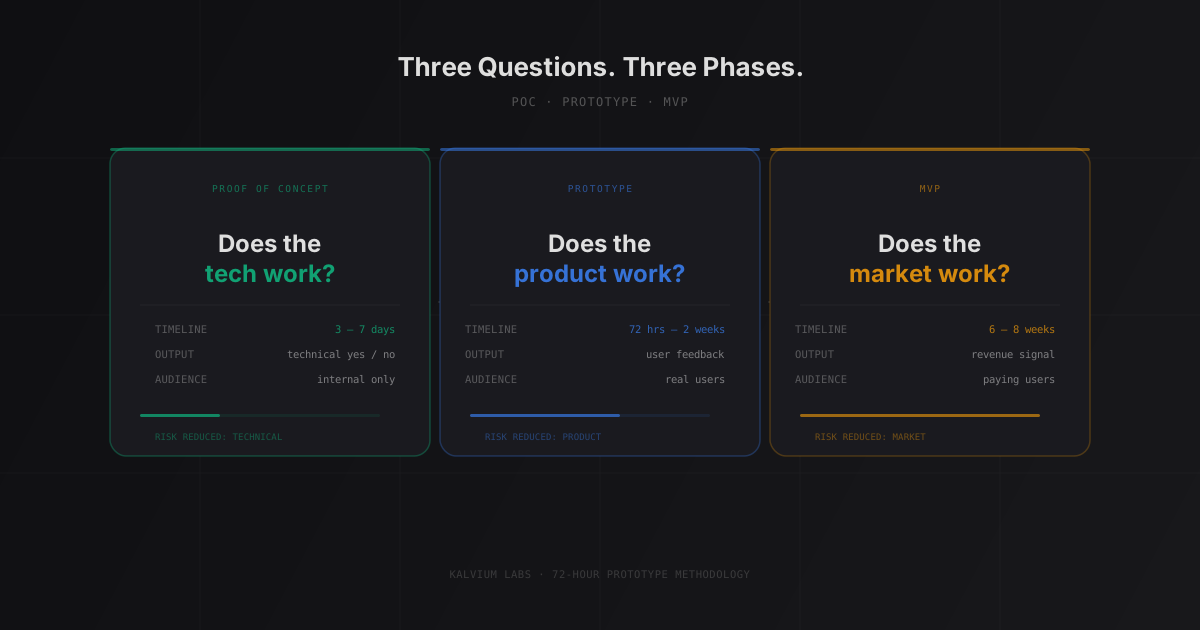
Before your architect draws a single blueprint, a structural engineer runs soil tests. Can this foundation support the building you have in mind? That question has a binary answer: yes or no. That’s your POC.
Then comes the show home. Same floor plan as the final development, real materials, fully furnished rooms. You walk 50 prospective buyers through it. Does the kitchen feel right? Does the master bedroom flow well? Would you actually live here? That’s your prototype: a product question, not a technical one.
Your MVP isn’t the 200-unit development that follows. It’s the first 10 homes you sell to buyers who write real checks, move in, and stay. Do they refer their neighbors? Do the units hold resale value? That’s your MVP: a market question.
Three phases. Three completely different questions. Three different definitions of “it works.”
Most AI founders skip phases one and two, show up at phase three with an unvalidated architecture and an unvalidated product, and spend six months wondering why adoption is slow. The soil was never tested. The buyers never walked through.
Let’s fix that.
Why These Three Terms Get Confused (And What It Costs)
The confusion has two origins.
First, startup mythology. For years, “MVP” became the universal shorthand for “first version of the thing.” Ship early, ship often, iterate. The advice is correct, but it absorbed the other two terms along the way. Founders started calling everything an MVP, including things that were clearly prototypes or POCs.
Second, AI hype cycles. When a new model capability appears, teams want to demonstrate they’re moving fast. “We built a POC” sounds more rigorous and credible than “we built a demo.” So technical demos started getting called POCs. Internal tools started getting called MVPs. And somewhere in the middle, the prototype, the most useful stage of the three, almost disappeared entirely.
The result is concrete and costly. CB Insights has tracked startup failure patterns for over a decade: “no market need” has consistently ranked as the top reason startups fail. Teams built the wrong thing because they never validated what users actually wanted. Most of those teams would say they built an MVP. Most of them built a prototype-shaped MVP on top of a POC-shaped prototype, and validated nothing cleanly at any stage.
The cost isn’t just time. It’s the compounding cost of building features on top of unvalidated assumptions. Every engineering hour spent on a workflow that users don’t want is an hour that can’t be spent on the workflow they do.
What an AI Proof of Concept Actually Is (And When You Need One)
A proof of concept is a technical feasibility test, nothing more. It doesn’t ship. Users never see it. It answers one question: can this technology actually do what we think it can?
Not “will users like it.” Not “is this the right product.” Purely: can the system physically do the thing we need?
Concrete examples of when you genuinely need a POC for an AI product:
- You’re fine-tuning a model on a domain-specific dataset (medical records, proprietary contracts, specialized legal documents) and you’re not confident the base model has enough signal to learn your domain
- You need real-time processing of video frames through an LLM pipeline and you don’t know if the latency target is physically achievable at your volume
- You’re integrating with a legacy system via an unusual API and you need to confirm you can reliably extract structured outputs from unstructured responses
- You’re combining multiple models in a chain and you haven’t tested whether the error rates compound acceptably
The output of a POC isn’t a product. It’s a documented yes/no on a specific technical assumption, clear enough that the team can move forward with confidence or change the approach.
How long should it take? For most standard AI use cases in 2026, 3 to 7 days. If a team needs 4 weeks to run a POC on a RAG pipeline over company documents, they’re not running a POC. They’re building a prototype and calling it something else. (This happens more often than you’d think, and it’s usually a sign the team hasn’t isolated the actual assumption being tested.)
The right question to ask yourself before starting a POC: what is the single technical assumption that, if wrong, kills this entire idea? If you can name it precisely, scope the POC to that assumption alone. If you can’t name it, you probably don’t need a POC.
Here’s the honest answer for most AI products in 2026: you don’t need a POC at all. The base models exist, the infrastructure is mature, and the technical feasibility of conversational interfaces, document processing, and structured extraction is well-established. Skip straight to the prototype.
What a Prototype Actually Is (And Why It’s Different)
A prototype is a product question, not a technology question.
By the time you’re building one, you’ve either run a POC (if needed) or you’re confident enough in the technical feasibility to skip ahead. The prototype’s job is to answer: does this solve a real problem for real people, and does the workflow we’ve designed actually match how they want to work?
A prototype doesn’t need to scale. It doesn’t need proper error handling, observability, an auth system, or hardened prompts. It needs to be real enough that actual users can interact with it and give you feedback that changes what you build next.
What “real enough” means varies by product type, but some rough calibration points:
- A conversational AI prototype needs to handle at least 40-50 real queries from real users in your target domain, not synthetic test cases
- A document processing prototype needs to work on actual documents your users care about, not the clean examples from your test set
- An agent prototype needs to complete the 3-4 most common user intents reliably, even if edge cases fail
The measurement that matters for a prototype isn’t accuracy or response latency. It’s the quality of the surprises you encounter. A prototype has done its job when you can answer: “what did users actually try to do that we didn’t anticipate?” If everyone uses it exactly as you designed, either you designed something perfect on the first try (unlikely) or you didn’t test with enough real users.
The classic mistake: teams spend 3 weeks hardening the prototype before showing it to users. They fix latency, clean up the UI, add loading states and error messages. By the time they show it to 20 users, they’ve already made 30 assumptions about what users want, without testing any of them. The whole point of the prototype is to surface those assumptions early, when changing them costs hours instead of weeks.
Our 72-hour prototype methodology is built on this principle. Build something users can actually test, put it in front of real users within 72 hours of starting, and let their behavior tell you what to build next.
What an MVP Actually Is (And Isn’t)
An MVP is a market validation exercise. By the time you’re building one, you should have already answered two prior questions cleanly.
“Can we build this?” That’s the POC (or a confident skip). “Do users want what we’ve built?” That’s the prototype.
The MVP answers the third question: will users pay for this, and will they come back?
This is where most of the misuse happens. Teams call something an MVP when it’s actually:
- A prototype with payment bolted on, shown to users who’ve never used the core workflow before
- An internal tool that worked for the team but was never tested with external users
- A “v1” built entirely on the founding team’s assumptions, with no prototype validation behind it
A real MVP has three specific properties.
First, real users with real switching costs. Not friends. Not beta testers who signed up out of general curiosity. People who had a specific problem before, tried your solution, and made a conscious choice to use it again when they had that problem the next time.
Second, a measurable retention signal within 2 to 4 weeks. For AI products, this usually shows up as repeat usage patterns. Users who come back and run 10 or more queries in week two are voting with their behavior. Users who try it once and disappear are telling you something important about either the product or the audience segment.
Third, deliberately excluded features. This is the part founders consistently struggle with. The MVP ships with the minimum viable feature set that completely solves the core problem. Not 80% of it. The whole core problem, and nothing else. Every feature you add before validating retention is a feature built on assumptions you haven’t tested yet.
The Decision Framework: Which One Do You Need Right Now?
Three questions, asked in order.
Do you have genuine technical uncertainty?
Something specific: an unusual data format, a latency requirement you haven’t validated, a fine-tuning task on a domain where the base model’s capability is unclear. If yes, run a POC. Time-box it to 5 working days. Document the outcome. Kill it cleanly.
If no (or once the POC passes): move to the next question.
Do you know what users actually want to do with this?
Not what you think they want. What you’ve observed them trying to do, with something real in front of them. If no, build a prototype. Show it to 15 to 20 real users in your target segment. Measure the surprises.
If yes (or once the prototype teaches you enough): move to the third question.
Do the unit economics work if people pay for this?
Model API costs at scale, infrastructure costs, the support burden, the sales cycle. If yes, build your MVP around the single workflow that prototype users returned to most.
If the economics don’t work, you have a product problem, not a development problem. Back to the prototype stage.
The order matters because each stage answers a different category of risk. Skipping the POC when you have real technical uncertainty means your prototype might fail for reasons that have nothing to do with product-market fit. Skipping the prototype means your MVP is built on assumptions that no user ever validated.
Why AI Startups Specifically Tend to Skip Straight to MVP
The pattern repeats enough that I can describe it as a formula.
A founder sees a capability in a current model (GPT-4o, Claude, Gemini, whatever’s current when you’re reading this) that nobody has yet built into a product for their specific domain. They’re convinced the capability is real. They’re convinced there’s a market. And they skip validation because the development cost feels low. “It’s just API calls,” the thinking goes. “How hard can it be?”
Three months later: a product that works technically, costs more to run than expected, and has 200 users who tried it once and didn’t come back. The problem usually isn’t the AI. It’s that nobody validated whether the specific workflow made sense for the specific users before the full build started. The failure patterns are consistent enough to map: why most AI products fail traces the structural causes in detail.
Eric Ries documented the core problem when he articulated lean startup methodology: the most dangerous assumption isn’t “can we build it” but “should we build it.” That was true for software generally. For AI products, it’s compounded by the “just API calls” fallacy.
The technical barrier to shipping an AI feature is genuinely low right now. The product barrier, getting the workflow right, the prompt design, the context management, the trust signals users need before they rely on the output, is just as high as it’s always been. A prototype surfaces those product problems in 72 hours. An MVP built on wrong assumptions surfaces them in 4 months, after you’ve spent $30,000 to $50,000 and built an engineering team around a workflow that doesn’t match how users want to work.
The 72-Hour Prototype: Why This Stage Does the Most Work
For most AI products in 2026, the POC question is mostly pre-answered. The models exist and are capable. The infrastructure is mature: vector databases, streaming APIs, context windows large enough for real workloads. For the majority of use cases, you don’t need weeks to prove the technology works. You need 72 hours to prove the product is worth building.
At Kalvium, we build a working, user-testable prototype before any contract is signed. Not a demo video. Not a slide deck showing what we’d build. Something the client can click through, run real queries against, and get real outputs from. This single step eliminates the most expensive category of error in AI product development: building the wrong thing for 3 months before showing anyone.
For more on this, read our guide on Why Your AI POC Succeeded but Your Product Failed. Why 72 hours specifically? It’s the shortest time in which you can build something representative enough to generate real feedback. Less than that and you’re showing a mockup. More than that on the prototype stage and you’re starting to optimize something you haven’t validated yet.
What fits in 72 hours: a conversational interface over your actual data, a document processing pipeline on your real documents, an agent that completes your most common workflow. What doesn’t fit: scale, security hardening, full error handling, production-grade observability, integration with every system in your stack.
The prototype is explicitly a tool for making the build/don’t-build decision. If users interact with it and immediately try to do things we didn’t anticipate, we’ve learned something that changes the spec at zero cost. If users interact with it and the core workflow lands exactly as designed, we have enough confidence to scope the MVP correctly.
The Mistake That Compounds
If there’s one pattern worth naming directly: confusing “the tech works” with “the product works.”
A POC proves the tech works. That’s a necessary condition, not a sufficient one. Teams that celebrate a successful POC and immediately start building a full product are treating two separate experiments as one. They’re not saving time. They’re just delaying the product validation question until it costs more to answer.
The prototype is the bridge. It takes the technology that works and asks: does this solve a real problem in a way real users will actually adopt?
The MVP only makes sense after you’ve crossed that bridge.
Get the sequence right and you’re moving methodically from technical risk to product risk to market risk. Each phase is faster and cheaper than the one before. A POC that fails after 5 days costs you a week. A prototype that teaches you to pivot costs you 72 hours. An MVP built on two validated prior stages fails for market reasons you can measure and fix, not for reasons you should have caught in week one.
The founders who compress this the most, who do it in weeks rather than months, aren’t the ones who skip steps. They’re the ones who run each step quickly and cleanly, take the output seriously, and use it to make the next step faster.
FAQ
Should I ask my development team for a POC or a prototype first?
A proof of concept tests whether the technology can do what you need it to do. It’s internal, it’s a technical feasibility check, and it produces a yes/no answer on a specific assumption. A prototype tests whether users actually want the product you’re building. It’s externally facing, designed to generate user feedback, and doesn’t need to scale or harden. You run a POC when you’re not sure the technology can deliver; you build a prototype once you’re confident it can but don’t yet know if you’re building the right thing.
Do I need a POC before building an AI product in 2026?
Not always. For most standard AI use cases (RAG over documents, conversational interfaces, structured data extraction from text), the technical feasibility is well-established and you can skip straight to a prototype. You need a POC when your use case has genuine technical unknowns: unusual data formats, real-time latency requirements at scale, fine-tuning on domain-specific datasets where the base model’s capability is unclear, or deep integrations with legacy systems that haven’t been tested before.
How long should an AI prototype take?
Between 72 hours and 2 weeks, depending on complexity. For most single-workflow AI products, 72 hours is enough to build something real enough for user testing. If your prototype is taking longer than 2 weeks, you’ve probably started building the MVP without realizing it. The clearest sign this is happening: you’re adding features that weren’t in the original brief, rather than keeping the scope narrow enough to test the core workflow cleanly.
When should I move from prototype to MVP?
When two signals appear together: users are returning to use the prototype voluntarily (without you prompting them), and you know specifically which workflow they keep coming back for. If you have both signals, you have enough to scope the MVP around that workflow. If you only have the first signal, run more prototype sessions with a wider user sample to identify which specific use case is generating the retention.
How much does an AI MVP typically cost?
For a single-workflow AI product targeted at a defined user segment, a realistic range is $15,000 to $40,000 for a 6 to 8 week engagement with a qualified team. The bigger variable is usually the ongoing infrastructure cost (model API calls at scale, vector database queries), which a good prototype phase will help you estimate realistically before committing to an MVP scope. Teams that skip the prototype stage often underestimate infrastructure costs by a factor of 3 to 5x, because they don’t have real usage data to model from.
Not sure whether you need a POC, prototype, or MVP? Book a 30-minute call. We’ll look at what you’re building and tell you which stage you’re actually at, and what the next 72 hours should look like.