Dr. Suganya called me three days after we launched the system. Not to report a problem, but because she’d just Googled “PCOS diet plan” and found her own article on the first page.
“I didn’t even know that page existed,” she said. “I just reviewed it. I didn’t think Google would find it this quickly.”
That call is one I think about when clients ask whether doctor SEO actually works. The honest answer: it works faster than most doctors expect, and slower than most SEO agencies promise. The middle ground, when you get the content and the process right, is five weeks from zero impressions to a keyword ranking in the top two.
This is the story of how we built the system, what broke during the build, and what I’d tell a clinician who’s thinking about it now.
Why Most Medical Practice SEO Fails
Before we started the Fertilia Health project, I spent two weeks reading the content that ranked for the search terms Dr. Suganya cared about: PCOS symptoms, fertility treatment options, signs of hormonal imbalance, ovulation tracking. The quality was consistently disappointing.
Most of the ranking content fell into two categories. The first was generic health information lifted from WebMD or similar sources: technically accurate, entirely interchangeable with 40 other articles, nothing a patient couldn’t find on five other sites. The second was thin, keyword-stuffed content from clinics that had hired a content agency with no medical background. Sentences that included the phrase “seo for doctors” in a way that no actual doctor would ever write.
Neither category was doing patients any favors. But both were ranking because nobody else was publishing anything better.
That gap is the SEO opportunity for doctors. Most clinics either don’t publish consistently or publish content that looks like it was written by someone who Googled the symptom and summarized the first result. A doctor with real clinical experience, publishing content that reflects how they actually diagnose and treat, can outrank generic health content faster than almost any other niche.
The blocker is always the same: doctors don’t have time to write. Dr. Suganya sees 20-30 patients a day. She had 15 years of knowledge and no way to put it online at the speed Google rewards.
What We Actually Built
The system has three layers. I’ll describe them the way I described them to Dr. Suganya in our kickoff call, not the way a tech company would describe them.
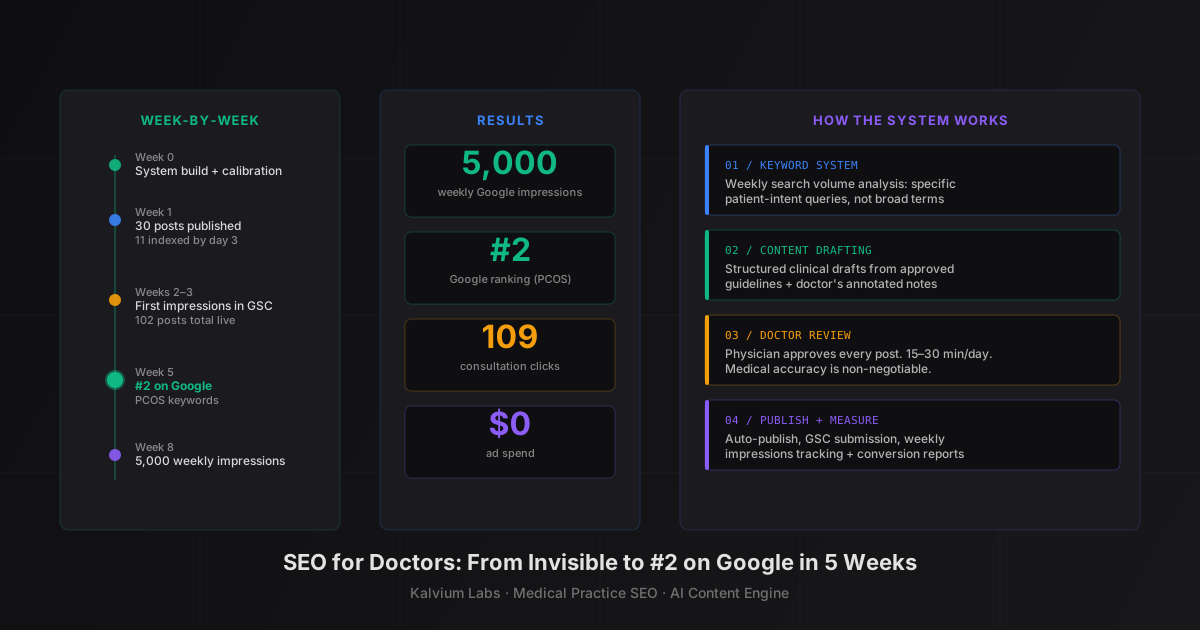
Layer 1: The keyword system. Every week, the system runs a search volume analysis on terms related to Fertilia Health’s specialty areas. Not broad terms like “women’s health” but specific, patient-intent queries: “PCOS and hair loss treatment,” “when to see a gynecologist for irregular periods,” “signs you’re not ovulating.” We use Google’s Keyword Planner API against the India geo target, since Fertilia serves Indian patients. The system flags which terms have search volume above a threshold and aren’t already covered by an existing post.
Layer 2: The content drafting system. For each flagged term, the system generates a structured draft. The structure is deliberate: a clinical framing (not a generic “what is X” opener), a symptoms and presentation section, a clinical context section, a treatment approach section, and a clear “when to book an appointment” section that converts readers into patients. The system doesn’t invent facts. It works from a set of approved clinical guidelines and Dr. Suganya’s own annotated notes on each condition.
Layer 3: The review queue. Every draft lands in a review queue. Dr. Suganya sees it as a clean document, not a CMS interface. She reviews the medical claims, adds her clinical observations, flags anything that doesn’t match her practice approach, and approves. The system handles publishing, formatting, and submitting to Google Search Console.
The full tech stack is described in our content engine case study, but what matters for the SEO question is the output: 102 posts published in 5 weeks, all medically reviewed, all targeting specific patient search terms.
We’ve written separately about how this same publishing architecture works at scale for those who want the technical detail.
The Problems We Hit
I want to be honest about what didn’t go smoothly, because the case study version of this story can read like a straight line from zero to results, and that’s not what actually happened.
The first week produced bad drafts. The initial drafts were too clinical in structure (they read like patient information leaflets) and not specific enough to Dr. Suganya’s practice approach. She flagged seven of the first twelve as “technically correct but not how I’d say it.” We spent three days recalibrating the prompts with her feedback. The revision loop was the most important part of the build, and I hadn’t scheduled enough time for it. We had to push the public launch by five days.
The review queue created a bottleneck. We’d planned for Dr. Suganya to review five to seven posts per day. Her actual capacity was three to four on a full clinic day and sometimes zero. We had to design a “light review” mode (quick approval on posts with fewer clinical claims) and a “full review” mode (detailed check on posts about treatment protocols or medication). The system now routes posts automatically based on clinical complexity.
Google’s indexing wasn’t instant. The first batch of 30 posts went live on a Friday. By Monday, Google had indexed 11 of them. By the end of week two, 28 were indexed. Six posts from the first batch took 12 days to appear in Search Console. We submitted URLs manually via Google’s URL Inspection Tool for the slow ones. This is a normal GSC behavior but worth knowing: you don’t publish 30 posts and see 30 sets of impressions the next morning.
The #2 ranking took 5 weeks, not 3. The original goal was 3 weeks to first meaningful rankings. We hit first-page impressions in 3 weeks and first-page rankings in 5. The difference matters if you’re setting expectations with a client. I now tell doctors: first indexing in 1-2 weeks, first impressions in 3-4 weeks, first rankings in 5-7 weeks. Everything faster than that is a bonus.
What the Keyword Research Actually Showed
One pattern from the keyword data surprised me, and it’s relevant for any doctor thinking about this.
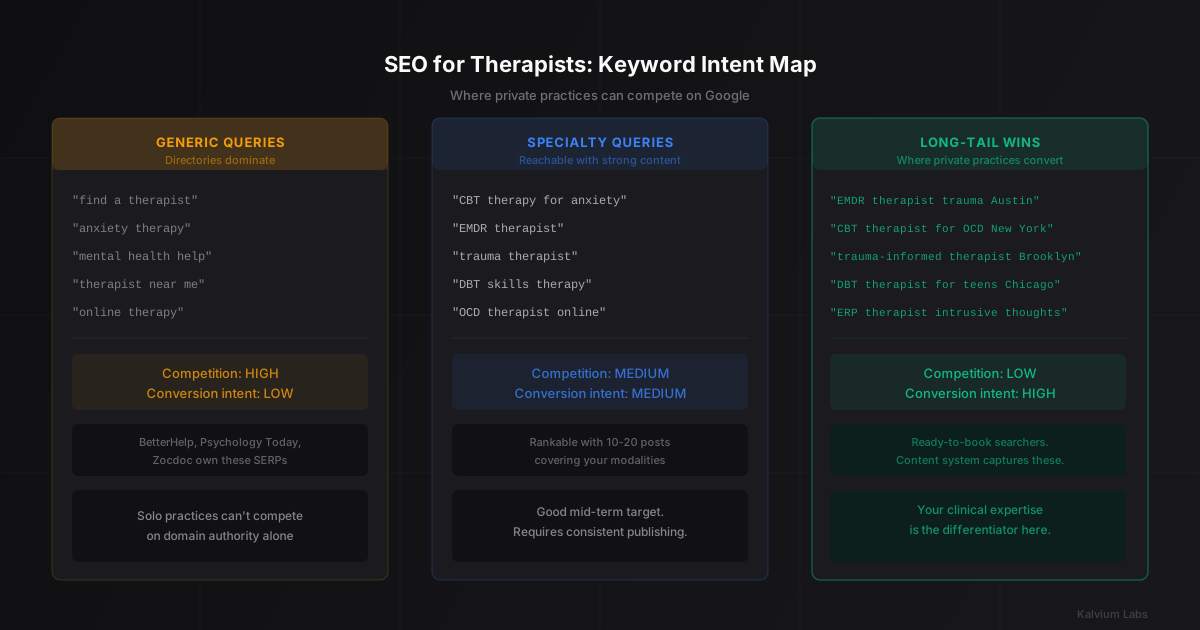
We’d assumed the highest-value search terms would be the most searched ones. “PCOS treatment” has 10x the monthly search volume of “PCOS and missed periods but negative pregnancy test.” But the high-volume terms are dominated by WebMD, Healthline, and national hospital systems with domain authorities we couldn’t touch in 5 weeks.
The specific symptom queries, 50-200 searches a month each, had almost no competition. The people searching them were patients in the middle of a health scare, not researchers. They needed a doctor’s answer, and almost nobody was providing one.
By the end of week three, Fertilia Health ranked top three for dozens of these specific queries. Not “best gynecologist in Coimbatore” (extremely competitive, requires different strategy), but “how to know if PCOS is causing hair loss” and “can you get pregnant with low AMH” and “when to see a doctor for brown spotting before period.” Real questions from real patients.
The conversion rate on specific queries is also higher. A visitor searching “PCOS and hair loss treatment” who finds a thorough, accurate article by an OB-GYN is closer to booking a consultation than someone who searched “women’s health” and landed on a generic page.
What Dr. Suganya’s Review Process Actually Looks Like
People ask me what it means for a doctor to be “in the loop” on an AI content system. The answer matters because the medical accuracy concern is legitimate, and “AI-generated health content” should raise flags.
Dr. Suganya reviews every post before it publishes. The system doesn’t go around her. What the system does is take the research and structuring work off her plate so the 15 minutes she spends reviewing a post is spent on clinical judgment, not on figuring out what the post should say or how it should be organized.
Her review process, as she described it to me: she reads for three things. First, does this reflect how she’d explain this condition to a patient in her consulting room? Second, are there any claims she’d qualify differently based on her clinical experience? Third, does the “when to see a doctor” section match when she’d actually want to see a patient?
She edits maybe 60-70% of posts in some way, usually small changes to clinical framing. She rejects about 5% and asks for a full redraft. The rest go live as written. That ratio is sustainable for a working clinician.
This is what I mean when I say the review process is the product. The technology is only as good as the physician oversight on top of it. A system that generates content without a doctor’s review is a liability, not an asset. The Fertilia system was built with the review layer as a non-negotiable constraint, not an afterthought.
What the Results Actually Mean for a Practice
The 5,000 weekly impressions number gets quoted a lot, and I want to contextualize it.
5,000 impressions means 5,000 times per week that a search result from Fertilia Health appeared on a Google results page. Not 5,000 clicks. The actual click-through rate on medical content varies widely by query type, position, and whether Google shows an AI Overview or featured snippet above the organic results.
What converted: 109 consultation clicks (patients clicking a “book appointment” button from the blog posts) and 157 email leads over the first 8 weeks. For a single-doctor practice running on referrals and Instagram, that’s a new patient acquisition channel that didn’t exist before and costs nothing to run month-to-month.
The ongoing cost of the system is the AI Content Engine service pricing: $500/month for the first three months, then $2,000/month once results are proven. Dr. Suganya described the math herself in our first check-in: “One new patient a month from SEO would pay for three months of the service. We’re getting more than that in the first week.”
The Question I Get From Other Doctors
Since the Fertilia case study went live, I’ve had three conversations with clinicians who saw it and asked variations of the same question: “Does this work for dentists / dermatologists / orthopedic surgeons?”
The honest answer: the model is replicable for any specialty where patients search for their symptoms before booking an appointment. That’s most outpatient specialties. The keyword opportunity exists wherever Google search volume exists for condition-specific queries and the ranking content is generic.
What doesn’t transfer cleanly: specialties where patients are referred rather than self-selecting (inpatient surgical work, for instance), or practices in markets with very low local search volume. Doctor SEO works best when there’s a meaningful gap between what patients are searching for and what’s currently ranking.
The setup requires a doctor willing to spend three to four hours in the first week on calibration (giving feedback on early drafts, flagging clinical inaccuracies, describing how they’d phrase things to a patient) and then 15-30 minutes per day on reviews. If that time isn’t available, the system either produces content the doctor won’t stand behind or stalls in the review queue. Either outcome defeats the purpose.
FAQ
How long does it take for a doctor’s SEO to show results?
First indexing in 1-2 weeks, first impressions in 3-4 weeks, first-page rankings for specific queries in 5-7 weeks. Broad, high-competition terms take longer, sometimes months. The fastest results come from targeting specific symptom and condition queries with low competition, not the highest-volume keywords in your specialty.
What does medical practice SEO cost?
The content system is $500/month for the first three months, then $2,000/month once results are established. There’s no ad spend involved. Most practices recoup the first month’s cost if they get one or two new patients from the content. The ongoing value compounds as more posts index and rank.
Do I need to write the content myself for medical SEO to work?
No. The system drafts content based on keyword research and your specialty’s clinical guidelines. Your job is review and approval, not authorship. Dr. Suganya spends 15-30 minutes per day reviewing drafts. That time is focused on medical accuracy and clinical framing, not on creating content from scratch.
Is AI-generated medical content safe to publish?
Only if a qualified clinician reviews and approves every post before it goes live. The system at Fertilia Health was built with physician review as a non-negotiable step. No post publishes without Dr. Suganya’s approval. The AI handles research, structure, and drafting. The doctor handles medical accuracy. Neither does the other’s job.
What specialties does this work for?
Any outpatient specialty where patients search for their symptoms before booking: gynecology, dermatology, dentistry, orthopedics, psychology, ophthalmology. The model is less suited to specialties that run primarily on physician referrals rather than patient self-selection, or practices in markets with very low local search volume.
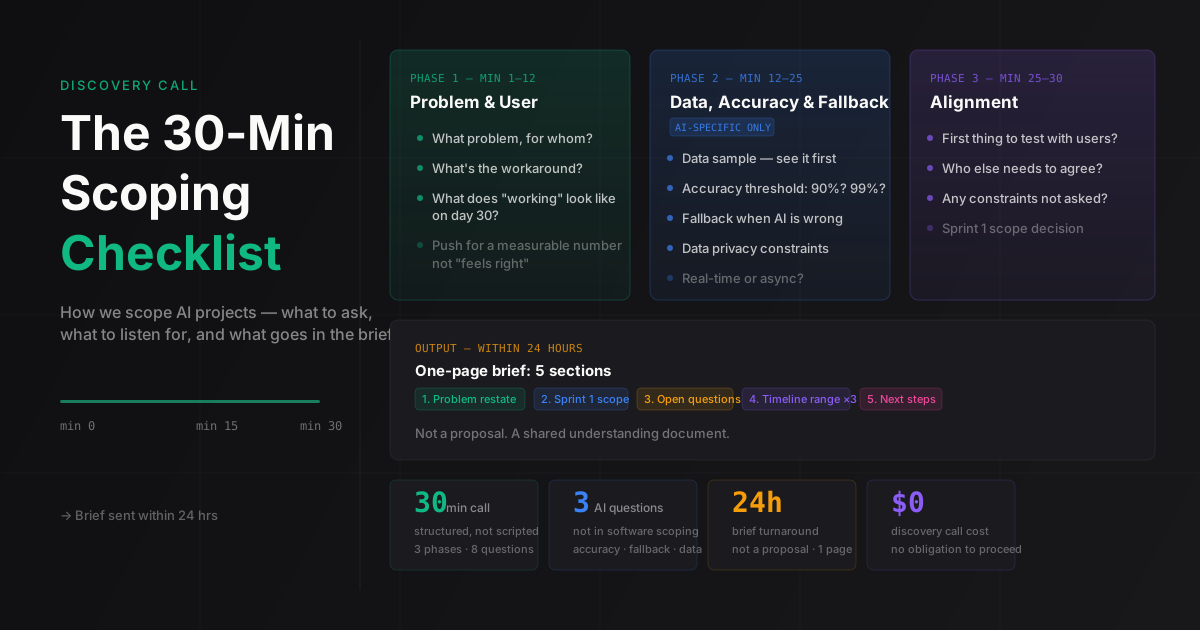
Running a medical practice and invisible on Google? Book a 30-minute call and we’ll pull live keyword data for your specialty and location before the call ends, so you can see the opportunity before committing to anything.