After we finished building the content system for Fertilia Health, I spent some time looking at how the same architecture would hold up in adjacent clinical niches. Therapy kept coming up.
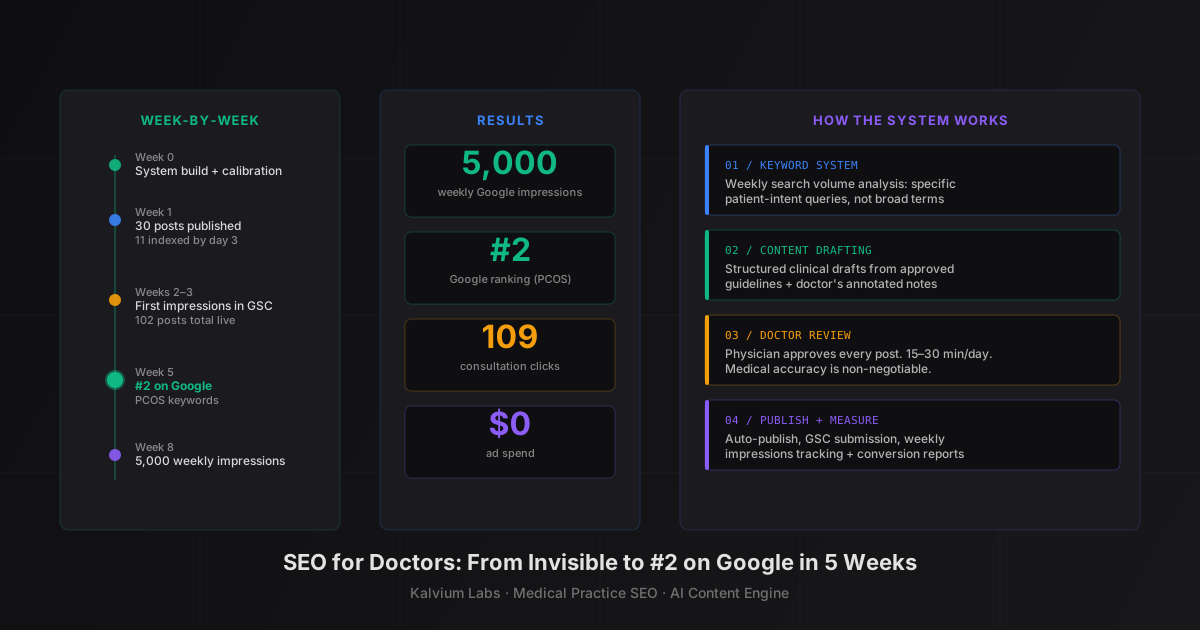
The Fertilia project went from zero Google presence to 5,000 weekly impressions in five weeks, 109 consultation clicks, zero ad spend. Dharini wrote about how that unfolded from the delivery side. I want to write about the keyword research layer, because the therapy niche has a different structure than women’s health, and getting that wrong means publishing content that never ranks.
The Psychology Today Problem
Most private practice therapists have a version of the same SEO strategy: create a Psychology Today profile, maybe add a Zocdoc listing, update it every few months when the directory sends a reminder.
Psychology Today has over a million therapist listings in the US. For someone who types “find a therapist,” PT often ranks first. The logic is understandable: put your profile where the searchers already are.
The problem is you don’t control that traffic. Psychology Today does. Your profile competes with hundreds of other listings in your metro area. PT can change its algorithm, its pricing (currently $30-$40/month per listing), or its SERP dominance at any time. Everything you’ve built on that platform is rented, not owned.
Building a practice website that ranks on Google is different. It’s slower to start, and it takes real content, but once a page ranks for “EMDR therapist for childhood trauma Austin” or “CBT therapist for intrusive thoughts Brooklyn,” it keeps getting clicks without monthly fees. The searchers who find you through a specific, clinical query are further along in the decision process than someone scrolling through 200 PT listings.
How Therapy Keyword Research Actually Works
This is where the therapy niche differs significantly from general healthcare.
Medical SEO often works on condition-level queries: “PCOS treatment,” “thyroid symptoms,” “irregular periods.” High volume, broad intent. A lot of the traffic is informational, but some portion converts to appointment inquiries.
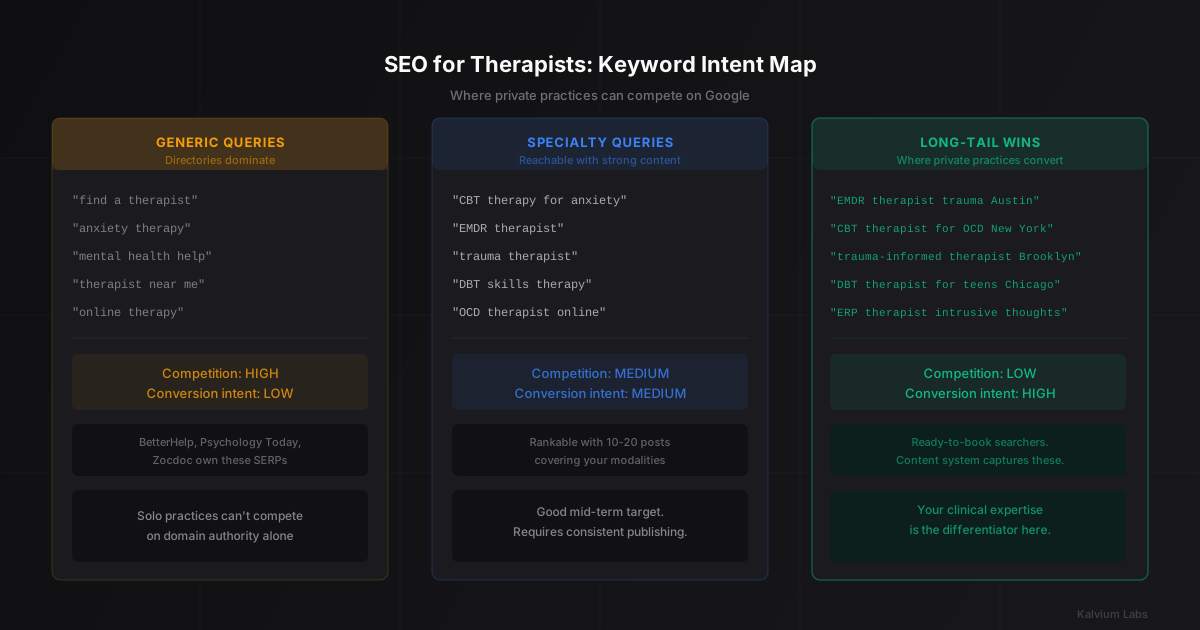
Therapy keyword structure is different. The high-volume generic queries (“therapist near me,” “find a therapist,” “anxiety help”) are dominated by directories and aggregators. A solo private practice won’t rank above BetterHelp or Psychology Today for those terms on domain authority alone.
Where therapy practices can compete: condition + approach combinations, and local + specialty combinations.
- “EMDR therapy for PTSD”
- “CBT for social anxiety therapist”
- “DBT skills group online”
- “trauma-informed therapist Brooklyn”
- “therapist specializing in OCD New York”
- “ADHD therapy for adults”
These queries have lower search volume per keyword, but the intent is specific. Someone searching “EMDR therapist for complex trauma” has usually already decided they want EMDR. They’re shopping for a provider, not researching a concept. Conversion rates on these queries, when you have content that describes your actual approach, tend to be better than high-volume informational queries.
The content strategy follows from this: publish posts that match the condition-approach combinations you actually treat. Not “how to cope with anxiety” (generic, competed, no conversion intent), but “how I use CBT with clients who have health anxiety” (specific, differentiating, shows clinical expertise).
Google’s YMYL Standard for Mental Health Content
While pulling keyword data for the Fertilia research, I started reading what Google’s quality guidelines say about health content. One thing I hadn’t fully appreciated: mental health content is evaluated under Google’s “Your Money or Your Life” (YMYL) framework, which means it gets scrutinized more carefully than most niches. Health content that could affect someone’s wellbeing needs clearer signals of expertise, authoritativeness, and trustworthiness.
I noticed the gap when comparing the draft content we generated early in the Fertilia project against what was already ranking. The drafts that struggled most were the ones that read like generic health summaries. The ones that performed were the posts where Dr. Suganya’s clinical perspective was actually present: her framing, her diagnostic approach, the way she talks about treatment.
For therapy specifically, that means:
Author credentials matter. Posts on a therapist’s practice website should have the therapist’s name attached, along with their credentials (LCSW, LMFT, PhD, etc.). An uncredited piece on a mental health topic is going to struggle.
Citations and sources. Linking to peer-reviewed research, the APA’s clinical practice guidelines, or NIMH publications helps signal that claims are grounded. “CBT has strong evidence for treating social anxiety disorder” should link somewhere. A meta-analysis, an APA summary, something real.
Specific, grounded content. Generic mental health advice doesn’t rank well because there’s too much of it. Your actual approach, how you think about treatment, what you do differently in sessions, these signals help.
This isn’t harder to achieve for a therapist with real clinical experience than for a content marketer. It just requires the therapist’s voice to actually be in the content, not just the byline.
What HIPAA Actually Limits (And What It Doesn’t)
The common concern: “I can’t write about client cases.” That’s true. But case studies aren’t the only content type that drives SEO for a therapy practice.
HIPAA restricts identifiable client information: patient names, demographics specific enough to identify someone, case details.
HIPAA doesn’t restrict your clinical approach, your therapeutic philosophy, descriptions of how you work with certain conditions in general terms, research summaries, psychoeducational content, or your honest take on treatment options.
A therapist who specializes in OCD can write “How I Work with Intrusive Thoughts: An ERP Approach” without mentioning a single patient. That post can describe the clinical framework, what sessions typically look like, what clients often experience during ERP, what the research says about efficacy. It’s educational, it shows expertise, and someone searching “OCD therapist who uses ERP” is going to find it relevant.
The constraint actually clarifies the content strategy. You’re writing about your expertise and approach, not testimonials or case narratives. For content that converts clients, that’s usually the right angle anyway.
What We’d Build Differently for Therapy vs. Medicine
When we were wrapping up the Fertilia build, I started thinking about what the same content engine architecture would need if a therapy practice came to us next. A few things would be different from the start:
Keyword targeting at the approach level, not just condition level. For Fertilia, we targeted condition + symptom queries (“PCOS hair loss treatment,” “fertility treatment options”). For a therapy practice, we’d layer in the modality: “EMDR,” “CBT,” “DBT,” “IFS,” “psychodynamic.” A therapist trained in EMDR should own “EMDR therapist [city]” queries in their market before going after broader competition.
Local signals on every page. Therapy is inherently local. A user in Chicago isn’t interested in a therapist in Seattle, even if the practice offers remote sessions. City and neighborhood references in content, combined with a Google Business Profile with accurate practice details, build local relevance faster than generic content.
Different review capacity assumptions. For Fertilia, Dr. Suganya reviewed and approved content, typically 3-4 pieces per day. A solo therapist in a full clinical schedule has fewer windows in a day. We hit this problem with Fertilia too, honestly. We’d planned for 5-7 reviews per day and got 3-4 on a good day, zero on some days. For a solo therapy practice, I’d start the system assuming 2-3 approvals per day and build a draft queue large enough to keep that pace sustainable.
The one honest challenge: a therapist who writes well and publishes consistently doesn’t need a system. The system matters when the therapist is booked with clients 30+ hours a week and has no time to write. That constraint is real for most solo practitioners I’ve seen going through this process.
A Realistic Timeline
For reference: Fertilia Health published 102 posts over five weeks, first rankings appeared around week three, 5,000 weekly impressions by week five. That’s a women’s health practice with a clinic’s review capacity.
A therapy practice would look different. Smaller initial content volume (solo therapist capacity vs. clinic with multiple reviewers). More specificity required per post. The competition dynamics vary by specialty and location.
Month 1: keyword research, first 15-20 posts covering your core specialties and modalities. Some indexing, a few impressions, not much traffic yet.
Month 2: first rankings appear for long-tail queries. A few clicks per week from searchers specifically looking for your approach.
Month 3: compounding. Each post links internally to related content, building topical clusters. Google starts routing more queries to the domain. The clicks become consistent, not occasional.
None of this is fast compared to Google Ads. It’s faster than most practitioners expect for organic search.
FAQ
What’s the difference between Psychology Today SEO and Google SEO for my practice?
Psychology Today SEO means ranking within PT’s directory, where you’re competing with other therapists for clicks inside their platform. Google SEO means your practice website appears directly in search results when someone looks for a therapist with your specific specialty. The first rents you visibility. The second builds an asset you own that compounds over time.
Do I need to write content about every condition I treat?
No. Start with your deepest expertise and most niche specialties. A therapist who specializes in OCD using ERP should own “ERP therapist [city]” before trying to rank for generic “anxiety therapist.” The narrower the query, the less competition and the higher the conversion intent of the searchers.
Can I use AI to draft therapy content without violating HIPAA?
AI can draft content based on clinical protocols and your therapeutic approach without touching patient data. The practical workflow: AI generates a structured draft from clinical guidelines and your approved topic notes, you review and add your clinical perspective, you publish with your byline and credentials. The AI handles the writing work. The clinical accuracy check has to stay with you.
How long does it take to see results from therapist SEO?
First impressions typically appear within two to three weeks of publishing, as Google indexes new content. Consistent organic traffic usually takes two to three months. The Fertilia Health project reached 5,000 weekly impressions in five weeks, but that involved publishing 102 posts with clinic-level review capacity. A solo practice publishing three to five posts per week should expect a longer ramp, with results appearing in month two to three.
If you’re thinking about what a content system would look like for your therapy practice, book a 30-minute call. We’ll pull keyword data for your specialty and location live on the call so you can see what you’re actually competing for before deciding anything.