The Pattern I Keep Seeing
18 years of building technology products across education, employability, and now AI. Three companies. Hundreds of product launches. And now, through Kalvium Labs, a front-row seat to how startups and enterprises approach AI product development.
The pattern is remarkably consistent.
A founder has an insight. The insight is often genuinely good. They hire engineers or an agency. The engineers build something impressive. The demo works beautifully. Everyone is excited.
Then it ships. And nothing happens. Users try it once. Maybe twice. Then they go back to their spreadsheet, their manual process, their existing tool.
Six months later, the product is shelved. The post-mortem says “the AI wasn’t accurate enough” or “the market wasn’t ready” or “we needed more data.” These are comfortable explanations. They’re also usually wrong.
The real failures are structural. They happen before a single line of code is written. And they follow predictable patterns. Stanford’s AI Index has tracked this gap between AI capability and real-world AI deployment for years — the failure modes have been consistent even as the models have improved.
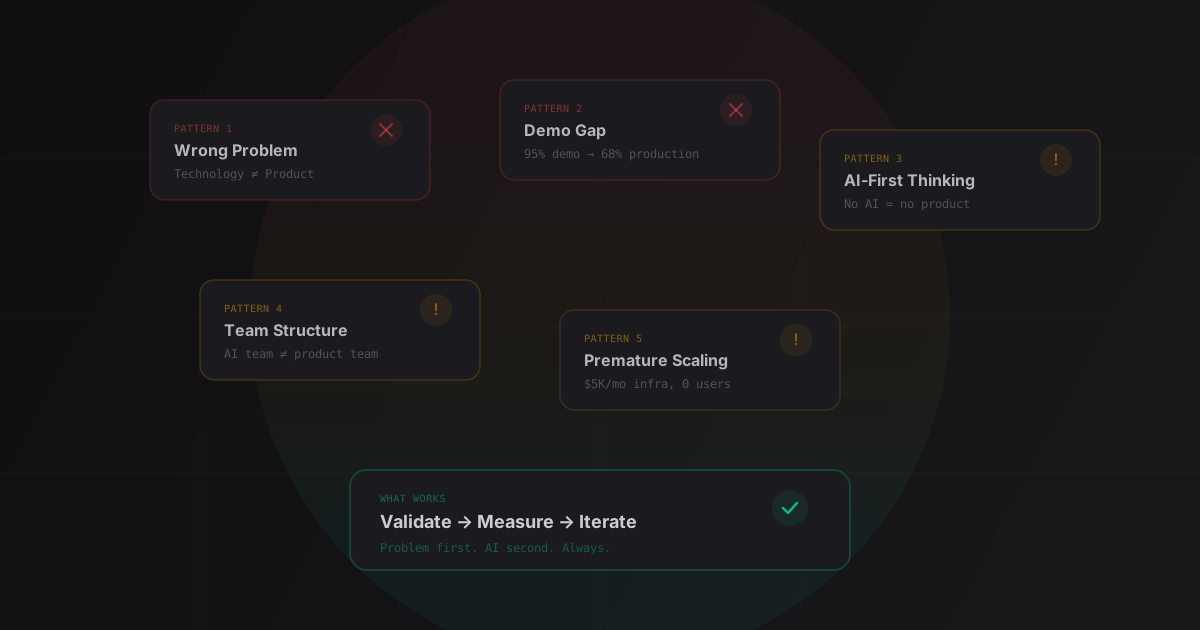
Failure Pattern 1: Solving a Technology Problem Instead of a Workflow Problem
This is the most common pattern and the most expensive.
→ A founder sees that LLMs can summarise documents. → They build a document summarisation tool. → The summaries are good. The technology works. → Nobody uses it.
Why? Because the problem was never “I can’t summarise documents.” The problem was “I spend 3 hours every Monday reading compliance reports to find the 2 things that need my attention.”
The first framing leads you to build a summariser. The second leads you to build a compliance alert system that reads the reports and only surfaces what matters. Same underlying AI. Completely different product. The second one gets used because it fits into how the person actually works.
The diagnostic question: “What does the user do in the 5 minutes before and after they would use this product?”
If you can’t answer this specifically (not hypothetically, but from observing actual users), you’re building a technology, not a product. Technologies get admired. Products get used. Harvard Business Review’s analysis of enterprise AI highlights the same distinction: AI that integrates into an existing process generates value; AI that requires the workflow to change around it usually gets abandoned.
I’ve seen this pattern with:
- AI writing assistants that nobody uses because writers don’t want assistance, they want first drafts
- AI analytics tools that nobody uses because analysts don’t trust outputs they can’t verify
- AI customer support bots that nobody uses because customers want to talk to humans when they’re frustrated
The AI works. The product doesn’t. Because the product doesn’t fit the workflow.
Failure Pattern 2: The Demo Gap
This one is subtle and devastating.
Every AI demo is built on curated inputs. The founder prepares 10-20 examples that showcase the AI at its best. The demo goes flawlessly. The board is impressed. The investors are excited.
Then the product ships to real users who send inputs the team never anticipated.
→ Misspelled queries → Ambiguous requests → Multi-language input → Edge cases that represent 30% of real-world usage → Adversarial inputs (users testing the AI’s limits, which they always do)
The demo accuracy was 95%. The production accuracy is 68%. The gap isn’t a bug. It’s the fundamental difference between curated inputs and wild inputs.
The teams that succeed close this gap before launch, not after. They build evaluation datasets from real user data (or realistic synthetic data). They test with 1,000 inputs, not 10. They measure accuracy on the hard cases, not the easy ones.
The teams that fail ship the demo.
I’ve started asking one question to every AI team we work with at Kalvium Labs: “Show me your 50 hardest test cases.” The teams that have them are the teams that ship products that work. The teams that don’t have them ship demos that break.
Failure Pattern 3: Building AI-First Instead of Problem-First
→ “We’re building an AI-powered [X].”
Every time I hear this, I ask: “What if there were no AI? How would you solve this problem?”
The question sounds absurd in 2026. But it reveals something important: the best AI products are products first and AI-enhanced second.
Google Search was useful before AI. The AI (PageRank, then ML ranking, then LLM summaries) made it better. But the product (“type a question, get an answer”) was the foundation.
Notion is useful without AI. The AI features (summarisation, writing assistance) enhance an already-valuable product.
The AI products that fail are the ones where removing the AI leaves you with nothing. If the only value proposition is “we use AI,” there’s no product. There’s a technology looking for a problem.
The practical test: Describe your product without using the words “AI,” “ML,” “LLM,” or “machine learning.” If you can’t, you don’t have a product yet. You have a technology.
This doesn’t mean AI shouldn’t be central to the product. It means the product should solve a clear problem, and AI should be the mechanism, not the pitch.
Failure Pattern 4: The Team Structure Problem
This is the pattern that’s hardest to see from the inside.
Most AI product teams are structured like traditional software teams: product manager, designers, frontend engineers, backend engineers, and one or two “AI/ML engineers” bolted on.
The AI engineers build the model. The software engineers build the product. The product manager tries to bridge the gap. And the gap is enormous.
What goes wrong:
→ The AI engineers optimise for model accuracy. The product engineers optimise for user experience. Nobody optimises for the intersection: whether the AI output is useful in the context of the product.
→ The AI work and the product work happen in parallel. The AI team delivers a model. The product team integrates it. The integration reveals that the model’s output format doesn’t match what the UI needs. Three weeks of rework.
→ Nobody owns evaluation. The AI team says “the model is 90% accurate.” The product team says “users are complaining about wrong answers.” These are both true. The disconnect is that the AI team’s 90% is measured on clean test data, and the product team’s complaints come from messy real data.
What works instead:
→ Small, integrated teams where the person building the AI also sees the product UI and the user feedback. Not separate workstreams that merge at integration.
→ A single evaluation framework that both the AI work and the product work are measured against. Not “model accuracy” and “user satisfaction” as separate metrics, but “does the product give the right answer to this specific user question?”
→ The product manager understands AI capabilities and limitations well enough to make scope decisions. “We can handle 80% of queries automatically and route 20% to humans” is a product decision that requires AI understanding.
Failure Pattern 5: Premature Scaling
→ “We need to fine-tune a model.” → “We need to build our own infrastructure.” → “We need to handle 100K users.”
Before you have 100 users.
This is the classic startup mistake applied to AI, and it’s more expensive in AI because the infrastructure is more complex.
A RAG pipeline using pgvector and Claude’s API costs $50/month and handles 10,000 queries per day. That’s enough for most startups for their first 12 months.
A custom fine-tuned model on dedicated GPU infrastructure costs $5,000/month. It handles more queries and has lower latency. It’s also 100× the cost for a product that might not have users yet.
The rule we follow at Kalvium Labs: Use managed services and API-based models until you have clear evidence that you’ve outgrown them. The “evidence” is specific: latency requirements you can’t meet, cost per query that’s unsustainable at your volume, or accuracy requirements that need fine-tuning.
“We should own our model” is not evidence. “Our API costs are $8,000/month and fine-tuning would reduce them to $2,000/month at our current 50K queries/day” is evidence.
What the Successful Teams Do Differently
The teams that succeed (and we’ve been fortunate to work with several) share three characteristics:
They Validate Before They Build
Not with a slide deck. Not with a survey. With a working prototype that real users interact with. The feedback from 10 users interacting with a prototype is worth more than 100 survey responses.
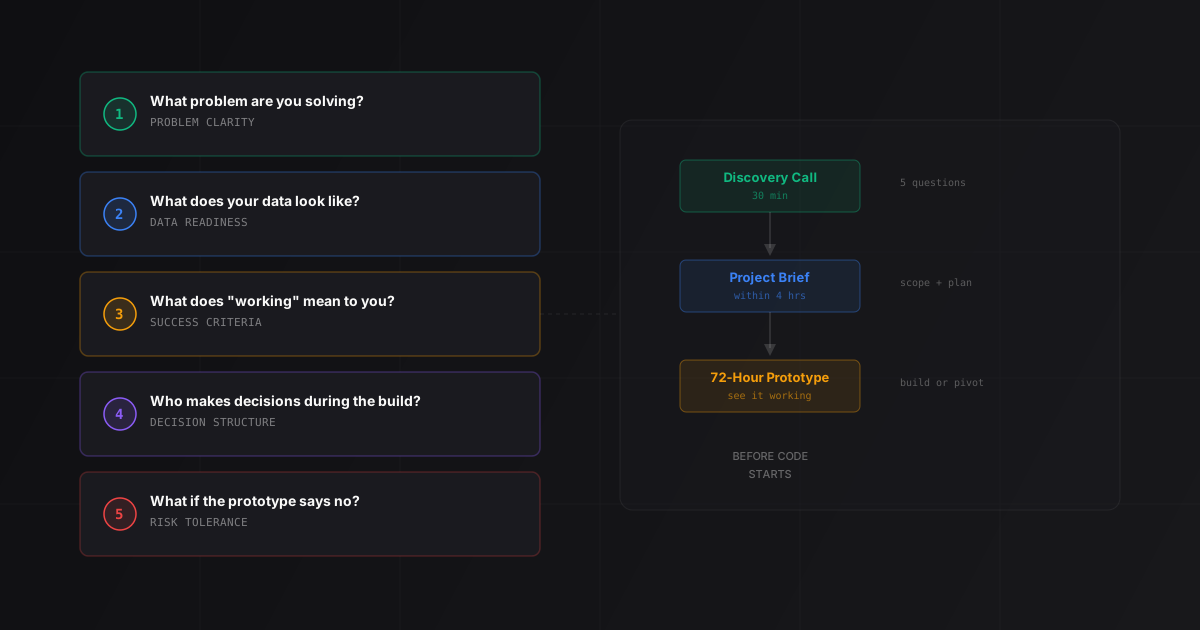
This is why we built Kalvium Labs around the 72-hour prototype model. Not because we’re fast (though that helps). Because validation speed determines whether you build the right thing or spend six months building the wrong thing.
They Measure What Matters
Not model accuracy. Not F1 scores. Business outcomes.
→ “Did the user get the right answer?” (not “did the model generate text?”) → “Did the AI save time compared to the manual process?” (not “did the AI produce output?”) → “Did the user come back the next day?” (not “did the user say they liked it?”)
The teams that measure business outcomes iterate on the right things. The teams that measure technical metrics optimise for metrics that don’t matter to users.
They Plan for the AI to Be Wrong
Every AI system produces wrong outputs some percentage of the time. The question isn’t “how do we make it perfect?” (you can’t) but “what happens when it’s wrong?”
→ Can the user easily identify when the AI is wrong? → Can the user correct the AI or override it? → Does the system degrade gracefully (giving a partial answer rather than a confidently wrong one)? → Are wrong outputs captured for future improvement?
The products that handle errors gracefully earn user trust. The products that present every AI output with equal confidence lose it.
The Uncomfortable Truth
The uncomfortable truth about AI product development in 2026 is this: the technology is no longer the bottleneck. McKinsey’s State of AI research documents this consistently: the organisations closing the gap between AI pilots and production aren’t the ones with the best models — they’re the ones who solved the implementation and workflow problems first.
We have models that can reason, generate, analyse, and create at a level that would have seemed impossible three years ago. The APIs are accessible. The costs are reasonable. The documentation is extensive.
The bottleneck is everything else. Understanding the user’s workflow. Closing the demo gap. Building evaluation systems. Structuring teams correctly. Resisting premature scaling. Planning for errors.
These are not exciting problems. Nobody writes Twitter threads about chunking strategies or evaluation pipelines. But they’re the problems that determine whether your AI product becomes a real business or an impressive demo that nobody uses.
The pattern is clear. The AI products that succeed are the ones that treat AI as an ingredient, not the recipe. The recipe is always the same: understand the problem, validate quickly, measure honestly, and iterate relentlessly. If you want a structured approach to those product decisions, our AI product decision framework for startups lays out the process end-to-end.
The AI is just what makes the recipe possible.
FAQ
What is the most common reason AI products fail in production?
The most common reason is a gap between how the AI was tested and how real users actually interact with it. Teams build and demo on curated inputs, then ship to users who send queries the system was never designed for. Closing that gap before launch, not after, is what separates products that survive contact with real users from those that get quietly shelved.
How do I know if my AI idea is worth building?
Start by describing the problem without mentioning AI at all. If you can clearly state who has the problem, how often it occurs, and what they currently do to work around it, you have a foundation worth validating. If the pitch only makes sense with AI in it, that is a signal to spend more time on the problem before touching any tooling.
What should I ask a development team before hiring them to build my AI product?
Ask them to walk you through how they would build an evaluation dataset for your use case and what they consider a passing result. A team that can answer this concretely has shipped products that work under real-world conditions. A team that jumps straight to model selection or architecture without asking about your users’ workflow is likely to hand you a well-engineered demo rather than a working product.
How long does it take to go from idea to a production-ready AI product?
A working prototype that tests your core assumption can be ready in a matter of days. Moving that prototype to production, meaning it handles edge cases, errors gracefully, and fits into your users’ existing workflow, typically takes four to twelve weeks depending on scope and integration complexity. The step that most teams underestimate is evaluation: building the test cases and feedback loops that tell you the product is actually working for real users, not just for the demo.
Do I need a custom AI model, or will a standard API be enough?
For the large majority of products, a well-structured prompt against an existing API is the right starting point and often the permanent solution. Custom fine-tuning makes sense only when you have concrete evidence that off-the-shelf models cannot meet your accuracy or cost requirements at your actual usage volume. Starting with managed APIs lets you validate product-market fit quickly and defers costly infrastructure decisions until you have real usage data to justify them.
If you’re building an AI product and want to avoid these patterns, start with a conversation. We’ll tell you honestly whether your idea has the structural foundations to succeed, and what a 72-hour prototype would reveal.