Most founders who try “AI content tools” tell the same story six weeks later. They got an account, generated some posts, published a few, then gradually stopped because nothing was happening and someone had to keep writing prompts every day.
The content tools worked. The content system didn’t exist.
That’s the gap worth understanding before spending money on either content creation or SEO. A tool that writes is not the same thing as a system that produces results. The writing is the easy part.
The Category Error: Tools vs Systems
Jasper, Copy.ai, Writer, and most AI content platforms are generation tools. You bring them a topic, they produce text. Some of them are very good at it. The output quality, especially with good prompting, has gotten genuinely impressive.
But none of them answer the three questions you actually need answered to have a functioning content operation.
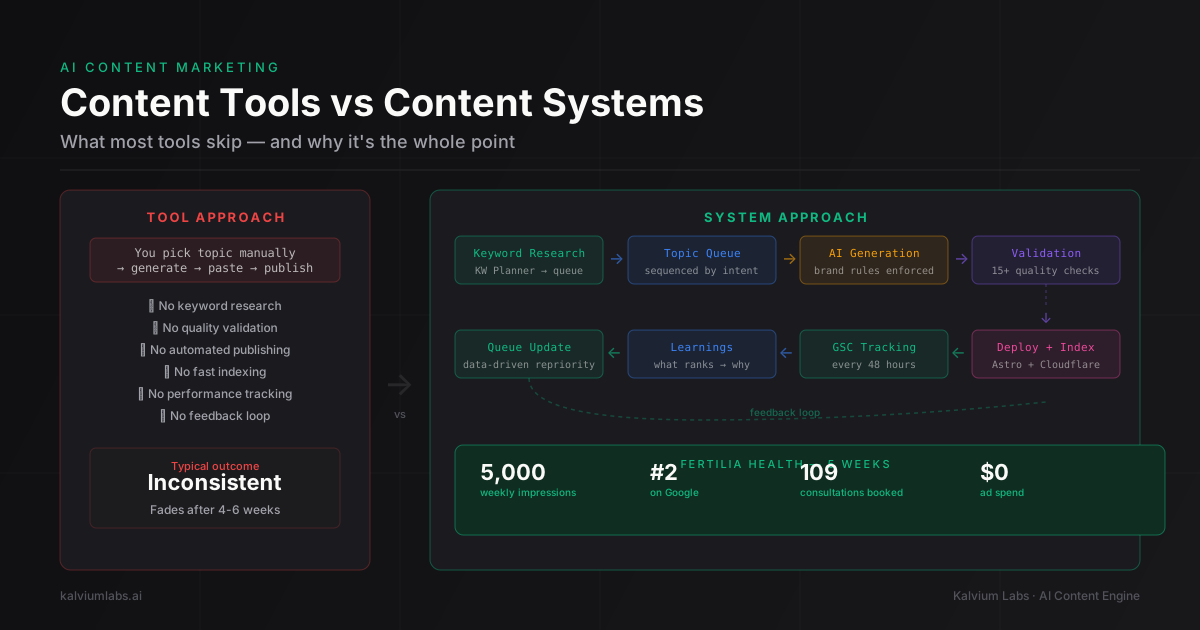
What should I write? Most tools let you enter a topic manually. A few suggest ideas based on broad categories. None pull live keyword data from Google Keyword Planner, map search volume against competition, filter for commercial intent, and slot topics into a sequenced publishing queue. That research step, done manually, takes 2-3 hours per post. At two posts a day, seven days a week, that’s 28-42 hours per week on topic selection alone.
Is the content good enough? AI-written content that reads like AI-written content damages search ranking and brand credibility. Google’s spam policies target AI-generated content that doesn’t provide genuine value. A technical founder who lands on obviously templated content leaves immediately. A generation tool that produces content can’t tell you whether that content will pass a credibility test.
What happened after you published? This is where most content strategies fall apart. You publish a post. Two weeks go by. Did it rank? For what queries? At what position? Did anyone click? Is the meta description matching what people actually searched? Without answers to those questions, you’re publishing into a void and calling it a strategy.
A content system answers all three automatically. The generation step is the middle part, not the whole thing.
What a System Has to Do
Walk through the components that a production content system actually requires:
Topic selection with data. Before any writing starts, you need Google Keyword Planner data for your target geographies. Which queries have commercial intent, not just curiosity? What’s the estimated monthly volume? What’s the competition level? For a medical practice targeting patients, “IVF success rates by age” and “how much does IVF cost” have very different search volumes, different competition profiles, and different conversion intents. You need to know which cluster to target first.
A sequenced queue. Topics need ordering. Highest-volume, lowest-competition first. Geographic targeting second. Content type third: case study vs educational vs comparison. The queue also handles rotation. Publishing only one content format daily makes the site feel thin. Two posts per day, alternating perspectives and formats, covers more of a keyword cluster faster.
Automated publishing. Someone can’t manually click “publish” every day at 8 AM. Not reliably, not for months. The pipeline has to run without human intervention. That means scheduled jobs that generate, validate, build, and deploy on schedule. Whatever the stack (Astro, Next.js, Hugo), the publish step has to be hands-off.
Quality gates before publishing. Automated content requires automated validation. Check for: em dashes (strong AI-writing signal), blacklisted vocabulary that reads as templated, missing required sections like FAQs, word count range by author voice, internal and external link counts, title character limits. Content that fails validation doesn’t publish; it flags for review.
Fast indexing. Publishing a post and waiting for Google to find it on its own can take 6-8 weeks. Submitting URLs to Search Console and Bing Webmaster Tools via API cuts that to 48-72 hours. Every post, immediately after deployment.
Performance tracking and feedback. Every two days, the system pulls data from Google Search Console: impressions, clicks, average position, by query, by page, by geography. That data gets analyzed into learnings: which clusters are rising, which posts have poor click-through despite good position (a title problem), which queries have AI Overviews consuming all the clicks.
Feedback into next topics. Those learnings feed back into the queue. If a cluster is performing better than expected, schedule more posts targeting it. If a query has zero clicks at position 1, an AI Overview is eating it: shift to adjacent queries where clicks still happen.
That’s a system. Most AI content tools handle one step of this.
What We Built for Fertilia Health
Dr. Suganya runs a fertility and reproductive health clinic in India. No SEO presence, no blog, no organic traffic. The practice was growing through referrals but had zero visibility for patients searching online.
We deployed the content system in early 2026. By week 5: 5,000 weekly impressions on Google Search. Ranked #2 for several core fertility queries. 109 consultations booked from organic traffic. Ad spend: zero.
The results weren’t from exceptional writing. They were from a consistent system: data-researched topics, published on schedule, indexed within 48 hours, tracked in near-real-time, with each cycle informing the next.
What we built for Fertilia Health is now the template for what we offer. We run the same system for our own blog at Kalvium Labs. Two posts per day, seven days a week, fully automated. The full breakdown of how Dr. Suganya’s practice went from invisible to #2 on Google covers the keyword strategy and content architecture in detail.
If you want to see how the publishing pipeline itself works under the hood, this post covers the mechanics.
The Architecture, Spelled Out
Here’s what the stack looks like in practice:
Google Keyword Planner (via Ads API)
  → Topic queue (sequenced by volume + competition + intent)
  → Content generation (Claude agents with brand voice rules)
  → Validation layer (15+ automated checks)
  → Content review (10-point quality gate before deploy)
  → Build + deploy (Astro + Cloudflare Workers)
  → URL submission (GSC API + Bing Webmaster Tools)
  → Performance tracking (GSC data pulled every 2 days)
  → Learnings update (feeds back into queue priorities)
The content generation layer uses Claude with a full brand rulebook in the system prompt: vocabulary blacklist, author voice guidelines, required sections, link requirements, word count targets per author. It’s not “write a blog post about fertility.” It’s a constrained generation task with 20+ requirements validated at every run.
The validation layer runs before any human reviews the post. If a post has an em dash, it fails. If the FAQ section is missing, it fails. If the cover image file doesn’t exist in the build, it fails. Posts that fail don’t deploy. They get flagged.
The content review agent is the quality gate before the build step. It checks: does this read like a person or a template? Is there at least one honest admission of a constraint or failure? Are internal links placed naturally or awkwardly? Is the FAQ oriented toward buying decisions or just educational filler?
Deployment runs automatically: build, deploy, submit URLs. The whole sequence, from generation to live post with Google notified, takes about 15 minutes.
Why the Feedback Loop Changes Everything
After three weeks of consistent publishing, you have something most content programs never build: actual data about what’s working.
For Fertilia Health, early Search Console data showed that certain query clusters had high impression volume but zero clicks. The reason: AI Overviews were dominating the SERP for those queries, answering the question directly without any click happening. Users were seeing the answer without visiting the site.
So we shifted. The next batch of posts targeted queries with consultation intent rather than pure informational intent. “Questions to ask your fertility doctor before IVF.” “What to expect at your first reproductive endocrinology appointment.” Lower volume, but clicks that actually led to bookings. The feedback loop made that pivot possible in one week, not three months.
For our own blog, the same feedback loop has told us: decision-content with cost framing converts better than general how-to content for our audience. We know which geographic clusters are rising (US is our primary, India our secondary). We know which posts need title rewrites to improve click-through rate. None of this is intuition. It comes from actual Search Console query performance data collected automatically every two days.
Most content teams look at analytics occasionally and in aggregate. A system that reads performance data automatically and extracts patterns continuously is a different capability.
Where This Breaks Down
Honest answer: there are real failure modes.
New domains take 3-5 weeks before Google starts indexing consistently. The first month looks like nothing is happening because Google is still deciding whether the site is real. This is a Search Console-verifiable reality, not an excuse. We set expectations on this upfront.
Not every topic cluster converts. Some queries have AI Overviews dominating the SERP. Some have competition so entrenched that a new site can’t break into the top 20 regardless of content quality. Keyword research filters for these, but it’s not a guarantee. You’ll invest in some posts that don’t rank.
The system requires a real technical stack. An Astro site on Cloudflare Workers is not difficult to set up, but it’s not a Squarespace plugin. If your site is on a platform without a build/deploy API, we either migrate it or we can’t run the automated pipeline.
Quality gates catch most problems, not all of them. A post can pass every validation check and still be mediocre. The content review agent catches obvious quality issues, but it’s not a domain expert. For compliance-sensitive verticals (healthcare, legal, financial), a human review step before publishing is worth keeping.
The system also doesn’t work without an existing audience hook. If you’re starting from a brand-new domain with no inbound links, the ramp-up period is longer. The content quality still compounds, but the timeline is slower.
What It Costs and Who It’s For
$500 per month for the first three months, then $2,000 per month. No setup fee. The discovery call is free, and we pull live keyword data for your domain during it. You see the actual search opportunity before deciding anything.
Who it works for: professional practices, SaaS companies, agencies, and startups that have a clear keyword cluster and an existing website. The system is domain-agnostic. What matters is: does a search audience exist for what you do, and is written content the right format for that audience’s search behavior?
Who it doesn’t work for: companies that already have a strong in-house content team and primarily need faster generation. That’s a tool problem, not a system problem. Jasper will serve you better and cost less. Also: industries where buyers don’t use search to find vendors. Relationship-driven enterprise sales, for example, doesn’t convert well from organic content regardless of volume.
The full service description is at /services/content-engine/.
FAQ
How is this different from Jasper or Copy.ai?
Jasper and Copy.ai are generation tools. You bring a topic, they produce text. They don’t do keyword research, don’t publish automatically, don’t track rankings, and don’t feed performance data back into future decisions. What we build is a system: keyword research to topic selection to generation to validation to publishing to tracking to feedback loop. The generation step is one of eight, not the whole thing.
How long before we see results from ai content marketing?
For sites with some existing domain authority, expect meaningful impression growth in weeks 4-6. Clicks and conversions follow 2-4 weeks after impressions stabilize. For new domains or dormant sites, the indexing phase takes longer: 5-8 weeks before Google is consistently crawling and ranking new posts. Fertilia Health hit 5,000 weekly impressions by week 5, which is at the faster end of the range.
Does automated content creation work for regulated industries?
Yes, with a human review step built into the pipeline. Healthcare, legal, and financial content requires a domain expert to verify accuracy before publishing. We build that checkpoint into the workflow: posts are generated, validated, and staged for review rather than auto-deployed. The human’s job shifts from writing to reviewing, which is faster and produces better outcomes. We built Fertilia Health’s system exactly this way.
How much of my time does this require?
After an initial onboarding session to set brand rules, voice guidelines, keyword targets, and approve the first topic batch, ongoing involvement is about 30 minutes per week. You receive a performance summary covering what was published, what’s ranking, and what we’re targeting next. If you want a review step before publishing, we build that in. If you’d rather it runs autonomously, it can.
Do we own the content and the system?
Yes. Everything published to your site is yours. The pipeline code can be handed off at the end of the engagement. We’d recommend a 6-month runway to see meaningful SEO compounding before making handoff decisions, but the exit path is clean. No proprietary lock-in.
Curious what the keyword opportunity looks like for your domain? Book a 30-minute call. We pull Keyword Planner data live during the call, so you leave with a concrete view of the search opportunity before you spend anything.