Three weeks into a discovery call with a US founder last month, we hit the question that breaks most AI product conversations.
She was building a compliance tool for financial advisors. The core workflow: ingest call recordings, score them against a regulatory rubric, flag violations, generate a report. Her current approach was stitching together Fireflies for transcription, an OpenAI assistant for scoring, and a Notion template for reports.
“Should I keep buying tools,” she asked, “or should I build something custom?”
The honest answer: it depends on four questions, not one. And the mistake most seed-stage founders make is treating this as a permanent decision rather than a staged one.
Why “Build vs Buy” Is the Wrong Frame
The phrase implies a binary. You either build from scratch or you purchase a finished product. In practice, most AI products at seed stage sit in a third position: you’re assembling and configuring off-the-shelf APIs and platforms, not buying a finished product and not writing models from scratch.
The actual decision has two axes.
Axis 1: Differentiation. Is the AI doing something generic (summarize, classify, extract, transcribe) or something that, if done well, would be impossible for a competitor to replicate quickly?
Axis 2: Control. Do you need to own the data flow, the prompt logic, the scoring rubric, the audit trail, or is someone else’s implementation of those elements good enough?
When differentiation is low and control requirements are low: buy or assemble from APIs. When differentiation is high or control requirements are high: build.
The financial advisor compliance tool is a useful case. Transcription is generic: Deepgram, Fireflies, and AssemblyAI all handle it adequately, and Deepgram’s Nova-2 model does it at roughly $0.04 per hour of audio. No competitive advantage comes from writing your own speech-to-text. But the scoring rubric, the specific rules a compliance team has developed over years, plus the client’s data on what violations actually cost them in regulatory fines: that’s proprietary. That’s the moat. That part needs to be built and owned.
The answer for her use case: buy the transcription and voice infrastructure, build the compliance evaluation layer.
The Four Questions That Actually Decide It
1. Is the AI feature table stakes or a moat?
Table stakes: every tool in your category does this, and if you don’t do it too, you can’t compete. Moat: doing this well would take a competitor 6 to 18 months and proprietary data to replicate.
Examples of table stakes AI features in 2026:
- Chat interface over your product’s content
- Summarizing long documents into structured output
- Classifying inbound queries into categories
- Extracting named entities from unstructured text
For table stakes features: buy. Your users don’t care how you built it, only whether it works. Spending 3 months building a summarizer when OpenAI’s API does it adequately is 3 months not spent on your actual differentiation.
Examples of AI features that can become moats:
- Scoring against a rubric developed from your proprietary domain expertise (compliance, medical, legal)
- Recommendations that get better as your specific users interact with the system, because you’re training on their behavior
- AI decisions that require auditability and explainability under regulatory frameworks your competitors haven’t navigated
For moat features: build. A buy decision here often means your differentiation sits on top of someone else’s platform, and you’re one API pricing change or terms-of-service update away from losing it.
2. Who owns the data, and does it compound?
This question trips up seed-stage founders more than any other.
When you buy an AI tool, the data you feed it often improves their model, not yours. That’s fine for generic inputs. It’s a strategic problem when your data is what makes your product valuable.
Consider two examples.
A legal contract review startup that processes thousands of contracts per month through a general-purpose LLM: the startup never learns from those contracts. The model provider might. That startup has a product but not a compounding data asset.
A medical coding startup that processes clinical notes through a custom model fine-tuned on their clients’ coding decisions: every document improves the model’s performance on that client’s specific note style. After 12 months, their error rate on established clients is 40% lower than on new clients. That gap is a moat.
The question to ask: if we use this tool for 12 months, will we have built something competitors can’t replicate? If the answer is yes, you need to own the data pipeline and probably some of the model. If the answer is no (the tool is stateless, each query is independent, you’re not accumulating anything), buying is fine.
3. What’s the true cost of switching?
Most founders underestimate switching costs when they make a buy decision.
The initial integration is usually fast. A few days to get an API working, a few weeks to build a basic workflow around it. The problem is what accumulates on top of that integration over 12 to 18 months.
Prompt engineering specific to that vendor’s model behavior. Workarounds for that vendor’s rate limits, context window constraints, or output formatting quirks. User expectations set by that vendor’s current latency and feature set. Internal tooling built around that vendor’s API schema.
When OpenAI changed how function calling worked in GPT-4 Turbo in late 2023, every team that had tightly coupled their agent logic to the old schema had to rewrite non-trivially. Teams that had abstracted the vendor behind their own evaluation layer rewired in an afternoon.
The switching cost question to ask before committing: if this vendor doubles their prices in 18 months, or gets acquired, or deprecates this model, how much engineering work does a switch require? If the answer is “one sprint,” buy with confidence. If the answer is “a quarter,” you should probably build an abstraction layer now or evaluate whether building the component yourself would give you better long-term control.
4. What does “fast” actually mean for your specific stage?
At seed: shipping to first users in 30 to 60 days beats building the right architecture for 6 months. Buying gets you there.
At Series A: you’ve validated the core workflow, you’re building toward scale, your investors expect you to have a defensible technical position. Building key components gives you that.
The mistake is applying Series A thinking to seed-stage decisions, or vice versa. Founders with engineering backgrounds often want to build everything from scratch at seed because they can. Founders without technical backgrounds sometimes buy everything because they’re not confident they can recruit or manage a build. Neither is automatically right.
The right question at seed isn’t “what’s architecturally elegant?” It’s “what gets us to 50 users in 60 days, and how much technical debt does that create?” If the technical debt is manageable, buying is the right call. If the technical debt would require a full rewrite before you can reach Series A, you’re better off building now.
The Hidden Cost Nobody Mentions: Vendor Concentration Risk
Once your product depends on a single vendor for a core AI capability, that vendor has pricing power over your margin.
This plays out predictably. A startup builds a workflow automation product on top of a leading AI platform. Works well. Users like it. They raise a round. Platform vendor changes pricing model from per-token to per-seat. Startup’s unit economics break. They can’t switch fast enough to prevent churn, and they can’t renegotiate from a position of strength because they need the platform more than the platform needs them.
The pattern has repeated enough in SaaS that there’s a name for it in enterprise software: platform risk. It’s less discussed in AI contexts because the current pricing is so low that founders assume it’ll stay that way. It won’t.
Diversification isn’t always possible at seed, but it’s worth building abstraction into your architecture early: a provider interface that makes swapping the underlying model or platform a configuration change rather than a rewrite. LangChain’s multi-provider abstractions and LiteLLM’s proxy layer both handle this at the code level. Neither requires building your own model.
What Actually Happens in Practice at Seed Stage
Here’s the decision matrix we use when scoping AI products with founders at the early stage.
| Situation | Recommendation |
|---|---|
| AI is a feature, not the product (e.g., “add AI search to our SaaS”) | Buy. Integrate off-the-shelf. Focus engineering on the product. |
| AI is the product but the task is generic (summarize, classify, extract) | Buy with abstraction layer. Don’t lock into one provider. |
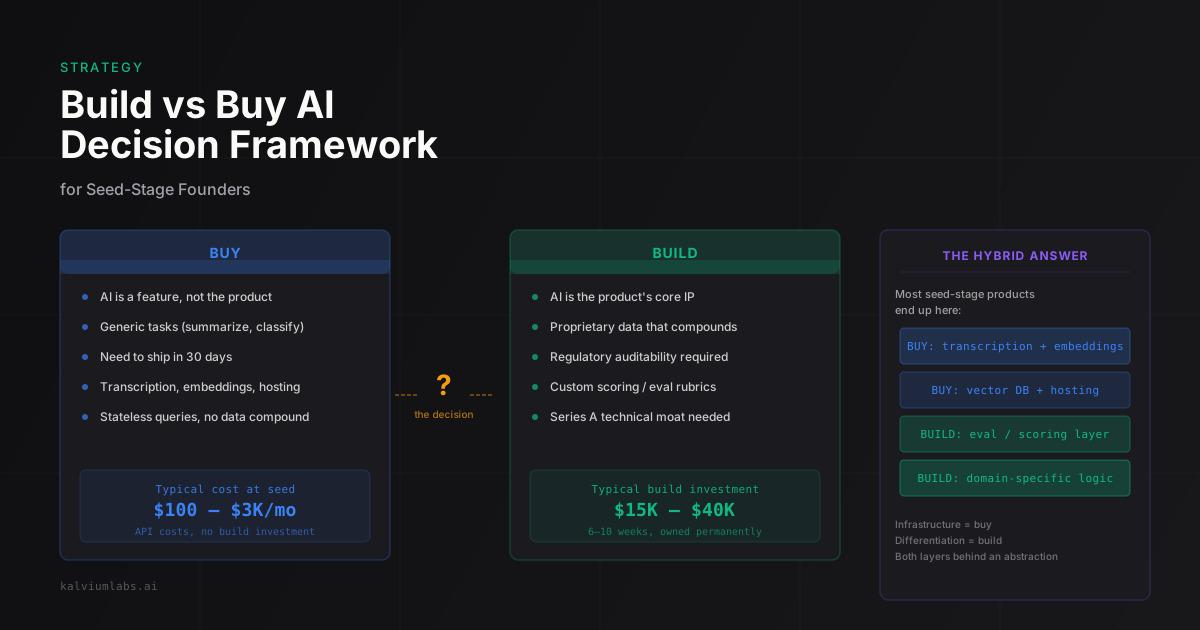
| AI uses proprietary data that compounds (user behavior, domain expertise, client-specific rubrics) | Build the evaluation/scoring layer. Buy the infrastructure (transcription, embeddings, vector storage). |
| AI requires regulatory compliance or auditability (healthcare, finance, legal) | Build. You need to own the data flow, the audit trail, and the explainability. |
| AI is the core IP and you’re planning to raise based on a technical moat | Build. Investors at Series A will ask about this. |
| You need to ship in 30 days | Buy everything you can, build only what you must. |
Most seed-stage companies end up in a hybrid: buy for infrastructure (transcription, embeddings, vector search, hosting), build for the domain-specific logic that differentiates the product. The line between the two shifts as the product matures.
The Prototype as a Decision Accelerator
Here’s the practical answer to “should we build or buy?” that skips a lot of the theoretical framework: build a 72-hour prototype using the cheapest available off-the-shelf tools, then run it with 15 real users. We wrote up how this prototype-first approach works in practice, including what POC, prototype, and MVP actually mean and when to use each.
What you learn in 72 hours usually answers the question better than a week of analysis.
If users engage deeply with the core workflow but ask for customizations that the off-the-shelf tool can’t support: the gap is real, and building makes sense. If users bounce at the same step regardless of the tool’s quality, you have a product problem, not a build-vs-buy problem. If the prototype performs well enough that users want to pay for it before you’ve written a line of custom code: the buy decision just got much easier to defend.
We’ve run this sequence enough times that we’ve stopped doing long architecture discussions until after the prototype. The prototype surfaces the actual tradeoffs faster than any framework. And it gives you real data to bring to the build-vs-buy question, instead of assumptions.
For the financial advisor compliance tool, that 72-hour prototype used Deepgram for transcription, OpenAI’s API for the initial scoring pass, and a Notion-templated report. Users tried it, liked the scoring structure, and immediately asked whether they could customize the rubric for their firm’s specific regulatory environment. That customization request, which came up in 11 of 15 user sessions, is the clearest possible signal: the evaluation layer needs to be built, not bought.
The infrastructure underneath? Still Deepgram. Still OpenAI for embeddings. Some things don’t need to be built custom at seed stage, and that’s fine.
When to Revisit the Decision
Build vs buy isn’t a one-time answer. It’s a running question, and the right answer changes as your company grows.
At seed: Ship fast. Buy what you can. Build the 20% that differentiates. Maintain abstraction layers so you can swap vendors.
At Series A: Audit your vendor dependencies. What are you paying per month to which providers? What’s your cost per active user? Where does your margin go if one vendor raises prices 40%? Consider internalizing the highest-cost or highest-risk components.
At Series B: If AI is central to your competitive position, you should have your own evaluation infrastructure and at minimum a fine-tuning capability on top of base models. You can still use vendor infrastructure underneath, but the proprietary layer needs to be owned and defensible.
The founders who get this right are the ones who treat the build-vs-buy decision as a rolling question attached to a specific component, not a philosophy. “We build everything” and “we buy everything” are both wrong. The right answer is: buy what’s generic, build what’s yours, and stay honest with yourself about which is which.
FAQ
How much does it cost to build custom AI vs using off-the-shelf tools?
Off-the-shelf tools at seed range from $100 to $3,000 per month in API costs depending on volume. Building a custom AI component typically costs $15,000 to $40,000 in development (6 to 10 weeks with a qualified team) plus ongoing infrastructure. The breakeven point varies, but for most seed-stage companies, the custom build pays off when the product reaches $5,000 to $10,000 in monthly API costs with off-the-shelf tools and the custom build would reduce that by 60% or more. For a fuller picture of what AI product costs actually look like across token bills, API fees, and infrastructure, see what clients underestimate about AI product costs.
Can we switch from bought AI tools to custom-built later?
Yes, but it’s expensive if you haven’t planned for it. The switching cost depends on how tightly you’ve coupled your product logic to the vendor’s API behavior. Teams that build abstraction layers (a provider interface, a model-agnostic evaluation layer) switch in days. Teams that hard-code vendor-specific behavior into core product logic take 4 to 8 weeks to migrate cleanly. The architectural decision worth making at seed: don’t let any single vendor’s quirks become a load-bearing part of your product logic.
What AI components should a seed-stage startup almost always buy?
Speech-to-text transcription, embedding generation, vector database hosting, and general-purpose LLM inference (for tasks that don’t require proprietary rubrics). These are infrastructure, not differentiation. The unit economics are favorable at seed-stage volume, and the engineering cost of building them custom wouldn’t be recovered for years. Save the build effort for the components where your proprietary data, your domain expertise, or your specific customer requirements create something that off-the-shelf can’t match.
Does build vs buy affect fundraising?
Yes, particularly at Series A. Investors evaluating an AI startup will ask where the technical moat is. If the entire stack is third-party APIs assembled together, that’s a product bet, not a technology bet. Either answer can work, but the investor thesis changes. Pure product bets need stronger distribution moats (network effects, switching costs, exclusive partnerships). Technical moats need to be real and defensible: fine-tuned models on proprietary data, evaluation systems that improve with usage, IP that took 12 months and specialized expertise to build.
When does building custom AI make sense at seed stage if budget is tight?
When the AI component is the product and you can ship a version in 4 to 8 weeks. Not when you’re adding AI features to an existing product, not when the task is generic (classification, extraction, summarization), and not when you haven’t validated that users actually want the thing you’d be building. The right test: would a buy decision for this component make you permanently unable to compete, or just temporarily? If it’s temporary, buy now, build later. If building this component is what makes you defensible, then seed budget or not, it’s worth finding the resources.
Trying to figure out the right architecture for your AI product? Book a 30-minute call. We’ll walk through your specific use case and tell you honestly where custom build creates a moat and where off-the-shelf is the smarter call.