Three data points from the last six months of founder conversations at Kalvium Labs:
A Series A founder in San Francisco was paying $340,000 per year for a single senior AI engineer in the Bay Area. His product had one AI feature working. His runway was 14 months. He moved to a Bangalore-based studio and shipped four AI features in the following three months at a fraction of the cost.
A UAE-based founder building an Arabic language AI assistant couldn’t find local engineers with production LLM experience at any price. He tried a London agency, got a $280,000 proposal for a six-month build. He found a Bangalore team, had a working prototype in eight days, and launched three months later.
A New York-based EdTech startup was running a “discovery phase” with a US agency for eleven weeks. No prototype, no code, just documents. They switched to a Bangalore AI product studio. Their first working prototype was ready in five days.
None of these outcomes are surprising to anyone who understands the current state of AI engineering talent globally. But they still catch founders off-guard, because the mental model most US and Gulf founders carry about offshore development is ten years out of date.
What Actually Exists in Bangalore Right Now
The narrative around Bangalore as a tech hub is old enough that most founders discount it. Yes, India’s IT industry. Yes, the outsourcing wave of the 2000s. Yes, the offshore body shops that built CRUD apps and ran conference call infrastructure. That’s the mental model.
Here’s what’s actually in Bangalore in 2026:
The city has more engineers who’ve shipped production LLM applications than any city outside San Francisco and London. This is a function of two overlapping dynamics.
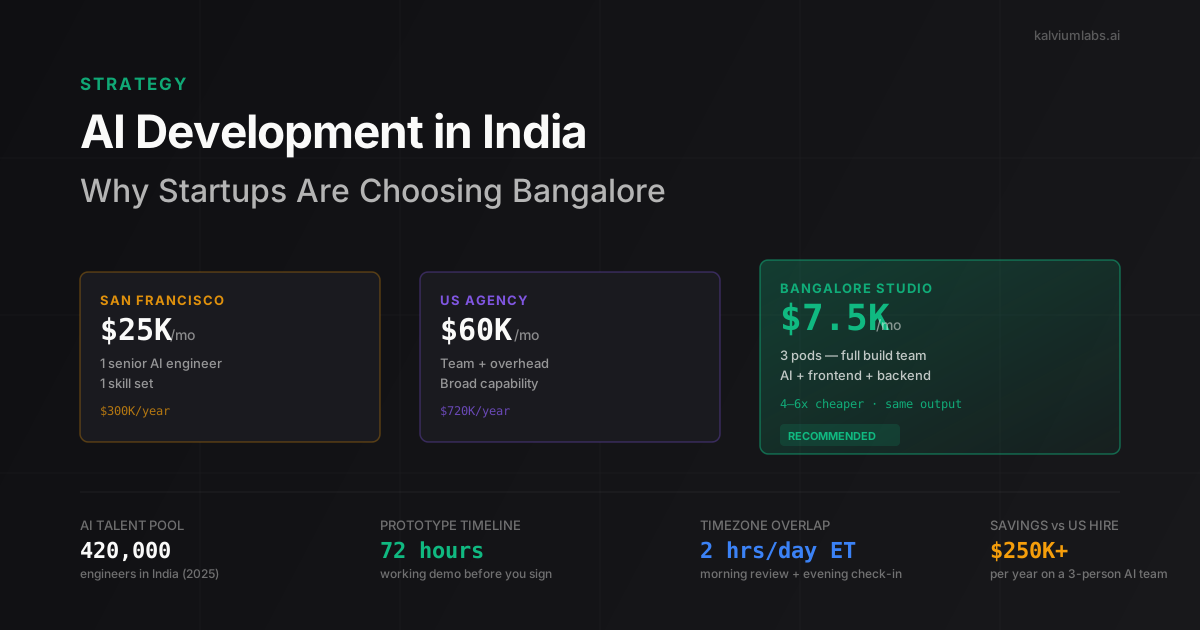
First, every major AI company has engineering presence in Bangalore. Google, Microsoft, Amazon, Flipkart, and dozens of AI-first startups have R&D centers there. Engineers cycle through these organizations and carry hands-on LLM deployment experience into the market. The NASSCOM Strategic Review 2025 estimates India’s AI talent pool at 420,000 professionals, with Bangalore holding the largest concentration.
Second, India’s engineering education pipeline has been systematically reoriented toward AI. This isn’t just institutions adding ML courses. Programs built around LLMs, RAG architecture, agentic systems, and production deployment are producing engineers who haven’t spent five years unlearning CRUD patterns before writing their first inference call. The foundational habits are different.
The result is a supply-side reality that doesn’t exist in other markets. You can hire AI engineers with Deepgram, LangChain, pgvector, and Qdrant production experience. Not just people who’ve taken a Coursera course, but engineers who’ve debugged a real RAG pipeline when embeddings started drifting, or traced a latency spike back to a context window that grew 3x after a feature request.
The Timezone Arithmetic That Most Founders Get Wrong
Offshore development has a reputation for timezone friction. The mental model is: you write requirements in the morning, they build something overnight, you see it at 8 AM, it’s wrong, repeat for months.
That model applies to 12-hour gaps. India Standard Time is UTC+5:30, which puts it 9.5 to 13 hours ahead of US time zones. That sounds like the 12-hour gap problem, but it actually works differently in practice.
Here’s the actual arithmetic for a founder in New York:
| Event | IST | ET |
|---|---|---|
| End-of-day check-in (you call in before bed) | 11:30 PM | 1:00 PM |
| Team’s morning standup | 10:00 AM | 11:30 PM |
| Your morning review of overnight progress | 9:00 AM ET | 7:30 PM IST |
| Two-hour overlap window | 6:30–8:30 PM IST | 8:00–10:00 AM ET |
The overlap window exists. Two hours of real-time collaboration per day is enough to unblock decisions, clarify requirements, and review code. The key is that India-based engineers work while you sleep and you review results when you wake up. When managed well, this is actually faster than a same-timezone team where you interrupt each other throughout the day.
For Gulf-based founders, the arithmetic is even simpler. IST is 1.5 hours ahead of Gulf Standard Time. You’re essentially in the same workday.
The timezone issue founders actually face with offshore teams isn’t the gap itself. It’s the response time when something breaks in production. This is solvable with explicit on-call arrangements, but it requires asking about it explicitly before signing any contract.
The Cost Reality (With Actual Numbers)
The cost advantage is real, but the framing matters. Offshore development isn’t cheap. It’s 4-6x less expensive than US equivalents, which is different from cheap.
A senior AI engineer in San Francisco or New York costs $200,000 to $350,000 per year in total compensation. In Bangalore, a comparable engineer with real production LLM experience costs $20,000 to $60,000 per year. The Stack Overflow Developer Survey 2024 puts the median US developer salary at $165,000 and Indian developer salary at around $23,000, though AI specialization adds a premium in both markets.
For a startup building an AI product:
| Model | Monthly cost | What you get |
|---|---|---|
| 1 US senior AI engineer | $18,000–$30,000/mo (all-in) | 1 person, 1 skill set |
| US AI agency | $40,000–$80,000/mo | Team with overhead, broad skills |
| Bangalore AI product studio pod | $2,000–$3,000/mo | 1 FTE equivalent (can be 1/3 AI + 1/3 frontend + 1/3 backend) |
| 3 Bangalore pods (full team) | $6,000–$9,000/mo | Full build capability |
The three-pod model gives you roughly the same output as a 3-person US team at 15-20% of the cost. Over a 12-month engagement, that’s $250,000 to $350,000 in savings while shipping the same product.
The caveat that matters: quality variance across Bangalore AI shops is wide. The top-tier companies have engineers who’ve shipped production systems. The bottom tier are still billing for junior talent at rates that don’t reflect capability. The cost difference between a $1,500/month “AI developer” and a $3,000/month engineer from a credible studio isn’t the $1,500 you save. It’s the extra 3 months it takes to fix what the cheaper option built.
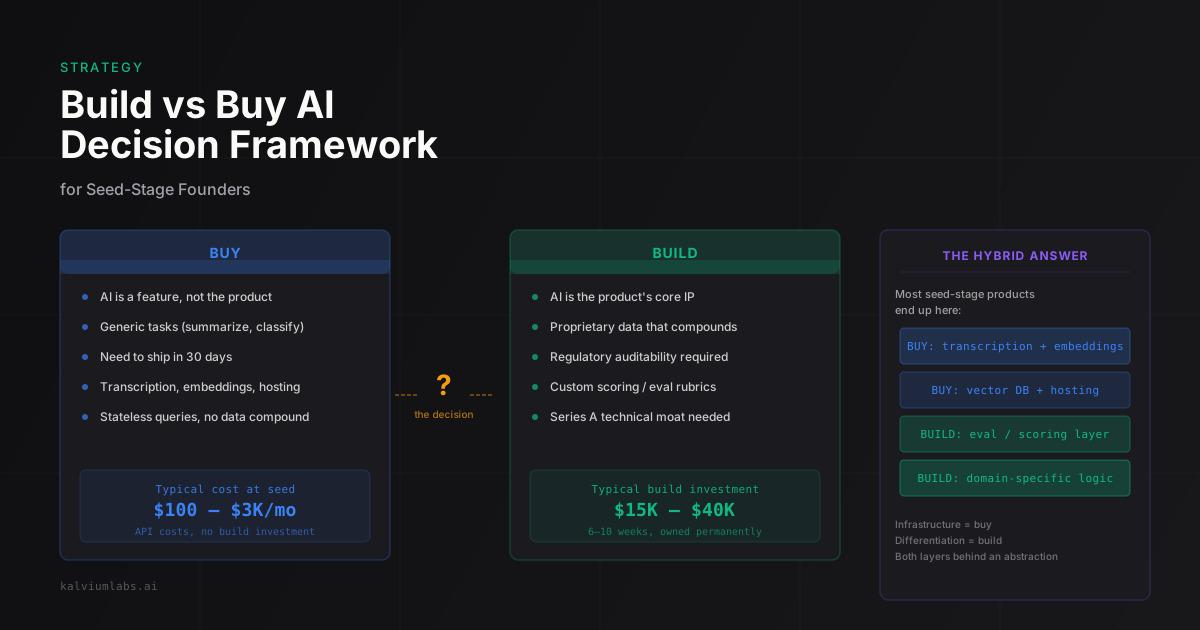
Choosing the right AI development company comes down to one question: can they show you a working prototype in 72 hours? If they can’t, the timezone and cost advantages don’t matter.
What Separates Credible Bangalore AI Teams from Cheaper Alternatives
Every offshore shop in India will tell you they do AI. The word “AI” appears in every proposal, every LinkedIn profile, every pitch deck. Most of what they’re selling is either basic ML pipelines from 2019 or thin wrappers around OpenAI APIs.
Here’s how to tell the difference:
Ask for production metrics, not demos. Anyone can build a demo that works in a controlled environment. Ask for the monthly active users on their most recent AI product. Ask for p95 latency. Ask what happens when the context window gets too long. Ask what they do when a model returns a hallucinated result. Real builders have answers to these questions because they’ve been paged at 2 AM when production broke.
Look at what they actually build. An AI product studio that’s built RAG pipelines, agentic workflows, voice interfaces, and document processing is different from a shop that’s deployed three chatbots using the same template. Ask for the specific engineering decisions they made on their last three projects: which embedding model, which vector store, how they handled chunking strategy, what their eval pipeline looks like.
Check the supervision layer. Quality Bangalore AI teams have ex-FAANG or ex-high-growth-startup engineers at the technical leadership level. This isn’t about credentials. It’s about whether the engineering decisions get reviewed by someone who’s seen what production failure looks like at scale. A team with a Google or HackerRank engineering background as technical oversight is categorically different from a team of talented junior engineers working without that review layer.
Pricing structure signals intent. Hourly billing means the vendor’s incentive is hours billed, not problems solved. Pod-based pricing (monthly retainer for a full-time-equivalent capacity) aligns incentives: you pay for capability, they have reason to build efficiently. Fixed-bid projects with clear deliverables are appropriate for scoped work. Avoid hourly billing for AI product development specifically because AI projects have highly uncertain complexity, and hourly billing rewards that uncertainty.
The Three Things Bangalore Gets Right for AI Specifically
India’s cost and talent advantages apply across software generally. But there are three things about the Bangalore AI ecosystem specifically that matter for building AI products:
ML infrastructure familiarity. The tooling used in modern AI development (LangChain, LlamaIndex, pgvector, Qdrant, Deepgram, Whisper, the OpenAI and Anthropic SDKs) is well-understood by Bangalore engineers because they’re building with it daily, not encountering it for the first time on your project. This reduces ramp-up time considerably. A team that’s already debugged a LangChain memory implementation issue or traced a pgvector index miss is faster on your project than a team reading the documentation for the first time.
English as a working language. This sounds obvious, but it matters for AI product development specifically because so much of the work involves prompt engineering, writing system prompts, crafting evaluation rubrics, and reviewing model output quality. These tasks require precise communication about language. India’s engineering education system conducts technical instruction in English, which means documentation, code comments, API discussions, and client communication happen in the same language as your product requirements.
The startup density is growing. Bangalore’s startup ecosystem has matured. Founders who built and sold startups to US companies are now building again, running engineering teams, and bringing that product-building instinct to service work. The best Bangalore AI studios aren’t staffing bodies. They’re operated by people who’ve shipped products, know what failure looks like, and build accordingly.
What to Watch Out For
The narrative above is honest about the advantages. The risks are equally real.
Scope creep on fixed-price contracts. If you sign a fixed-bid contract without clearly defined deliverables, the conversation about “what’s in scope” will cost you more than the contract itself. This isn’t specific to India, but it’s more common in offshore relationships where requirements were under-specified because of communication gaps at the start.
Senior pitch, junior delivery. Some agencies show senior engineers in sales calls and assign junior engineers to the actual project. The way to prevent this is to meet the engineers who will work on your project before signing. Ask for a code review of something they’ve built recently, not a portfolio presentation.
The architecture gets complicated. AI products built to impress during demos often have architectures that become expensive to maintain: too many API calls per query, context windows that bloat costs at scale, eval pipelines that don’t automate correctly. Ask any potential partner what their cost-per-query looks like at 10x current usage. If they don’t have an answer, the architecture wasn’t built for scale.
For the full picture of the hiring models and how to evaluate each one, that comparison covers where studio pricing actually fits into a startup’s hiring sequence.
FAQ
Why are US startups building AI products in Bangalore specifically, not other Indian cities?
Bangalore has the highest concentration of production AI engineering talent. Hyderabad is second, with strong presence from Microsoft and Amazon. Delhi/NCR has more enterprise IT than AI product experience. Mumbai has strong fintech and finance technology, but the AI engineering ecosystem is thinner than Bangalore. For a startup specifically building AI products (RAG, agentic systems, LLM fine-tuning, voice, multimodal), Bangalore has the deepest available talent pool.
How much does it cost to build an AI product with a Bangalore-based studio?
A typical AI product MVP with a Bangalore studio runs $15,000 to $50,000 for the build phase, depending on complexity and timeline. This covers 2-3 pods (full-time-equivalent engineers) over 8-12 weeks. Operating costs after launch (token bills, infrastructure, observability) are separate and run $400 to $3,500 per month at early-stage usage volumes. For a full breakdown of how these numbers stack up, the real cost of building an AI product post covers every line item.
What’s the typical timeline to get a prototype from a Bangalore AI team?
A credible AI product studio should show you a working prototype in 72 hours from a clear brief. Not a polished product, but something that demonstrates the core AI feature works. If a team needs two weeks of “discovery” before showing any working output, that’s a signal about their process, not the complexity of your idea. A proper team already has the infrastructure, tooling, and engineering patterns to stand up a prototype quickly because they’ve done it before.
Is intellectual property secure when building with an Indian development company?
IP protection in Indian development contracts operates under standard international contract law. A well-structured engagement includes an IP assignment clause that transfers all work product to the client upon project completion, and a mutual NDA covering both project details and proprietary data. Ask for these explicitly before signing. The risk with poorly structured offshore contracts isn’t unique to India; it’s the same risk with any development partner. The risk is in the contract, not the geography.
What happens after the build phase? Who maintains the AI product?
Ongoing maintenance after launch is where many offshore arrangements break down. The engineers who built the product may move to other projects; the AI models you relied on will deprecate; your data distribution will shift in ways that affect model quality. The best Bangalore studios offer dedicated maintenance pods on monthly retainers after the build phase. This keeps the same engineers on your product and gives you a clear cost structure for ongoing improvements. If a studio only offers project-based fixed bids and no retainer option, their model isn’t designed for long-term ownership.
Evaluating Bangalore AI studios and want a straight answer about whether your project is the right fit for this model? Book a 30-minute call and we’ll tell you honestly what it would take to build.