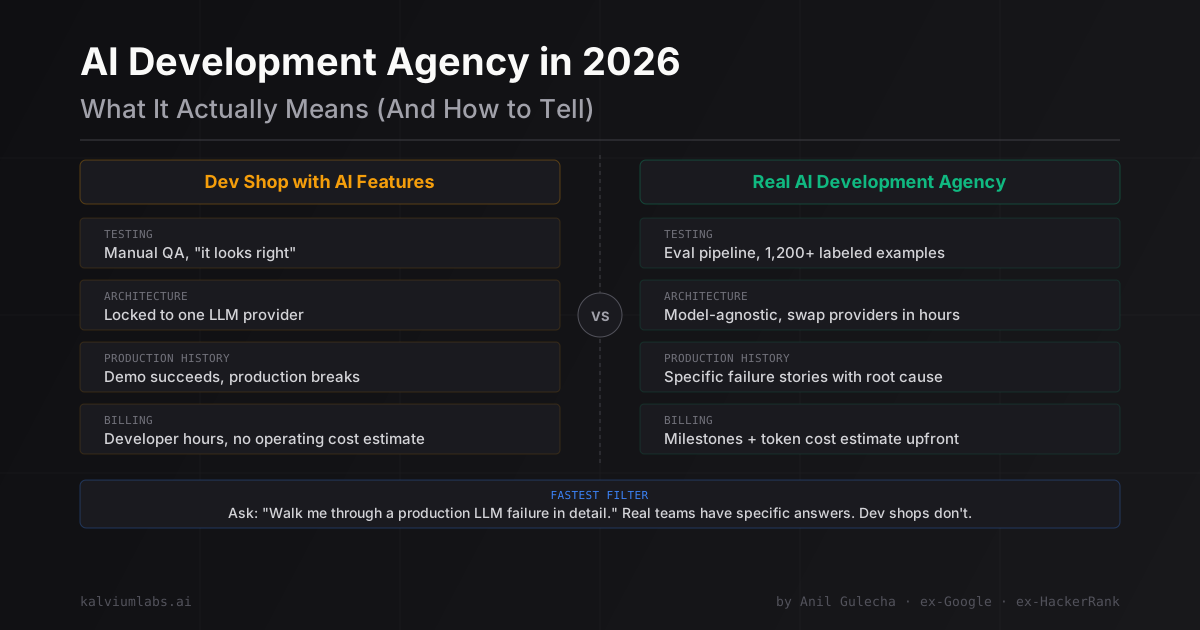
Most AI content tools optimize for one thing: output volume. They measure success in posts per week and words per dollar. I understand why, because volume is easy to count and easy to sell. But volume doesn’t close deals.
We run a content engine that publishes two posts per day, seven days a week. Not because publishing 14 posts a week is inherently better than publishing 3. We publish that much because our system generates and validates each post faster than a human can, and because we have enough keyword demand to justify filling that pipeline. Volume is an output of having a working system, not a goal.
The difference matters. Teams that start with a volume goal end up with 200 posts that rank for nothing and a CMS that nobody reads. Teams that start with the right inputs, run the right feedback loops, and track the right outputs get qualified readers who turn into meetings.
Here are the 5 workflows we’ve learned to care about, from building content engines for clients and for ourselves.
The Vanity Metric Problem
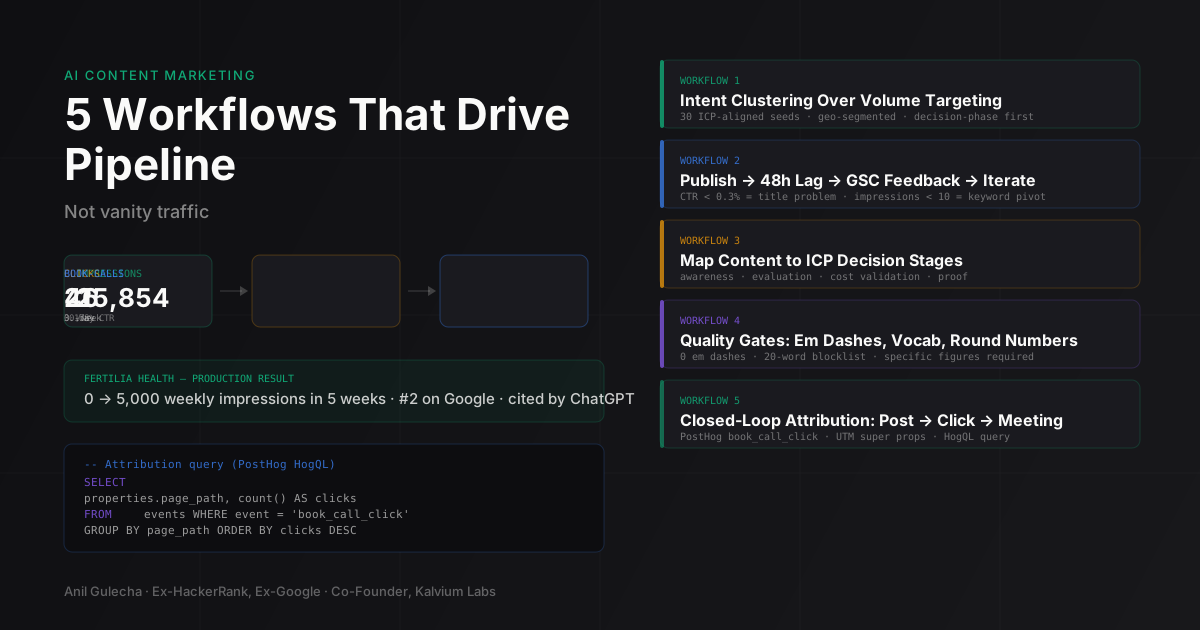
Our own blog had 25,854 weekly impressions as of last week. Sounds good. The same week, it drove 46 clicks. That’s a 0.178% CTR. And of those 46 clicks, 21 became book-call conversions over the trailing 30 days.
This is not a failure. Our conversion path from organic search click to book-call is functioning. But it illustrates the ratio: 25,000 impressions, 46 clicks, 21 conversions in a month. Someone looking only at impressions would think we’re winning. Someone looking only at conversions would think something is broken. The truth is neither, but the only number that pays rent is the last one.
The content marketing programs I’ve seen fail, both in-house and at agencies, almost always die at one of two places. The first is the impression-to-click gap (ranking for queries nobody who buys clicks on). The second is the click-to-conversion gap (getting technical readers who never need to hire anyone).
The 5 workflows below address both gaps in order.
Workflow 1: Intent Clustering Over Volume Targeting
Standard keyword research optimizes for search volume and competition scores. You find queries with 1,000 monthly searches and low competition, write posts targeting them, and wait for traffic. This works when you’re a publication and traffic is the product. When you’re selling services, it doesn’t work, because traffic without buyer intent is not a lead source.
Intent clustering is different. Instead of sorting by volume, you sort by the question: “Who is searching this, and what would they do next?”
The query “ai content marketing tools” (1,000 monthly searches) attracts marketing managers shopping for software subscriptions. Not our buyers. The query “ai content engine for healthcare practice” (30 monthly searches) attracts clinic owners evaluating an automated publishing solution. Exactly our buyers.
We use Google Keyword Planner segmented by geography and clustered by intent phase, not volume. For each seed query, we look at the full query expansion and ask which queries map to: awareness (“what is X”), consideration (“X vs Y”), or decision (“how much does X cost”, “X for my industry”). Decision-phase queries have tiny volumes and are worth 10x more than awareness-phase queries with large volumes. Google’s own search quality rater guidelines categorize queries by “know,” “do,” “website,” and “visit-in-person” intent, a more precise version of the same framework we apply to commercial keyword selection.
One specific pattern we’ve learned: qualifier words signal intent phase reliably. “For [industry]” = decision (they know what they want, are now asking if it fits). “vs [competitor]” = consideration. “what is” or “how does” = awareness. We deprioritize awareness-phase queries when our pipeline goal is short-cycle conversions, and we write to decision and consideration clusters first.
The Fertilia Health content engine was built on 30 ICP-aligned seeds pulled via multi-geo Keyword Planner (US + UAE + Saudi + India). Not one of those seeds was chosen for raw volume. Every seed was chosen because the people searching it could plausibly book a consultation. Five weeks after launch: 5,000 weekly impressions, a Google #2 ranking, and 109 consultation inquiries. The volume came later, as a byproduct of ranking for the right intent.
Workflow 2: The Publish-Feedback-Iterate Loop
Most teams treat publishing as the endpoint. Write post, publish post, track impressions. If impressions are up, the content program is working. If impressions are flat, write more posts.
This loop has a fundamental problem: it conflates publishing with winning. Getting indexed is not winning. Ranking is not winning. A ranking on page 2 that earns zero clicks is worth nothing.
The correct loop has a feedback step between publish and measure. We run it on a 2-day lag, because GSC data takes roughly 48 hours to stabilize. The loop is:
Publish → Wait 48-72 hours → Pull GSC data by page → Check: (a) impressions, (b) average position, (c) CTR, (d) which queries triggered the post.
The query data is the important part. You write a post targeting one primary keyword. GSC shows you 30 other queries the post ranked for that you didn’t anticipate. Some of those queries have much higher intent than your original target. The feedback loop tells you: go update the post to also target these queries, or write a follow-up post that goes deeper on the high-intent variant.
Concretely: our post on AI bot detection ranked for "google notebooklm user agent" within a week, which we hadn’t explicitly targeted. We updated the post to include a dedicated section on Google-NotebookLM specifically. That section now ranks separately for that query cluster.
The technical implementation for running this loop at scale: we pull GSC data via API, filter to posts published in the last 21 days, flag any post with >100 impressions and <0.3% CTR as a “CTR problem” (ranking but not clicking), and surface those for title/description review. Posts with <10 impressions in their first 14 days go to a “no-traction” queue for either a keyword pivot or consolidation into a higher-traffic post.
None of this is manual. The feedback loop runs on a cron and outputs a prioritized list. Human review is required only for the posts that fall into the CTR or no-traction buckets. Everything else keeps publishing.
Workflow 3: Mapping Content to ICP Decision Stages
The standard advice is to write a content calendar. Awareness posts, consideration posts, decision posts, mixed across weeks. This is sound in principle and broken in practice, because most teams don’t know who their ICP is at each stage, so the “decision post” ends up being generic and the “consideration post” is just a comparison of tools they’ve never used.
We map content to specific ICP roles and questions instead of to abstract funnel stages.
For Kalvium Labs, our ICP is a seed-to-Series-B US or Gulf startup founder evaluating whether to build AI features with an outside team. That founder has four distinct questions at different points in the conversation:
- “Is AI actually what I need, or am I chasing a trend?” (Anil posts on specific use cases with production outcomes answer this)
- “Who should build it, and how do I evaluate them?” (the founder checklist and agency comparison posts address this)
- “What does it cost, and how long does it take?” (the cost breakdown and prototype-to-production timeline posts address this)
- “Can this team actually ship what they’re proposing?” (case studies and build stories address this)
Every post maps to one of these questions. We don’t publish posts that answer none of them, even if the keyword volume looks attractive. We deprioritize awareness content (question 0: “what is AI?”) because founders who don’t know what AI is aren’t our buyers yet.
The technical output of this mapping: each post in our queue has a decision_stage label: awareness, evaluation, cost_validation, or proof. Before a post goes into production, it gets reviewed against the ICP question it’s supposed to answer. If the post doesn’t clearly answer the question without assuming background knowledge the reader might not have, it gets revised.
Most AI content engines don’t have this step. They pick topics from keyword lists and generate content. The posts are readable, sometimes well-researched, but structurally disconnected from any real buyer question. They get traffic from curious readers, not pipeline from qualified buyers.
Workflow 4: Quality Gates That Keep AI Writing From Sounding Like AI
We use AI to write most of our first drafts. This is not a secret. It’s also the part that most content engine builders get wrong.
The problem isn’t that AI writes badly. The problem is that AI writes in a recognizable pattern, and readers in technical, high-trust markets (our buyers are CTOs and founders) have learned to recognize that pattern. The moment a post reads as AI-generated, trust drops. Not because AI writing is factually worse, but because a post that reads AI-generated signals that nobody cared enough to edit it.
Our quality gates catch five specific failure patterns:
Pattern 1: Em dashes. AI uses them constantly. They’re the single highest-signal AI tell in English prose. We run a regex check on every post: if it contains the Unicode U+2014 character, it doesn’t ship until removed. No exceptions.
Pattern 2: Tier 1 vocabulary. AI defaults to a recognizable set of emphasis words when it needs to sound important. Three categories: grandiose adjectives that signal importance without specifics, hype verbs that signal scale without data, and literary-sounding verbs that no working engineer would say out loud. Real engineers don’t write like this. We have a 20-word blocklist that triggers a hard failure in our validation script. Any post with a Tier 1 word gets rejected and rewritten. (We built a full 57-post audit against Google’s Quality Rater Guidelines to define our blocklist; the methodology is documented here.)
Pattern 3: Uniform sentence length. AI writes in a narrow band: 15-20 words per sentence, consistently. Real writers vary. Short sentences for emphasis. Longer sentences when an idea needs the space to breathe and context to land correctly. Our linter checks sentence length distribution; we flag posts where more than 60% of sentences fall between 14-22 words.
Pattern 4: Round numbers. “Significantly faster.” “Substantially cheaper.” “Dramatically reduced.” Real engineers remember the specific number. 37% faster. $0.04 per call. 94% agreement with human reviewers. Our review pass replaces vague quantifiers with specific figures, or flags sections where a specific figure should exist but doesn’t.
Pattern 5: Missing rough edges. This one’s harder to automate. AI describes what worked. Real build stories describe what didn’t work too. We have a checklist item for every post: “Does this post mention at least one thing that went wrong, one version conflict, one assumption that turned out to be incorrect?” If not, the post goes back for a revision pass.
These five gates don’t make the writing better in a literary sense. They make the writing more credible in a specific sense: the kind of credibility that earns trust from a founder who is deciding whether to hand us $40,000 to build something important.
Workflow 5: Attribution That Actually Closes the Loop
This is the workflow most content programs either skip entirely or implement badly.
Standard attribution looks like this: Google Analytics shows 200 sessions from organic search. You attribute those 200 sessions to your content program and call it a win. You don’t know which posts those sessions came from. You don’t know which sessions led to book-call clicks. You don’t know which book-call clicks became client conversations.
Real attribution connects each step. Our implementation:
Step 1: UTM tagging at the session level. Every reader who arrives from organic search gets their UTM source captured via PostHog’s super properties. Even if they return three sessions later from direct, their original organic attribution is preserved.
Step 2: PostHog events at every conversion surface. book_call_click fires when any reader clicks the calendar link. The event payload includes page_path, link_location, and the UTM data from step 1. We know which post the click came from and where on the page it happened.
Step 3: HogQL queries to close the loop. Once a week, we run:
SELECT
  properties.page_path AS blog_post,
  count() AS book_call_clicks
FROM events
WHERE event = 'book_call_click'
  AND properties.page_path ILIKE '/blog/%'
  AND timestamp > now() - INTERVAL 30 DAY
GROUP BY blog_post
ORDER BY book_call_clicks DESC
This tells us which posts are generating actual conversion intent. Not impressions. Not clicks. Specific posts that led readers to click the calendar link. PostHog’s HogQL documentation covers the full query syntax if you want to adapt this to your own event schema.
The insight this produces is not obvious until you have the data. Two of our blog posts have generated direct book-call clicks in the past 30 days: a Cloudflare Workers architecture post and an AI assessment platform build story. Neither is a “high-volume” post by impression count. Both are specific technical posts that land with developers evaluating similar infrastructure decisions. The conversion path is: developer reads the post, recognizes we’ve shipped something similar to what they need, and books a call.
Without step 3, we’d have no idea those two posts were doing any work. We’d keep publishing based on impressions, ignoring the posts that actually convert.
What Most Teams Get Wrong
The mistake I see most often: treating publishing as the goal instead of treating pipeline as the goal.
Publishing is an intermediate step. It’s necessary but not sufficient. A team that publishes 14 posts per week to a consistent schedule, without checking what’s ranking, which queries are triggering which posts, and which posts are generating actual conversion intent, is running a content production operation, not a content marketing program.
The specific behaviors this produces:
- Publishing posts that rank for queries with mismatched intent (we ranked for “cloudflare ai gateway update”, a news query, with a comparison post, and got 1,060 impressions and zero useful clicks for 6 weeks before fixing the description)
- Optimizing for broad traffic keywords that attract readers who’ll never buy (our India traffic is 2.8x our US traffic in volume; US traffic converts, India traffic doesn’t, and they read different posts)
- Skipping the attribution step because it’s technically complex, which means the program can’t prove ROI, which means it gets cut when the budget tightens
The fix for all three is the same: start with the pipeline question, not the traffic question. “Which buyers search for what, and when, and what would make them want to talk to us?” Everything else is implementation detail.
For what the architecture of a self-operating content system looks like in practice, including how we handle keyword selection, quality gates, and deployment automation, the AI Content Engine service page covers the full system. And if you want to see how it contrasts with the tool-only approach that most teams take, this post on what most AI content tools get wrong is a useful complement.
FAQ
How many posts per week does a content engine need to publish?
The right number depends entirely on how much keyword demand you’ve identified that maps to your ICP. If you have 10 high-intent topics and you publish 14 posts per week, you’ll run out of good topics in a week and fill the rest with posts that nobody who buys will ever read. Start with your keyword research. The publishing cadence should match your validated topic backlog, not an arbitrary schedule. For most B2B services businesses, 3-5 posts per week is the right starting cadence while the feedback loop develops. Scale up only when you’ve validated that the feedback loop is working.
What does it cost to build an AI content engine?
The architecture cost depends on how much you want automated. A minimal system (topic selection, draft generation, human review, publish) runs about $500-800 per month in infrastructure and AI API costs for a 2-3 post/week cadence. A fully automated system with keyword research, quality gates, SEO feedback loops, and attribution tracking runs $2,000-3,000 per month. Custom builds vary. The labor cost it replaces is typically 3-4x the tool cost: a freelance content team producing the same volume would run $8,000-15,000 per month. The economic case for automation is straightforward if you have the volume to justify it.
How long does it take to see results from an AI content program?
GSC starts registering impressions within 2-7 days of publishing for new posts, assuming the domain is already indexed. Ranking meaningful traffic (top 10) for non-competitive queries takes 4-8 weeks. Ranking for competitive queries (500+ monthly search volume, established competition) takes 3-6 months. Fertilia Health hit 5,000 weekly impressions in 5 weeks because we targeted low-competition queries with clear ICP intent. That’s the fast path. Broad keyword strategies with higher competition take longer. Set expectations accordingly before you start.
How do you measure whether a content program is driving pipeline?
The minimal measurement stack: PostHog (or any product analytics) with a custom event on your booking/contact CTA, UTM parameters on all organic traffic to preserve source attribution across sessions, and a weekly query joining CTA-click events to the page they came from. This gives you a direct line from “which post” to “which booking intent.” Without this stack, you’re measuring impressions and hoping they convert, which is not measurement.
When should we build a content engine vs just hire writers?
Build the engine when: you have enough validated keyword demand to fill a consistent publishing schedule (50+ topics with clear ICP intent), you need to scale to more than 4-5 posts per week without proportional headcount cost, and your content quality bar is high enough that the engine’s quality gates will produce usable output without constant human intervention. Hire writers when: you’re at early stage and still finding product-market fit, your topics require primary research that AI can’t do, or your publishing volume is low enough that automation doesn’t provide economic leverage.
Running a content program and not sure why it’s generating traffic but not meetings? That’s the intent-to-pipeline gap. Book a 30-minute call and we’ll pull your GSC data live, identify which queries are sending the wrong audience, and show you the 2-3 workflow changes that close the gap.