I spent two years building AI products at HackerRank and Google before we started Kalvium Labs. In that time, I hired about twelve external vendors for different parts of the stack. Two of those experiences were good. The rest taught me more about how to read a vendor’s actual capability than any due diligence checklist.
We’re now on the other side of that table. Founders evaluate us the way I used to evaluate vendors. And the same pattern keeps showing up: someone does reasonable due diligence, picks an agency that looked credible, and calls me four months later when the build has stalled or shipped something that breaks under real traffic. Not because they were careless. Because the label stopped meaning anything around 2023.
“AI development agency” used to narrow the field. In 2026, it doesn’t. Here’s what it actually takes to tell the difference.
The Label Problem
In 2022, an AI development agency meant something fairly specific: a team with ML engineers, probably some research background, who had shipped models or intelligent systems to production. The bar was high enough that the label was informative.
From late 2023 onward, the GPT-3.5 and GPT-4 APIs made it possible for any web developer to add natural language features to an existing product over a weekend. Thousands of agencies did exactly that. Most updated their website copy to lead with “AI” within weeks. The label now describes a range so wide it’s functionally useless on its own.
Here’s roughly what you’ll find under “AI development agency” today:
Tier 1: Web shops with API calls. Build chatbot wrappers, call the OpenAI API, ship fast. Quote $25K for something that takes 6 weeks and involves mostly prompt tweaking plus UI work. Not bad at what they do. But not an AI shop in any meaningful sense.
Tier 2: Dev agencies with ML talent. Have two or three engineers who understand embeddings, RAG pipelines, and standard agent patterns. Production record is limited but real. Quote $50K-150K depending on complexity.
Tier 3: Production AI teams. Have shipped AI systems that handle real traffic, failed in production and fixed it, and can explain precisely why their architecture holds up under load. Most teams at this tier in the US quote $200K-400K+ for the same scope we take at $40K-80K.
All three call themselves AI development agencies. None of the tiers advertise their tier. (If the comparison between agency, product studio, and freelancers is where you are right now, that framework is here.)
The Four Differences That Actually Matter
These aren’t about culture fit or communication style. They’re about whether the team can build AI that works when deployed to real users.
1. Eval Infrastructure
Ask any AI agency how they know whether the product they built works.
A Tier 1 shop will describe manual testing, QA sessions, client review rounds. They test features, not model outputs. In traditional software that’s often sufficient. In AI systems, it isn’t.
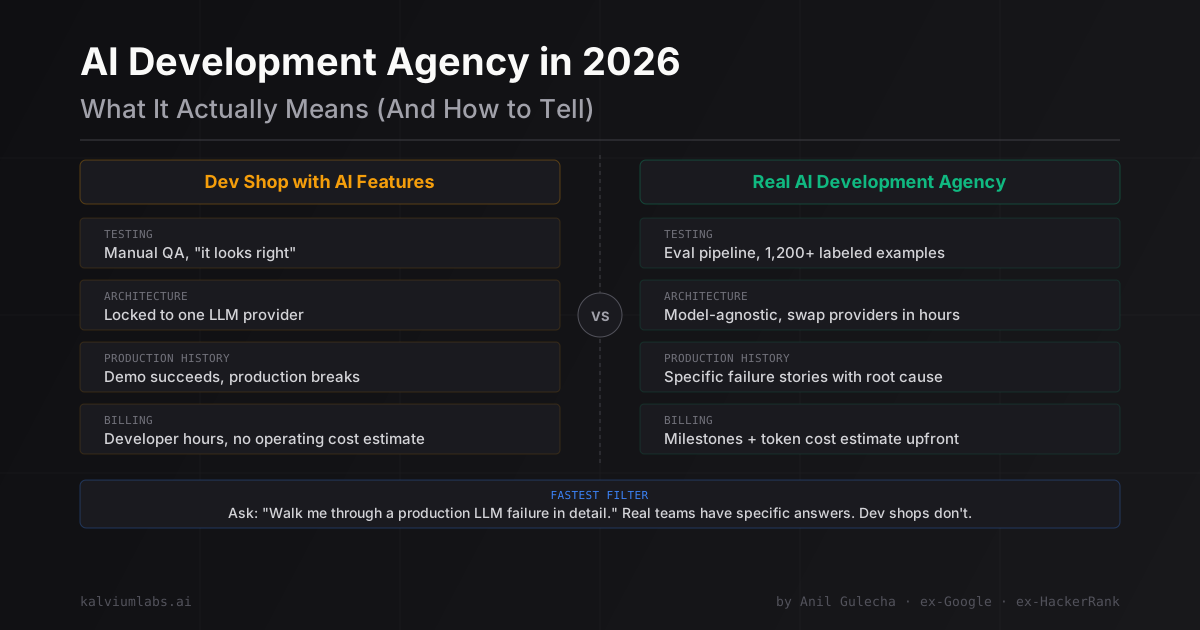
Real AI agencies have an eval pipeline: a dataset of inputs, a set of expected outputs or behavioral criteria, and automated tests that run against every model change. They talk about eval pass rates, not just “it looks right in the demo.” They’ve done red teaming. They’ve measured false positive and false negative rates on classification tasks.
We shipped a compliance AI that classifies whether sales calls contain prohibited statements. Before it went to production, we ran it against 1,200 labeled call examples. Our target was 94% agreement with human reviewers. We hit 91% on the first pass. The eval showed exactly where it failed: calls where the rep partially disclosed something but self-corrected mid-sentence. We fixed that category specifically.
A shop without eval infrastructure would have shipped on demo performance. The eval existed because “looks good in the demo” and “works on 50,000 calls per month” are different statements.
2. Model-Agnostic Architecture
Ask them: what happens if OpenAI raises API prices by 3x next month, or if Anthropic’s Claude outperforms GPT-4o on your specific task?
Agencies locked to one provider deliver systems that need architectural surgery to migrate. Real AI agencies build with a provider abstraction layer from day one: a model client that the rest of the application calls without knowing which model is behind it. Swapping from GPT-4o to Claude 3.7 Sonnet takes hours, not weeks.
We’ve migrated three production systems in the past 18 months because the optimal model for the task changed. One migration happened because Anthropic dropped API prices by 40% on a model that performed equivalently for our use case. Another happened because a client’s use case involved sensitive content and one provider’s content policy was causing 6% false positive rejections.
Teams that built without abstraction couldn’t make either move without significant rework. Teams that built with it could. The architectural decision costs about one extra day at the start of a project. The savings downstream are not theoretical.
3. Production Failure Experience
This is the single most diagnostic question you can ask: “Walk me through an LLM system you shipped that failed in production and how you fixed it.”
Teams that haven’t shipped enough don’t have good answers. They’ll describe a bug in a demo, a scope disagreement with a client, or something vague like “the model gave wrong answers sometimes.” Those aren’t production failures.
A production failure is: users are hitting the system, something breaks, the team has to diagnose and fix it under live conditions. A few examples from our work:
We shipped a document processing system that worked on our test dataset and started returning malformed JSON on roughly 8% of documents in production. The failure was non-deterministic, which made it difficult to reproduce. We traced it to a specific category of multi-column PDFs where the text extraction library was outputting characters in non-logical order. The model would get confused by the jumbled input and produce partial structured output. Fix: pre-processing to detect and correct column order, plus a retry-and-validate loop for outputs that failed to parse. Total diagnosis and fix: about two days.
That specific experience now lives in our standard architecture for any PDF-ingestion system. We add the pre-processing step up front instead of discovering the need in production.
A team that’s shipped enough has three or four stories like that. They know the failure categories: context window edge cases, API timeouts under load, model response format drift after a provider update, latency spikes from cold starts on serverless deployments. If they can’t name any from experience, they haven’t hit production volume.
One thing I’ll be honest about: we still don’t have a great systematic answer for evaluating agentic systems that involve multi-hop tool use. Our evals for those are less rigorous than for single-model classification or extraction tasks. It’s an open problem for us and for the field. Teams that claim perfect eval coverage on complex agentic workflows are probably overstating it.
4. Operating Cost Ownership
Ask them: “Can you give us a rough estimate of monthly API costs for what you’re building, and how do you approach token cost optimization?”
Most Tier 1 and Tier 2 shops don’t think about this until after the invoice arrives. Real AI agencies price operating costs into the conversation early. They’ve seen the 10x surprise when a client’s usage scales from 100 users to 10,000. They know when to use gpt-4o-mini versus gpt-4o, when to cache prompt prefixes, when to distill a large model for a specific task.
On a recent project, we cut monthly API costs by 73% between the first sprint and the production build by: routing 62% of lower-complexity queries to gpt-4o-mini instead of gpt-4o, implementing prompt prefix caching for a 2,000-token system prompt that was being re-sent on every request, and batching background processing jobs that weren’t latency-sensitive. None of that was complicated. But it required four days of engineering time that the team’s initial scope didn’t budget for because no one had asked the operating cost question.
The Red Flags
These are faster to check than the four differentiators above.
They quote in developer hours. Contracts measured in hours signal a staff-augmentation mindset, not a delivery team. AI projects have too many unknowns for hourly billing to map reliably to value. Real agencies scope by milestone or phase.
They list every AI technology on the website. LangChain, CrewAI, AutoGPT, Hugging Face, OpenAI, Anthropic, Google Vertex, AWS SageMaker, Azure OpenAI, plus ten more. This is a marketing signal, not an experience signal. Teams that have actually shipped AI in production have opinions. They use certain tools because they’ve evaluated the alternatives and found them worse for specific purposes. A list of everything signals they’re pitching surface area, not depth.
No mention of evals or testing methodology in the proposal. If the proposal doesn’t say anything about how they’ll measure whether the AI is working, you’ll find out at UAT that it works on the happy path and breaks on edge cases. By then you’ve paid for the build.
“We use LangChain” with no further explanation. LangChain is a reasonable choice for some applications and an abstraction layer that introduces debugging complexity in others. Teams that built with it and have thought through its trade-offs have opinions about when to use it and when to bypass it. Teams that list it without context have read the docs.
They can’t tell you their production user scale. Not asking for a client name. Just scale. “Our largest production deployment serves about 2,000 daily active users” is an answer that tells you something. “We’ve worked with enterprise clients” doesn’t. According to State of AI in 2026 and similar industry data, most AI projects fail before reaching meaningful production scale, which is exactly why production experience is the differentiator that matters.
What This Actually Costs
The honest version.
For a small fixed-scope build (3-5K tokens of context per call, single model, defined use case, 6-8 weeks): $15K-30K at a quality Tier 2/3 agency outside the US, and $50K-80K at a comparable US-based Tier 3 team.
For a complex multi-model system (RAG plus agent orchestration, integrations, admin tooling, monitoring): $40K-80K internationally, $100K-200K+ in the US.
Monthly operating costs are a separate line that most clients forget to ask about: budget $500-2,500/month for smaller deployments at moderate usage, more for high volume or long prompts.
The cost gap between Tier 1 and Tier 3 is mostly accumulated production experience. A team that’s never debugged a context window overflow in production will create that problem in your project and charge you while they learn to fix it. A team that’s seen it twelve times designs around it from the start. The price difference is often just someone else’s tuition.
Where We Are in This
We’re a Tier 3 shop by the criteria above. We’ve shipped 25+ AI systems to production. Eval pipelines on all client work. Model-agnostic architecture from day one. We’ve had production failures, and a few of them are documented in case studies here (the compliance AI, the document pipeline).
We’re cheaper than US-based Tier 3 agencies because we operate out of Bangalore with engineers from India’s first AI-native engineering program, supervised by the same founding team. That’s a real cost advantage, and we pass it on.
We’ve also said no to projects. A founder came to us last year wanting to build a claims-processing AI for a mid-sized insurance company. The build itself was tractable. The problem was their underlying data: four systems with inconsistent schema, some records as scanned PDFs, and two years of labeled training data that turned out to be inconsistently labeled by different teams. We told them to fix the data infrastructure first, spend about 90 days doing it, then come back. They did. We built it. The project took 10 weeks instead of the 14 we’d have needed with the messy underlying data.
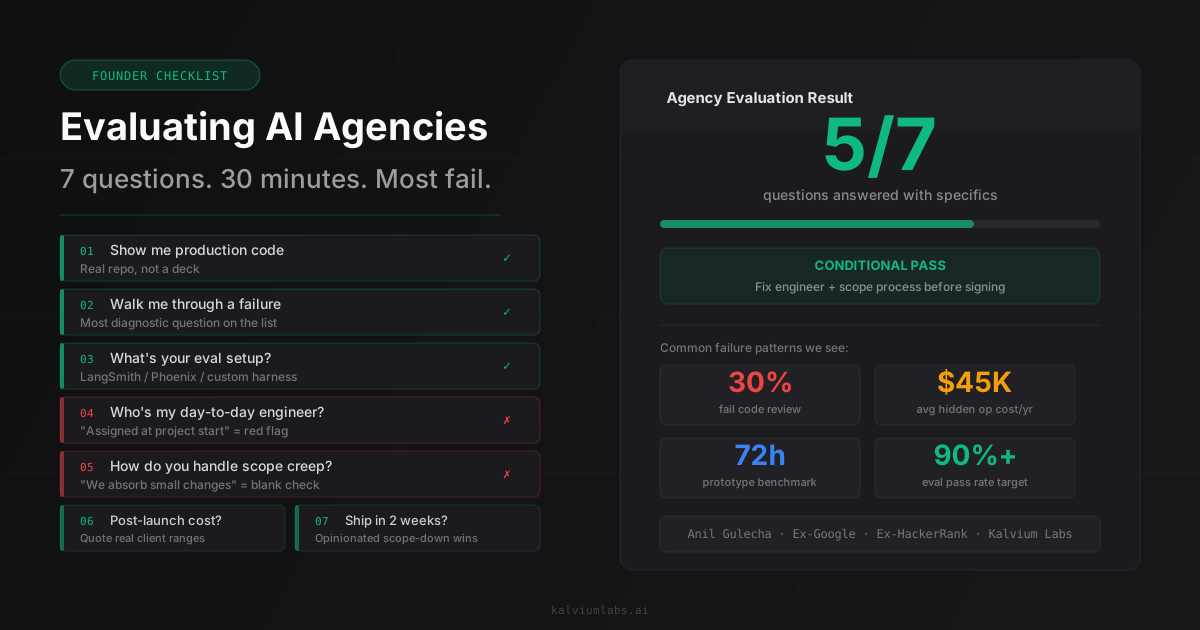
That’s the behavior to look for in an AI development agency. Whether or not it’s us. (If you’ve already narrowed the field and want a framework for the final evaluation step, the 7-question checklist we published last week covers exactly that.)
FAQ
What should I look for when evaluating an AI development agency?
Four things: eval infrastructure (do they test model outputs, not just features), model-agnostic architecture (can they swap providers without rework), production failure experience (ask for a specific failure story with technical detail), and operating cost ownership (can they estimate token costs before signing).
The fastest filter is the production failure question. Teams that have shipped enough have specific, detailed answers. Teams that haven’t give vague descriptions that lack technical specificity.
How much does an AI development agency charge in 2026?
For a small fixed-scope project (6-8 weeks, single model): $15K-30K with a quality international Tier 2/3 agency, $50K-80K with a US-based Tier 3 team. Complex multi-model systems (RAG plus agent orchestration) run $40K-80K internationally and $100K-200K+ in the US.
Monthly operating costs after launch are a separate budget line: $500-2,500/month for smaller deployments, more at scale. Any agency that doesn’t give you an operating cost estimate before the proposal has never thought hard about this.
What’s the difference between an AI development agency and a dev shop with AI features?
A dev shop with AI features integrates a model API the way they’d integrate any third-party service. They test the feature interface, not the model’s behavior. They quote in hours and haven’t seen what happens when the model starts returning different formats after a provider update, or when production volume hits API rate limits at 2 AM.
An AI development agency has shipped enough to know those failure modes from experience. The practical markers: they have eval pipelines, they think in tokens not hours, and they can describe a specific production failure in technical detail.
How do I know if an AI agency has actually shipped production systems?
Ask them to show you production code. Not slides, not case studies. A sanitized repo or a screen-share where they walk through the actual implementation: prompt versioning, retry logic, monitoring setup, error handling.
Then ask about production failures. Teams with real production history have specific failure stories. They remember the exact error, the debugging trace, and what they changed. Teams without sufficient production experience describe failures vaguely, in terms of “the model wasn’t accurate enough” rather than specific technical failure modes.
Do AI development agencies work on fixed-scope or time-and-materials contracts?
Real AI development agencies scope by milestone or phase, not by hours. Fixed milestones let you see working product before the next phase unlocks. Pure hourly contracts give limited incentive to scope correctly.
Watch out for agencies that start hourly and “convert to fixed” after discovery. Discovery is where the real scoping happens. An agency that can’t give you a rough fixed-scope estimate after two or three discovery calls hasn’t done this enough times to have a mental model of the work.
Trying to figure out whether a specific AI build is worth doing, and who to do it with? Book a 30-minute call and we’ll tell you what we’d build, what it would cost, and what the operating costs would be after launch.