There’s a moment in every AI project where you realize the original problem statement was slightly wrong.
For this EdTech client, the problem as stated was: “We can’t produce courses fast enough.” The catalog was growing too slowly. Competitors with bigger teams were shipping faster. The ask was: use AI to write courses.
That’s a reasonable framing. It’s also not quite the right one.
The real problem wasn’t writing speed. It was that every course required a subject matter expert’s time twice: once to produce the content, and again to verify it. If you apply AI to the first step but leave the second step unchanged, you cut the calendar time by maybe 30%. You don’t cut it by 95%.
The insight that changed the architecture: the constraint wasn’t how fast we could generate content. It was how accurately we could generate it on the first pass, so that “SME review” meant editing and refining, not rereading everything with red pen in hand.
What the Old Process Actually Cost
The client’s content team was producing structured educational courses. Each course took 3-4 weeks:
- Topic research and outline creation: 3-5 days
- Lesson content writing: 8-12 days
- Assessment creation (multiple-choice, short-answer, coding exercises): 4-6 days
- Learning path mapping and LMS import prep: 2-3 days
- Expert review and correction: 3-5 days
That’s not an inefficient team. That’s the minimum viable time for a human to do this well. The problem wasn’t process. It was input capacity. One person, one course per month. Competing with teams three times the size.
The goal wasn’t to eliminate any of those steps. It was to collapse the time on each one while keeping the expert review step as the quality gate.
Why We Didn’t Fine-Tune
The first thing any ML-adjacent person suggests when you describe an AI content problem is fine-tuning. Take the client’s existing courses, train a model on them, generate new courses in the same style. It sounds right.
We looked at it and decided against it for three reasons.
The training data was too small. The client had about 200 courses in their catalog. That’s a reasonable sample for understanding their style and structure, but it’s not enough for reliable fine-tuning, especially not for a model that needs to generalize to topics outside the existing catalog. Fine-tuning on small datasets produces models that overfit to the training examples. You get courses that sound like existing courses, not courses that are actually good on new topics.
Their content standards changed often. The client updated their lesson templates, assessment formats, and LMS metadata requirements roughly every quarter. Fine-tuned models don’t adapt to those changes without retraining, and retraining is a project in itself. A prompt-based system adapts in an afternoon: update the template, update the schema, done.
GPT-4o was already better at the job. For structured educational content, GPT-4o with a well-designed prompt was generating better first drafts than a fine-tuned smaller model. The gap between a 200-example fine-tune and GPT-4o’s training scale is large enough that instruction tuning with a strong system prompt beats fine-tuning for most structured generation tasks.
We chose structured prompting with GPT-4o and JSON schema validation. The client could adjust the templates themselves without touching the codebase. For a detailed breakdown of when fine-tuning actually wins over prompting, the fine-tuning vs RAG vs prompt engineering comparison covers the decision criteria with real examples.
The Pipeline Architecture
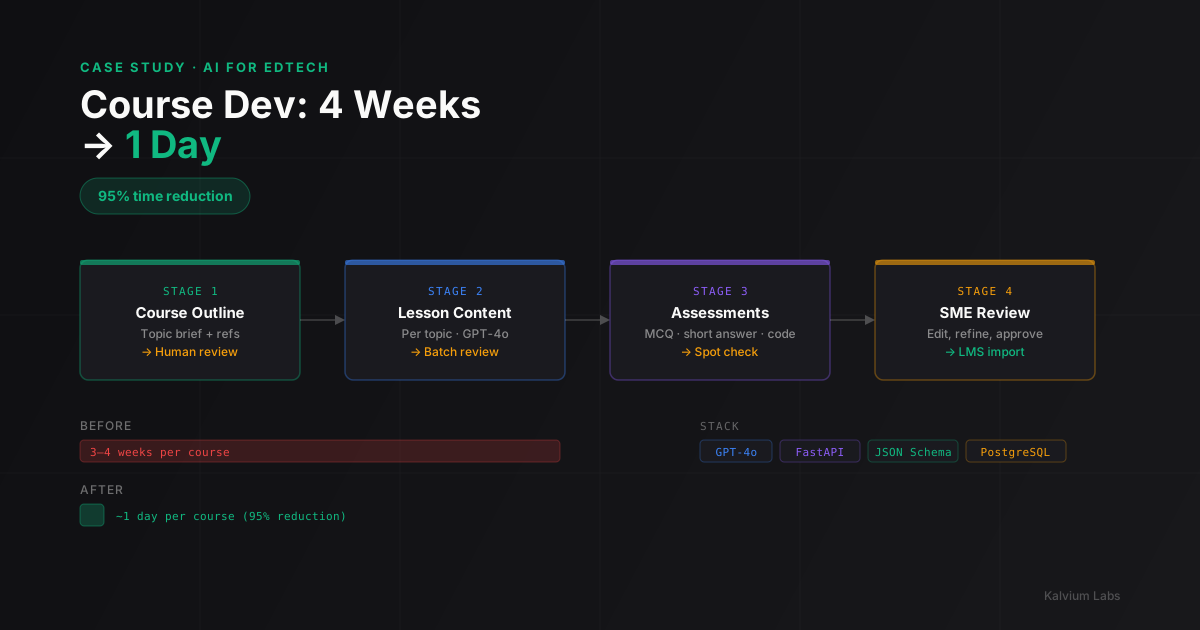
The pipeline runs in four stages, with human review checkpoints built in at each stage rather than only at the end. That staging decision is the most important thing in the architecture.
Input: Topic brief + reference materials + curriculum standards
  ↓
Stage 1: Course outline generation
  → Human review: topic structure, sequencing, scope
  ↓ (approved)
Stage 2: Lesson content generation (per topic, using approved outline)
  → Each lesson: concept explanation + worked example + misconceptions + practice prompt
  ↓ (batch review)
Stage 3: Assessment generation (calibrated to learning objectives per lesson)
  → Multiple choice + short answer + coding exercises with difficulty metadata
  ↓ (spot check)
Stage 4: Full package review by SME
  → Edit, refine, approve for LMS import
The reason for Stage 1 review before Stage 2 generation: errors in the outline are cheap to fix. Errors in the outline that propagate into 15 lessons of content are expensive to fix, because now you’ve generated content that needs to be thrown away or extensively rewritten. Catching structural problems at the outline stage saves the most downstream time.
The lesson template we landed on after two iterations:
{
  "lesson_id": "string",
  "learning_objectives": ["..."],
  "concept_explanation": "...",
  "worked_example": {
    "problem": "...",
    "solution_walkthrough": "...",
    "key_insight": "..."
  },
  "common_misconceptions": ["..."],
  "practice_prompt": "...",
  "difficulty": "beginner|intermediate|advanced",
  "bloom_taxonomy_level": "remember|understand|apply|analyze|evaluate|create",
  "estimated_completion_minutes": number
}
The bloom_taxonomy_level field was a specific ask from the client’s LMS system. Their platform uses it for adaptive learning path recommendations. We had to generate it reliably for every lesson. GPT-4o gets Bloom’s taxonomy levels right about 85% of the time without additional prompting; we added a few-shot examples to the system prompt and got it to 94%, which the SME said was acceptable for a “review and confirm” step rather than a “verify from scratch” step.
The assessments were generated separately, after lesson content, using the lesson content as context. Each assessment item included:
- The question text
- Answer choices (for multiple choice)
- The correct answer
- An explanation of why the other options are wrong
- The learning objective it maps to
- Estimated difficulty (1-5 scale matching the client’s rubric)
Getting the difficulty calibration right took the most iteration. We added a calibration step where we fed the model ten existing assessment items with their known difficulty ratings before asking it to rate new ones. That reference set cut the difficulty miscalibration rate significantly.
What First-Pass Accuracy Actually Requires
The client’s requirement was clear: generated content had to be accurate enough that SME review was editing, not rewriting. They defined “editing” as making changes to less than 30% of the text. “Rewriting” was more than 30%.
First version of the pipeline was hitting about 65% accuracy on that definition. Better than writing from scratch, but not good enough to change the workflow. The SME was still spending nearly as long on review as they’d have spent writing.
Three changes moved it past the threshold:
1. Reference material injection. We added a step where the system extracted key concepts, definitions, and examples from the client’s reference materials before generating each lesson. Those extracted elements were injected into the lesson generation prompt as constraints: “Use these specific definitions. Reference these examples.” This eliminated the hallucination problem that was causing most of the rewriting: the model was generating technically plausible but inaccurate content when working from topic briefs alone.
2. Curriculum standards as a hard constraint. The client had specific standards documents (aligned to K-12 curriculum frameworks in their target markets). We included the relevant standards section in every generation call. When the prompt explicitly referenced “this lesson should address standard X.Y.Z,” the model’s output aligned to those standards at a much higher rate than when we asked it to “write for the appropriate grade level.”
3. Reducing generation scope per call. Early versions generated an entire lesson in one API call. Longer outputs had more variance and more drift from the constraints. We broke it into smaller calls: concept explanation first, then worked example (using the concept explanation as context), then misconceptions, then practice prompt. Each shorter output was easier to constrain and easier for the SME to review in sections.
After those three changes, first-pass accuracy improved. Not dramatically. The improvement felt incremental during development. But it crossed the threshold where the SME stopped rewriting and started editing. That’s when the time savings became real.
The Numbers
Build time: 4 weeks. Team: 3 engineers (1 AI/backend, 1 frontend, 1 integration) plus a PM.
The stack: Python and FastAPI for the pipeline, GPT-4o for generation, React for the review interface, PostgreSQL for storing course structures and generation history, JSON Schema for output validation. Nothing exotic. The stack was chosen to be maintainable by the client’s technical team after handoff.
Post-deployment results:
- Course development time: from 3-4 weeks to roughly 1 day
- That’s a 95% reduction in calendar time
- Same content team size (no headcount change)
- Catalog growth rate: significantly accelerated (client preferred not to share exact figures)
- SME review time: the step that was unchanged. Still takes a few hours. But the team is now reviewing 20x as many courses per month, which is a different kind of work from writing 1 course per month.
The content team’s job changed. They used to be writers. Now they’re editors and curators. A subject matter expert who spends 3 hours reviewing and refining an AI-generated course is producing better educational output than the same expert spending 3 weeks writing the same course from scratch. Review catches errors that the original writer was too close to see.
That shift is worth noting: AI integration doesn’t always reduce headcount. Sometimes it changes what the existing headcount does, and the outcome is better work, not fewer people.
What Didn’t Work
We tried generating the entire course outline and all lesson content in a single API call on an early prototype. Fast to build. Terrible results. The model lost track of structural consistency across a 15-lesson course when forced to generate everything at once. Lesson 12 would silently contradict something established in Lesson 3, and neither the model nor a casual review caught it.
We also tried an automated quality check step between generation and human review: a second model call evaluating the first output for consistency and accuracy. It caught obvious problems (factual errors that were clearly wrong, structural inconsistencies that any reader would notice). It missed the subtle problems (slightly wrong difficulty calibration, learning objectives that were technically met but not well-addressed). The human review step is not replaceable for content that has to be educationally sound. We kept the automated check as a filter, not as a gate.
The AI integration services pattern we’ve seen across multiple projects applies here: the AI doesn’t replace the expert judgment in the workflow, it replaces the parts of the workflow that don’t require expert judgment. Writing a course outline is mostly structure. That’s replaceable. Verifying that the concepts in lesson 7 build correctly on what was introduced in lesson 4 requires someone who understands the subject. That’s not replaceable.
For more on evaluation approaches that work at production scale, OpenAI’s guide on evaluations and Anthropic’s documentation on test-time compute are both worth reading before you design a content pipeline that needs to hit a quality threshold.
Where This Pattern Applies
This wasn’t a unique problem. The same architecture applies anywhere an expert produces structured, templated content at high volume:
- Legal document drafting (standard contracts, NDAs, compliance summaries)
- Technical documentation (API docs, integration guides, runbooks)
- Compliance reports (audit summaries, regulatory filings)
- Marketing content at scale (product descriptions, localized landing pages)
- Medical documentation (clinical summaries, discharge notes)
The pattern is the same in all of these: identify the template structure, identify the constraints that determine accuracy, inject reference material, break generation into stages, keep expert review as the quality gate. What changes is the domain knowledge needed to design the template and calibrate the quality threshold.
The EdTech case happened to hit 95% time reduction because the underlying task (structured educational content following a defined schema) was well-suited to constrained generation. Not every content workflow will hit that number. A legal document pipeline might achieve 60% time reduction because the accuracy requirements for legal content are higher, the edge cases are more numerous, and the rewriting threshold is effectively zero. Still worth building. Just with different expectations.
FAQ
How much does it cost to build an AI content pipeline for EdTech?
At studio rates, a content pipeline like the one described here typically runs $30,000-$60,000 for the build phase, depending on the complexity of your template structure and LMS integration requirements. The ongoing operating cost is primarily LLM API calls: at GPT-4o pricing ($2.50 per 1M input tokens, $10 per 1M output tokens), generating a complete course with 15 lessons and 50 assessment items runs roughly $1.50-$3.00 in API cost. At 100 courses per month, that’s $150-$300 in token costs, which is negligible compared to the labor saved.
How long does it take to integrate AI into an existing EdTech workflow?
Build time for a structured content pipeline is typically 3-6 weeks depending on integration complexity with your LMS. The bottleneck is usually not the AI generation itself. It’s the schema design work to match your LMS import format, and the calibration iterations to hit your quality threshold. Plan for 2-3 weeks of iteration on prompts and templates before first-pass accuracy reaches a level that actually changes the workflow for your SMEs.
What’s the risk of AI-generated educational content?
The biggest risk is hallucination in technical content: the model confidently generating a plausible-sounding but wrong explanation of a concept, especially in math, science, and programming topics. The mitigation is reference material injection (force the model to use your approved definitions) and SME review as a hard gate before anything reaches learners. Don’t use AI-generated educational content without expert review unless the content is very low-stakes. The pipeline should reduce the burden on experts, not eliminate them.
Is fine-tuning better than prompting for educational content generation?
For most EdTech use cases, no. Fine-tuning makes sense when you have thousands of high-quality training examples and want the model to match a very specific style consistently. Most EdTech providers have smaller catalogs and evolving content standards, making prompt-based generation with GPT-4o more practical and adaptable. Fine-tuning also requires ongoing maintenance as your standards change. The one case where fine-tuning wins: highly specialized domain content where GPT-4o’s general knowledge is insufficient, such as niche technical certifications or proprietary curriculum frameworks.
Can AI content pipelines work for interactive and coding content?
Yes, though assessment generation for coding exercises requires additional validation. Text-based assessments (multiple choice, short answer) are more straightforward. For coding exercises, we add a syntax validation step after generation and include expected outputs as part of the schema so reviewers can verify correctness quickly. The LangChain documentation on structured output covers the tooling for constrained generation of code-heavy content.
Building an AI product for education, content creation, or document-heavy workflows? Book a 30-minute call. We’ll tell you whether your workflow is a good fit for this pattern and what the quality threshold looks like for your use case.