A fintech founder asked us something useful during a discovery call recently: “We have twelve AI vendors in our inbox. How do we know which problems to build ourselves versus buy a solution for?”
That question is the right one. You’re operating under compliance constraints that make bad AI investments expensive to unwind. You’re handling data with regulatory implications at every layer. And you’re getting pitched products that all sound like they solve the same problem.
After working with fintech teams across lending, insurtech, and payments, we’ve landed on a framework that cuts through this quickly: AI in fintech is worth building when a workflow meets three conditions at the same time. Not one. Not two. All three.
The Three-Condition Test
Condition 1: The data already exists internally.
This sounds like a baseline requirement, but fintech teams routinely overestimate their ability to get data they don’t have and underestimate the data they do. Transaction history, loan applications, KYC documents, support tickets, call transcripts, compliance records: most fintech companies above 500 customers have rich internal data they’re barely touching. The AI use cases that hold up in production are almost always built on this data.
If your AI feature requires external data that needs a partnership, a licensing arrangement, or an API from a third party you don’t yet have access to, the build isn’t ready. Secure the data first.
Condition 2: The output criteria are auditable.
Fintech has a compliance layer that most other industries don’t. A chatbot that occasionally gives bad advice in a consumer context is embarrassing. The same thing in a banking context is a regulatory event.
Can a compliance officer review what the AI produced and apply a clear pass/fail criterion? If yes, the use case is buildable. If the answer involves too many “it depends” clauses, narrow the scope first before touching the technology. The compliance requirement is actually a feature here, not just a constraint: it forces you to build auditable systems instead of black-box models, which makes your product more defensible to regulators and to enterprise clients.
Condition 3: The labor cost being replaced is meaningful.
AI projects that save 2-3 analyst hours per week don’t make the math work in fintech. The build cost, the compliance overhead, and the ongoing maintenance don’t pencil out at that scale. Worth-it use cases either replace substantial manual hours (40+ per week), compress revenue cycles in ways that compound, or reduce risk exposure with direct financial value.
Run the three conditions. What’s left is a short list. Let’s go through it, starting with the use cases where we’ve seen the clearest payback.
What’s Actually Worth Building Right Now
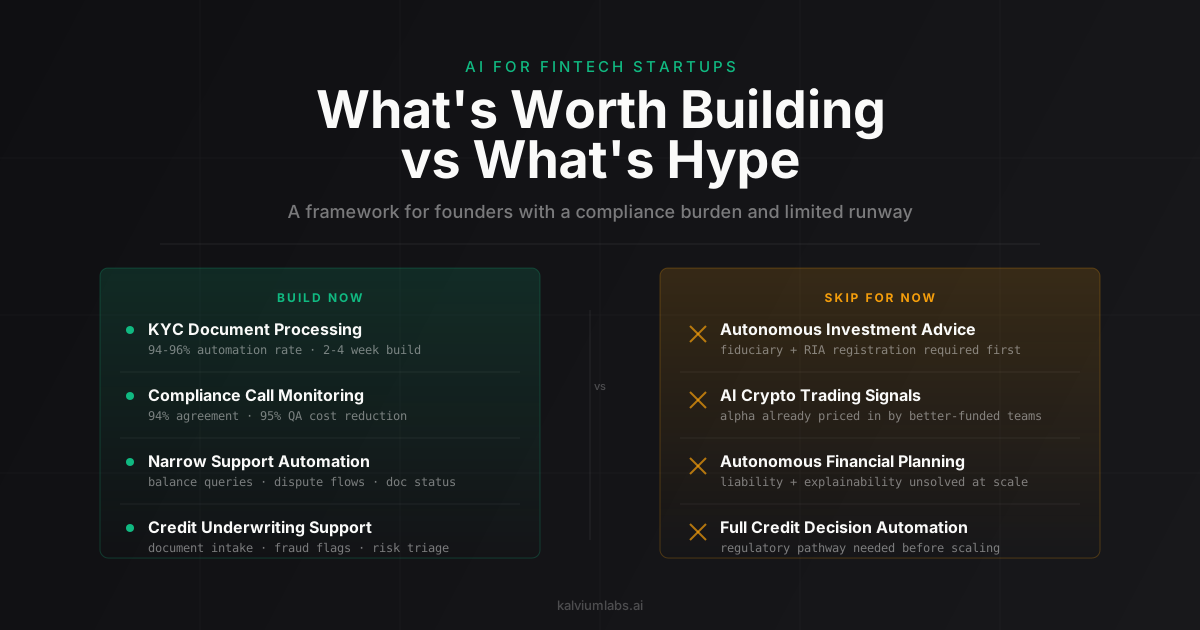
KYC and document processing.
Know-your-customer workflows consume hours in every fintech operation above a few hundred customers. ID verification, income documentation, business registration documents, address confirmation: the manual review cost scales linearly with customer volume, which is exactly the wrong cost structure when you’re trying to grow.
AI document extraction combined with a flagging system that surfaces anomalies for human review is the highest-ROI AI project for most early-stage fintech companies. It passes all three conditions cleanly. The data is internal (documents customers already submitted). The output criteria are explicit (does the extracted data match the source? does it clear the AML checklist?). The labor cost compounds with scale.
A few specifics that matter in production: multi-model extraction outperforms single-model approaches when document formats vary (different country IDs, scanned vs photographed documents, varying field layouts). We’ve found that combining AWS Textract for structured extraction with a custom LLM validation layer to check cross-field consistency (does the DOB on the ID match the DOB in the application?) reduces the error rate substantially compared to either approach alone. We’ve run this stack in production: the exception rate sits around 4-6% of documents, meaning 94-96% go through without human review.
Compliance monitoring and call quality assurance.
If your product involves sales conversations, customer support calls, or any regulated financial communication, you probably have a compliance rubric that humans are meant to apply to those interactions. Most fintech companies apply it to 1-5% of calls because reviewing every call manually is cost-prohibitive. AI can apply it to 100%.
We’ve built this specific system for a compliance-heavy financial services context. The production numbers: 94% agreement with human reviewers on a multi-point rubric, deployed in two weeks, with QA labor dropping by roughly 95%. The build worked because the rubric was the training spec. There was no judgment involved, only application of a written standard.
The same pattern holds for marketing compliance review. Financial promotions regulation requires promotional copy to pass specific checks before publication. AI review against a documented checklist is faster and more consistent than manual review, and it creates an audit trail that regulators actually appreciate.
Narrow-scope customer support automation.
Generic financial chatbots have a bad reputation, and most of it is earned. “Our AI assistant can help you with anything” fails in fintech because the surface area of “anything” is too wide to handle reliably.
Narrow-scope support automation works: account balance queries, transaction dispute initiation, document submission status, product eligibility checks. In our builds, we scope these to 5-8 intent categories maximum at launch. These are retrieval tasks with deterministic answers from your product data. The risk is scope creep: a limited support bot gets asked to handle edge cases it wasn’t designed for, the team adds capabilities without the compliance review, and three months later the bot is doing things nobody intended. Define the scope explicitly at build time and build a clean escalation path to a human agent for anything outside that boundary.
Where the Hype Lives
“AI-powered investment advice”
Consumer investment advice has fiduciary and regulatory implications that vary by jurisdiction and product type. Building AI that delivers personalized investment recommendations to US retail consumers without the right registrations is a regulatory problem, not a technology problem. The companies doing this credibly (Betterment, Wealthfront) are registered investment advisors with compliance teams, years of regulatory history, and significant legal infrastructure. If this is your product direction, the compliance infrastructure is the actual build. The AI is the easier part.
AI trading signals for retail crypto
The hypothesis: large models trained on market data, social signals, and on-chain activity should outperform simple momentum strategies. The reality: if this worked consistently, the teams with 100× your data budget and compute resources would already have captured the alpha. Startups selling AI trading signals to retail investors are mostly selling the appearance of edge, not the substance of it. This isn’t a product category worth building unless you have a genuinely novel proprietary data source that isn’t already priced into the market.
Autonomous financial planning agents
The demos look compelling. The agent reads your spending, analyzes your goals, builds a financial plan, rebalances accordingly. The failure modes are consequential in ways that current AI agent architectures don’t handle reliably: wrong advice stated confidently, state-specific tax implications not flagged, timing recommendations not aligned with a client’s actual liquidity situation. The regulatory, liability, and data portability dimensions aren’t solved at scale yet. This is a 2027-2028 product category, not a 2026 one. The infrastructure layer (clean financial data pipelines, compliance monitoring, explainable decisions) is what’s worth building now as the foundation.
Build vs Buy vs Wait
| Use Case | Build | Buy | Wait |
|---|---|---|---|
| KYC document extraction (standard) | - | ✓ Onfido, Persona | - |
| KYC with proprietary compliance standards | ✓ | - | - |
| Compliance call monitoring (custom rubric) | ✓ | - | - |
| Compliance call monitoring (standard contact center) | - | ✓ Observe.ai, Gong | - |
| Full credit risk ML model | - | ✓ Zest AI (for established lenders) | - |
| Credit underwriting support tools | ✓ | - | - |
| Customer support chatbot (narrow scope) | ✓ | ✓ Intercom AI | - |
| Transaction categorization | - | ✓ Plaid, Finicity | - |
| Consumer investment advice | - | - | ✓ regulatory pathway first |
| Autonomous financial planning agents | - | - | ✓ 2027+ |
The build column makes sense when your compliance rubric is proprietary enough that generic tools won’t match, your data can’t move to a third-party cloud for compliance reasons, or the cost-at-scale math for a SaaS subscription has crossed the build-and-own break-even. In our experience, that break-even usually sits around $2,000-3,000 per month in subscription fees, which for most seed-stage fintechs is still a few years out.
For a fuller treatment of the build vs buy decision across different scenarios, the build vs buy framework we published earlier covers the generic version. Fintech adds one variable that most other sectors don’t: the regulatory timeline.
The Regulatory Clock
Timing matters more in fintech than in most sectors because regulatory compliance isn’t retroactive. A feature that’s acceptable in a closed beta pilot may require licenses, registrations, or explicit consumer disclosures before you can take it to full production.
Pre-product-market-fit: Build AI into your operations first (KYC automation, compliance monitoring, internal support triage). Don’t build AI into customer-facing financial decisions until you’ve mapped the regulatory pathway for your specific product and jurisdiction. We’ve seen founders skip this step and spend six months undoing customer-facing features that turned out to require licenses they didn’t have.
Post-PMF, around Series A: Now you have the volume to justify more complex builds (credit decisioning support, personalized product recommendations) and the team to manage the compliance overhead. This is when the full fraud detection stack, custom risk models, and investment-adjacent features become worth the investment.
If you’re at seed stage and investors are pushing for autonomous financial AI features, ask specifically which regulatory pathway they think you’re on. The CFPB’s guidance on AI in lending decisions and the OCC’s guidance on model risk management are the two regulatory documents that matter most for US fintech founders building AI into financial decisions. Worth reading before committing to a product roadmap.
FAQ
How much does it cost to build AI for a fintech startup?
Targeted operations automation (KYC document processing, compliance call monitoring, support triage) typically runs $5,000-15,000 over 2-6 weeks. Custom fraud detection or credit underwriting support with model validation runs $20,000-50,000 over 2-4 months. Budget separately for legal counsel if your product influences financial decisions for consumers.
Do we need to disclose when AI is making decisions about customers?
Yes, in most jurisdictions for most categories. US ECOA and FCRA requirements apply to AI-assisted credit decisions, and EU GDPR includes a right to explanation for automated decisions that materially affect individuals. Get legal guidance before you deploy anything customer-facing in a regulated financial product area, not after.
Should we build credit decisioning AI now or wait until Series A?
Wait, unless you’re limiting it to pre-decision support tools (document intake, fraud flags, risk triage). Full credit risk ML models require regulatory pathways, fair lending compliance, and model validation infrastructure that seed-stage teams rarely have the bandwidth to manage correctly. Build the foundation now, ship the decision layer post-PMF when you have the compliance team to own it.
How do we handle model explainability requirements from regulators?
Treat explainability as a design constraint from day one: regulators don’t require full model transparency, but they do expect you to explain what inputs drove a decision in plain language. This pushes toward interpretable architectures for high-stakes decisions (simpler feature-based models over deep learning for credit scoring, rule-based filters with LLM secondary review over pure LLM for fraud flagging).
How long does it take to see ROI from a fintech AI build?
For operations automation (KYC processing, compliance monitoring), ROI is measurable from week two or three of production: hours saved per week is directly observable. For revenue-impacting builds (fraud reduction, credit support), the measurement window runs 60-90 days to accumulate enough volume to compare against a baseline.
Working through what’s worth building in your fintech product right now? Book a 30-minute call. We’ll walk through your specific use cases, tell you honestly where the regulatory traps are, and give you a realistic timeline and cost for the builds that make sense at your current stage.