Every technology ecosystem follows the same growth sequence. Government policy opens the door. Capital walks through. Talent follows the capital. Companies follow the talent. Then it all compounds.
Silicon Valley had DARPA and Stanford in the 1960s. Bangalore had India’s IT liberalization in the 1990s. Shenzhen had Special Economic Zones in the 1980s. Same pattern, different geographies, same result: a flywheel that took a decade to start but became self-sustaining once the four inputs (policy, capital, talent, companies) reached critical mass.
Dubai and Riyadh are in that sequence right now, specifically for AI. And they’re moving faster than any previous cycle because they don’t need to build foundational infrastructure from scratch. The models exist. The cloud regions are expanding. What the Gulf is building is the application layer on top, and the capital environment to accelerate it.
What’s Actually Happening in Gulf AI
The numbers are concrete, not aspirational.
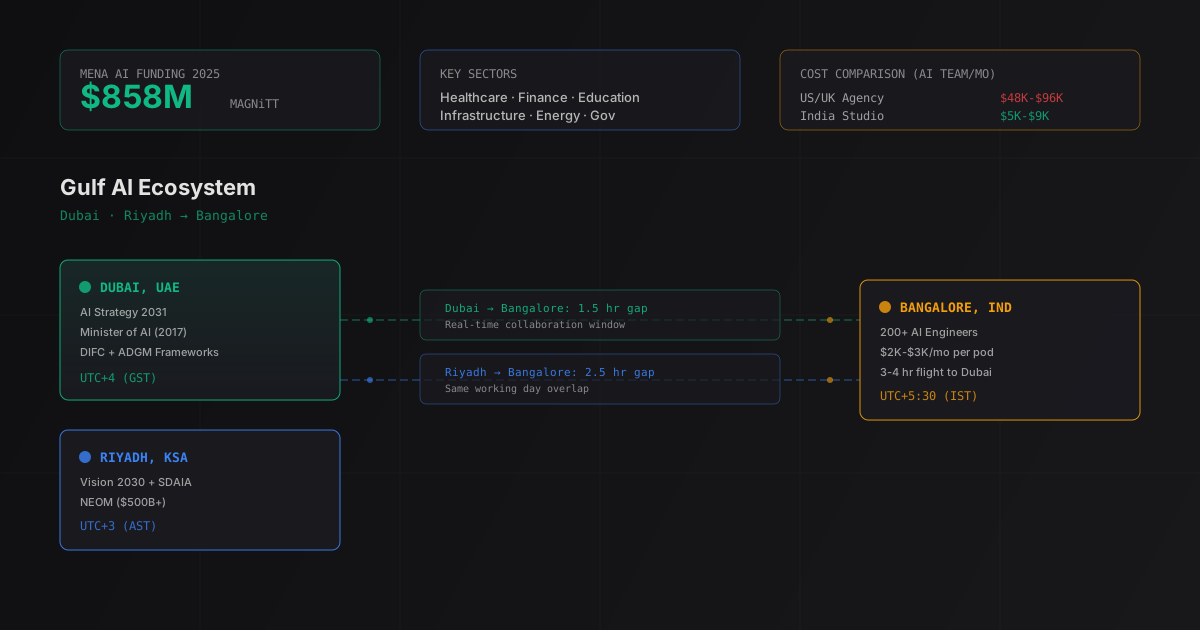
MENA AI funding reached $858M in 2025, according to MAGNiTT’s annual venture data. The bulk of that capital landed in UAE and Saudi Arabia. That’s not a rounding error. It’s a real funding market with a growth trajectory that looks nothing like the flat lines of 2020-2022.
But the policy infrastructure matters more than the funding numbers, because policy precedes capital in every ecosystem cycle.
| Country | Key AI Initiative | Governing Body | Focus Areas |
|---|---|---|---|
| UAE | National Strategy for AI 2031 | Office of AI (Minister: Omar Sultan Al Olama, appointed 2017) | Healthcare, transport, energy, education |
| Saudi Arabia | Vision 2030 + National Data & AI Strategy | SDAIA (Saudi Data and AI Authority) | Smart cities (NEOM), finance, government services |
The UAE became the first country to appoint a dedicated Minister of State for AI. That’s not symbolic. It produced tangible regulatory frameworks through DIFC and ADGM that make it possible for AI startups to operate, raise capital, and process data within clear legal boundaries.
Saudi Arabia’s SDAIA isn’t just a policy body. It runs national AI competitions, publishes Arabic language datasets, and coordinates AI procurement across government ministries. NEOM, whatever you think of its timeline, is a $500B+ smart city program with AI infrastructure as a core pillar.
What does this mean if you’re a founder?
Two things. First, there’s government demand for AI products. Not theoretical demand. Procurement budgets exist for AI solutions across healthcare, education, finance, and infrastructure. Second, venture capital is following the government signal. Funds like Hub71 (Abu Dhabi), Flat6Labs, and STV are actively backing AI-first startups. The check sizes tend to be smaller than US Series A rounds, but the competitive density is also lower. Fewer startups chasing similar capital means faster decisions and less noise.
What’s Different About Building AI for the Gulf
Here’s where the generic narrative falls apart. Building AI products for Gulf markets isn’t the same as building for US markets with an Arabic translation layer. The differences are structural, and they affect architecture decisions, not just marketing copy.
Arabic NLP is harder than most teams expect. Modern LLMs handle Arabic significantly better than they did two years ago. GPT-4o and Claude 3.5 both produce decent Arabic output. “Decent” is the key word. For high-stakes applications (legal document analysis, medical records, financial compliance), Arabic processing still requires more prompt engineering, more evaluation, and more domain-specific testing than equivalent English applications. Dialectal Arabic (Gulf Arabic vs Egyptian vs Levantine) adds another layer entirely. If your AI product needs to process real Arabic text from real Gulf users, budget 20-30% more evaluation time than you’d spend on an English-only build.
Data residency isn’t optional. UAE and Saudi Arabia both have data localization requirements for certain categories of data, particularly in healthcare, finance, and government. This affects which cloud regions you can deploy to and which model APIs you can call. As of early 2026, Azure has regions in UAE and Saudi Arabia. AWS has a region in Bahrain. GCP has announced a Saudi Arabia region but availability varies by service. If your architecture assumes you can call an API endpoint in us-east-1 and return results to a user in Riyadh, check the regulatory requirements first.
Bilingual UX is the baseline, not a feature. Most Gulf AI products need to work in both Arabic and English, often within the same session. A user might type a query in English and expect Arabic output, or switch languages mid-conversation. This isn’t just a translation problem. It’s a UX architecture problem that affects prompt design, response formatting, and how you structure your evaluation pipeline. Right-to-left rendering in mixed-language interfaces is its own category of engineering work.
The local AI talent pool is thin. Gulf countries have invested heavily in AI education. MBZUAI in Abu Dhabi is a serious research institution. But the supply of engineers who’ve shipped production AI systems, people who’ve debugged a RAG pipeline at 2 AM when embeddings started returning garbage, is still limited. This is the single biggest reason Gulf startups look outside the region for development partners. The ideas and the capital are local. The engineering capacity often isn’t.
The Three Partner Models for Gulf Startups
When Gulf founders look for an AI development company, the options fall into three categories. Each has specific trade-offs for this market.
| Model | Typical Cost | Timezone Gap to Gulf | Strengths | Weaknesses |
|---|---|---|---|---|
| US/UK agencies | $150-300/hr | 8-11 hours | Deep AI expertise, strong portfolios | Expensive, timezone makes daily collaboration difficult |
| Local Gulf agencies | $100-200/hr | 0 hours | Same timezone, cultural alignment | Small talent pool, AI-specific depth varies widely |
| India-based AI studios | $2K-3K/mo per pod | 1.5-3.5 hours | Cost-effective, large talent pool, deep AI engineering | Requires clear communication cadence |
The timezone numbers deserve attention. Dubai (GST, UTC+4) to Bangalore (IST, UTC+5:30) is a 1.5-hour difference. Riyadh (AST, UTC+3) to Bangalore is 2.5 hours. Compare that to Dubai-New York at 8-9 hours or Dubai-San Francisco at 11-12 hours.
That 1.5-hour gap means real-time collaboration during normal working hours. Sprint demos at 5 PM Gulf time happen at 6:30 PM India time. Slack messages sent at 9 AM in Dubai arrive at 10:30 AM in Bangalore. There’s no “we’ll pick this up tomorrow” delay that kills velocity on US-Gulf partnerships.
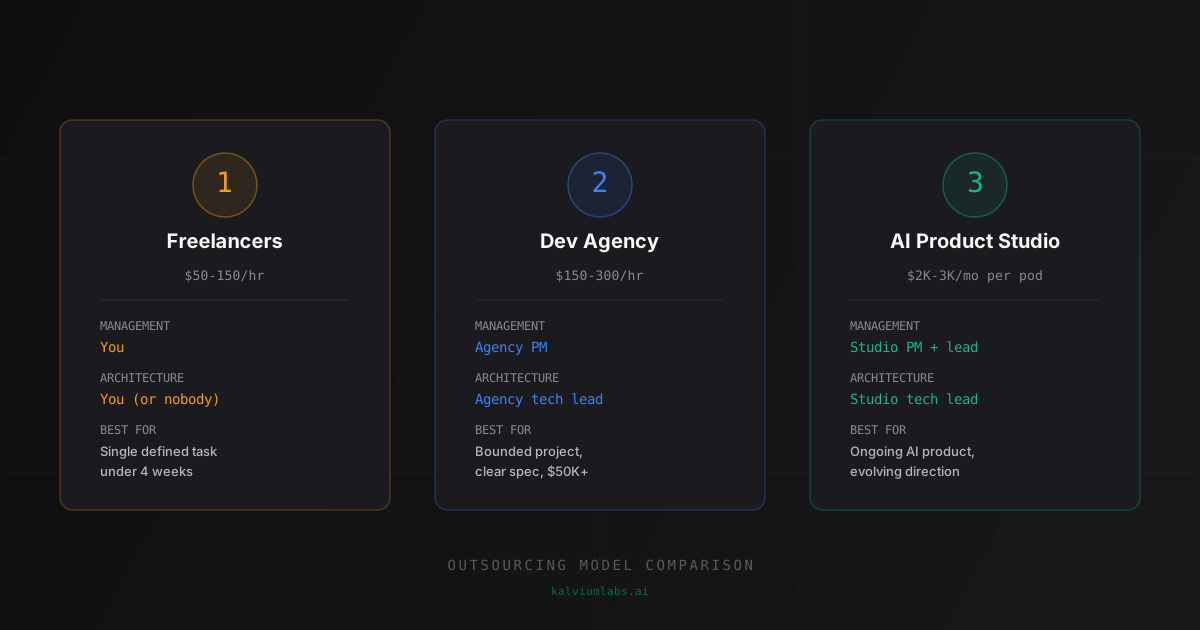
For a detailed breakdown of how these outsourcing models compare beyond the Gulf context, the full comparison of studios vs agencies vs freelancers covers the structural differences and failure patterns of each.
Why India-Based Studios Fit the Gulf Best
I’ll be transparent about the conflict of interest: we’re an India-based AI product studio, so weigh this section accordingly. That said, the structural advantages are real and they’re not unique to us.
Cost arbitrage that isn’t a quality gap. A senior AI engineer in Dubai typically commands AED 35,000-50,000 per month ($9,500-$13,600), based on regional hiring data we’ve seen across Gulf job markets. An equivalent engineer in Bangalore, working in a supervised studio environment with PM and architecture oversight, costs $2,000-$3,000 per month as part of a pod. The delta isn’t about skill. It’s about cost of living. The engineer in Bangalore works with the same stack: Python, PyTorch, LangChain, vector databases, production deployment on AWS and Azure.
Existing commercial relationships. India and the Gulf have deep, long-standing trade corridors. The cultural comfort level is high. Travel is a 3-4 hour flight from Bangalore to Dubai. These seem like soft factors until you’re three months into a project and need a face-to-face architecture review on short notice.
Scale when you need it. Gulf startups often need to move from prototype to production faster than their US counterparts because market windows are shorter and competition is ramping quickly. An India-based studio with 200+ AI engineers can go from a 2-pod prototype to a 4-pod production build in the same sprint cycle. Try doing that with local Gulf hires when the talent pool is constrained.
At Dubai AI Week 2025, we were recognized as a Top 5 AI Startup. That wasn’t an accident. It was the result of building multiple AI products for Gulf-based clients and demonstrating what a supervised engineering model from India can deliver for this market.
How to Evaluate Any AI Development Company (Gulf Edition)
If you’re a founder in Dubai or Riyadh evaluating AI development partners, five questions separate real capability from a good sales deck.
1. Can you show me something working in 72 hours?
Not a proposal. Not a Figma mockup. A working prototype against your actual problem. Any AI development company that needs 4-6 weeks of paid discovery before they can show you something running either lacks the talent depth or is optimizing for billable hours over speed.
2. Who makes the technical decisions on my project?
Ask for a name and a background. “Our team lead will handle it” isn’t an answer. You want to know: who decides between RAG and fine-tuning? Who picks the model? Who designs the prompt architecture? If that person is a project manager with no engineering background, keep looking.
3. How do you handle Arabic language requirements?
This is the Gulf-specific filter. If the answer is “we’ll add Arabic later” or “the model handles it natively,” the team hasn’t built for Gulf markets before. Arabic requires specific evaluation pipelines, prompt engineering for dialectal variation, and UX patterns for RTL rendering in mixed-language interfaces. Ask for a concrete example.
4. Where will my data be stored and processed?
For regulated industries in UAE and Saudi, this isn’t optional. The development company should know which cloud regions comply with your data residency requirements and architect accordingly from day one. If they look surprised by the question, they haven’t worked with Gulf clients before.
5. What does a sprint cycle look like?
You want weekly demos, not monthly reports. You want direct access to the engineer building your product, not communication filtered through three layers. The best AI development partnerships feel like the team is in the next room, even when they’re in another country.
The Window Is Open. It Won’t Stay Open Forever.
Here’s the honest assessment. The Gulf AI market is in an early-mover window. Government spending is active, competition is relatively thin compared to the US, and the ecosystem is looking for solutions, not just strategy decks.
That window has a timeline. Google Cloud, Microsoft Azure, and AWS all expanded their Gulf presence in 2024-2025. More AI companies are establishing regional offices. As local competitive density increases, the advantage of being early, of having client relationships, deployed products, and real usage data, becomes the moat.
If you’re a Gulf founder sitting on an AI product idea, the cost of waiting isn’t zero. Every month of delay is a month where someone else is building for the same market, with the same models, targeting the same users.
The question isn’t whether AI products will get built for Gulf markets. They will. The question is whether you’ll be the one building them.
FAQ
Is the Gulf a good market for AI startups in 2026?
Yes, specifically for applied AI rather than foundational model research. UAE and Saudi Arabia have active government procurement programs for AI solutions in healthcare, education, finance, and infrastructure. MENA AI funding reached $858M in 2025, and the competitive density is lower than in the US. The combination of real demand, available capital, and limited local competition makes this one of the stronger markets for AI product companies right now.
What are the biggest challenges building AI products for Gulf markets?
Three structural challenges stand out. Arabic NLP requires significantly more evaluation and prompt engineering than English for high-stakes applications like legal, medical, and financial processing. Data residency regulations in UAE and Saudi Arabia constrain which cloud regions and APIs you can use, so architecture decisions need to account for compliance early. And bilingual UX (Arabic + English, often mid-session) requires specific design patterns and RTL rendering work that most US-focused AI products don’t address.
How much does it cost to build an AI product for the Gulf market?
Development cost depends on the partner model. US/UK agencies charge $150-300/hr, putting a 3-month project at $144K-$288K. Local Gulf agencies charge $100-200/hr with varying AI depth. India-based AI studios charge $2K-$3K/month per pod, putting a full AI team at $5K-$9K/month. Infrastructure costs (model API calls, compliant cloud hosting, evaluation pipelines) are similar regardless of who builds the product. Budget 20-30% more for Arabic language features compared to English-only builds.
Do I need a local office in the Gulf to sell AI products there?
Not at the early stage. Remote partnerships work well thanks to the timezone overlap between South Asia and the Gulf (1.5-3.5 hours). What you do need is someone who can attend in-person meetings for enterprise sales and government procurement. Many startups solve this with a local BD representative or a co-founder who travels to the Gulf regularly, rather than a full office. A local presence becomes more important as you scale past the first few clients and need ongoing relationship management.
How do I find an AI development company that understands Gulf markets?
Three qualifying questions filter fast. First: have you built anything with Arabic NLP? If yes, ask to see the evaluation pipeline and results. Second: do you know the data residency requirements for UAE and Saudi Arabia? If they can name specific regulations (PDPL in Saudi, UAE’s frameworks under DIFC and ADGM), they’ve done this before. Third: can you show me a working prototype in 72 hours? Speed of execution is the best proxy for actual capability. Companies that need weeks of discovery before building anything are optimizing for their billable hours, not your timeline.
Building an AI product for the Gulf market? Book a 30-minute call. We’ll tell you whether your idea can be prototyped in 72 hours and what the Gulf-specific architecture considerations look like for your use case.