The hourly rate is the worst way to compare AI development partners. It’s also the first number every founder asks for.
A freelancer at $75/hour looks cheaper than an agency at $200/hour, which looks cheaper than a product studio at whatever-their-monthly-rate-is. The comparison feels straightforward. It isn’t.
I’ve had this conversation with founders at least forty times over the past year. Someone will say “we found a freelancer who can do it for half the agency’s price” and my first question is always the same: do the math on total project cost, not hourly rate.
The hourly rate is the line item. The total cost includes coordination, rework, context loss, decision delays, and the opportunity cost of your own time managing the work. Those numbers are where the three models actually diverge.
This post breaks down AI product studios, dev agencies, and freelancers as outsourcing options for AI development. Not theory. Real costs, real failure modes, and a framework you can use this week.
The Three Models at a Glance
Before diving into specifics, here’s the structural difference.
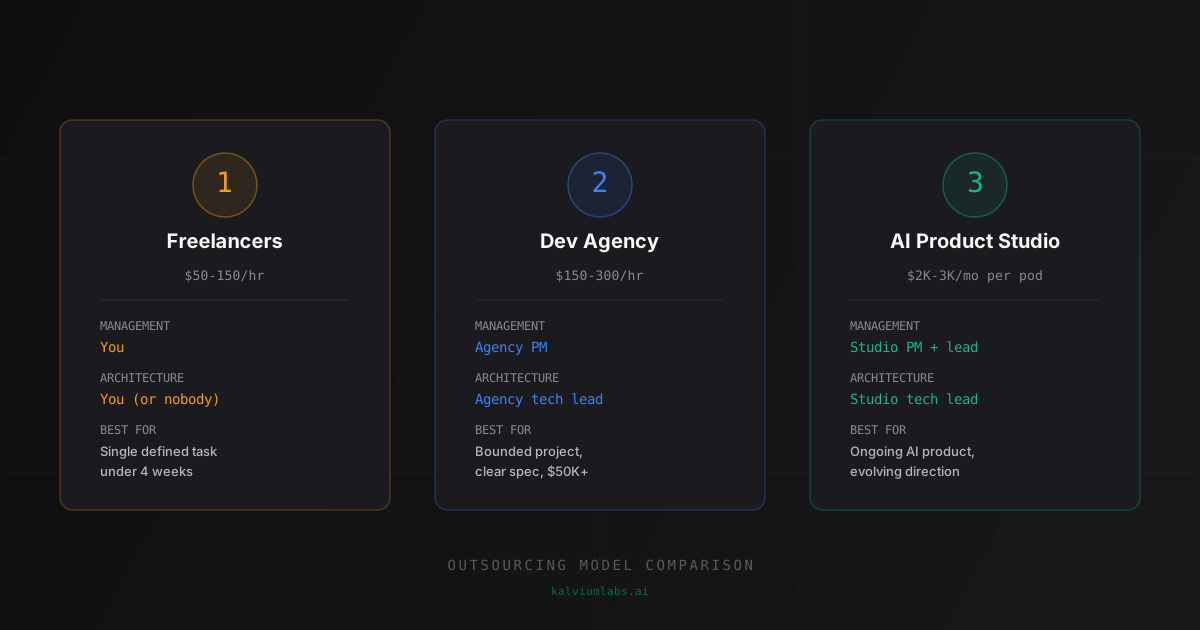
Freelancers are individuals you hire directly. You find them on Upwork, Toptal, your network, or LinkedIn. You manage them. You define the scope, review the work, and coordinate between multiple freelancers if the project needs more than one skill set.
Dev agencies are companies that sell you a packaged team. You scope a project, sign a contract, and they assign engineers. They manage the team internally. You get a project manager or account manager as your point of contact.
AI product studios are a hybrid. You get a dedicated pod of engineers working on your product, supervised by senior technical leadership at the studio, at a monthly retainer. The studio handles architecture, PM, and quality. You’re involved in product decisions, not day-to-day engineering management.
Same goal (AI product gets built), very different operating models. And the cost differences matter less than the structural ones.
Freelancers: The Economics of Going Direct
The appeal is obvious. No agency markup. No studio overhead. You’re paying an engineer directly for their time.
Market rates for AI/ML freelancers range from $50 to $150 per hour depending on experience and geography. A senior freelancer with production LLM experience on Toptal runs $100 to $150/hour. Mid-level freelancers on Upwork range from $50 to $90/hour. Those numbers are real and current as of early 2026.
For a single, well-defined task, this works. “Build me a RAG pipeline over these 500 documents using LangChain and pgvector, deployed on AWS Lambda.” One person, one skill set, clear inputs and outputs. A good freelancer can do this in 2 to 3 weeks for $4,000 to $9,000. Hard to beat that economics.
Here’s where it breaks.
The coordination tax. Most AI products aren’t one-person jobs. You need at minimum an AI/ML engineer, a backend engineer, and a frontend engineer. Maybe a data engineer if the pipeline is complex. The moment you have three freelancers, you become the project manager. Every architecture decision routes through you. Every integration question is a Slack thread between people who’ve never worked together.
That coordination overhead adds 30 to 40% to the actual project timeline in my experience. A project that should take 6 weeks takes 8 to 9. Not because any individual freelancer is slow, but because nobody owns the system-level thinking.
The disappearing freelancer. This happens more often than founders want to believe. You’re four weeks into a project, the freelancer takes another gig, and availability drops from 30 hours a week to 12. Or they go silent for three days. You have no leverage and no backup. Your project just stalled, and the only option is to find someone new and pay the ramp-up cost again.
The handoff gap. Freelancers optimize for their deliverable, not your system. The code works in isolation but doesn’t integrate cleanly because nobody was thinking about the full architecture. You end up spending 2 to 3 weeks after the freelancer leaves, cleaning up integration issues with your own team or a different freelancer who has to read the first person’s code.
When freelancers are the right call: A single, bounded task with clear specs. A proof-of-concept that one person can build in under 4 weeks. An audit or review of existing AI code. Anything where you don’t need a team and you have the technical ability to specify the work clearly and evaluate the output.
Dev Agencies: The Packaged Team
Agencies solve the coordination problem by packaging engineers into a managed team. You don’t hire three people and manage them yourself. You hire one company that assigns three people and manages them for you.
US-based AI development agencies charge $150 to $300 per hour. A typical AI project engagement (3 engineers, 3 months) runs $144,000 to $288,000 based on 160 hours per month per engineer. Offshore agencies price at $25 to $75 per hour, with the expected trade-offs in communication, timezone overlap, and quality variance.
The agency model works well for specific project shapes.
The defined-scope build. You know what you want. You can write a requirements document that an engineer would find sufficient. The project has a clear start, a clear end, and a defined handoff. Example: “Add an AI-powered document summarizer to our existing SaaS product, integrated with our S3 storage and user authentication.” An agency can scope that in a week and deliver it in 6 to 8 weeks.
The regulated build. Agencies that specialize in healthcare, fintech, or legal AI come with domain knowledge your freelancers won’t have. That domain premium is worth paying.
Here’s where agencies struggle.
The exploration problem. “Build us an AI product that makes our sales team more effective” is not an agency-friendly brief. Agencies are structured for execution, not discovery. They’ll happily run a 4-to-6-week discovery phase at $150/hour and produce a proposal. But that discovery is a revenue model for the agency, not a methodology that benefits you. A team that’s built 20 AI products should be able to assess your problem and propose an approach in a week, not six.
The handoff cliff. Agency projects end. The team that built your product moves to another client. Knowledge leaves with them. If your internal team can maintain the codebase, this is fine. If you don’t have an internal team (common at the seed stage), you’re stuck. The agency knows this, which is why maintenance retainers exist. Whether that retainer is worth the cost depends on how often you need changes.
The account manager buffer. At most agencies, your primary contact is a project manager or account manager, not the engineer doing the work. Questions go through a layer. Context gets lost. Decisions take 24 to 48 hours that should take 20 minutes. Not universal, but common enough that you should ask during sales: “Can I talk directly to the technical lead assigned to my project?”
For a deeper look at how to evaluate whether a development agency actually knows AI (versus having added “AI” to their services page last year), start with agency reviews on Clutch and read how to choose an AI development company for the five-question evaluation process.
When agencies are the right call: Well-defined projects with a clear scope document. Builds where you have an internal technical team to own the code after handoff. Projects with regulatory requirements that benefit from specialized agency experience. Budgets of $50,000 or more for a specific, scoped engagement.
AI Product Studio: The Dedicated Pod
The product studio model is newer, which means it’s less understood. The quality variance across studios is enormous. “AI product studio” can mean a five-person boutique with ex-FAANG engineers or a rebadged offshore agency with a better website. The label tells you nothing. The operating model tells you everything.
The core structure: you get a dedicated pod of engineers working on your product at a monthly rate. The pod is supervised by a senior technical lead at the studio. A PM handles sprint planning, client communication, and delivery coordination. Your engineers aren’t context-switching between five clients. They’re building your product.
At Kalvium Labs, our pod pricing is:
| Pod Type | Monthly Cost |
|---|---|
| Frontend | $1,999/month |
| Full-Stack | $2,499/month |
| AI / Mobile | $2,999/month |
A typical AI product runs 2 to 3 pods: $5,000 to $9,000 per month. That’s $60,000 to $108,000 per year for a full engineering team, including PM and architecture oversight. For context, that’s less than one mid-level US engineer’s total compensation.
What makes this different from an agency?
Three structural differences. First, the relationship is ongoing, not project-based. The team building your product in month one is the same team in month six. Context compounds instead of dissipating at handoff. Second, you’re working with the technical leadership directly, not through an account manager. When we say every project is supervised by Anil Gulecha (ex-HackerRank, ex-Google), you can talk to Anil directly. Third, the engagement is flexible. Scale up to four pods during a sprint push. Scale back to one pod during a planning phase. You don’t pay for capacity you’re not using.
The 72-hour prototype model sits at the front of studio engagements. Before committing to a monthly retainer, you see something working. Not a wireframe. Not a proposal. A working prototype running against your actual problem. That changes the risk calculation entirely. You’re not committing $50,000 on faith. You’re committing based on evidence.
When studios work best: Seed to Series A startups building an AI product over months, not shipping a one-off feature. Founders without internal AI engineering teams. Situations where the product direction is still evolving and you need a partner who can adapt weekly, not just execute a fixed spec.
When studios don’t fit: One-off, well-defined projects with a clear end date (agency is better for that). Single-task builds that one person can handle (freelancer is better). Companies that need 24/7 on-call coverage or deep integration with internal security infrastructure (full-time hires are better for those requirements).
If you’re weighing the studio model against building an in-house team specifically, our comparison of full-time vs agency vs studio goes deeper on that decision.
The Hidden Variable: Who Manages the Work?
Every outsourcing model has a management surface area. The question is who covers it.
| Model | Who manages engineers? | Who owns architecture? | Who handles coordination? |
|---|---|---|---|
| Freelancers | You | You (or nobody) | You |
| Agency | Agency PM | Agency tech lead | Agency PM |
| Product Studio | Studio PM + tech lead | Studio tech lead | Studio PM |
If you’re a non-technical founder, the freelancer model requires you to manage people whose work you can’t fully evaluate. That’s a risk most founders don’t price in until they’re three months deep and unsure whether the code is actually good.
If you’re a technical founder with 10 hours a week to spare, freelancers can work. But those 10 hours are hours you’re not spending on fundraising, customer conversations, product strategy, or closing deals. The opportunity cost is real even if it doesn’t appear on any invoice.
The agency and studio models externalize management. The difference between them is continuity: agencies manage for the duration of a project, studios manage for the duration of a relationship.
The Decision Framework
Here’s how I’d map the choice to your situation.
| Your situation | Best model | Why |
|---|---|---|
| One defined task, under 4 weeks, you’re technical | Freelancer | Cheapest, fastest, you can manage the scope |
| Defined project, $50K+ budget, clear spec, internal team to maintain | Agency | Packaged execution, clean handoff, done |
| Building a product over months, no internal AI team | Product studio | Ongoing team, architecture ownership, flexible |
| Need a prototype to validate an idea before committing | Studio (72-hr prototype) | See it working before committing budget |
| Compliance/regulated domain, enterprise requirements | Specialized agency | Domain expertise justifies the premium |
The mistake founders make most often: choosing based on hourly rate instead of total cost of ownership. A freelancer at $75/hour on a project that takes 9 weeks because of coordination issues costs more than a studio at $8,000/month that delivers in 6 weeks. The rate is lower. The project cost is higher.
What Actually Breaks in Each Model
Every model has a failure pattern. Knowing them in advance is worth more than the comparison table.
Freelancer failure pattern: You hire a strong AI engineer. They build a good prototype. You need a frontend, so you hire a second freelancer. Now you need them to integrate. Neither one designed for the other’s architecture. You spend two weeks mediating. The AI engineer gets another offer and drops to half-time. You’re now project-managing two people, context-switching constantly, and the prototype that was “almost done” three weeks ago still doesn’t have a working UI.
Agency failure pattern: The proposal looks great. The discovery phase produces a solid architecture document. Month two, the senior engineer on your project gets rotated to a bigger account. The replacement engineer needs two weeks of ramp-up. Your timeline slips by three weeks. The agency apologizes and offers a small discount on the next milestone. You accept because switching agencies mid-project is worse than a three-week delay.
Studio failure pattern: The first few months are productive. Then the product direction shifts significantly (as it does in most startups). The pod team is good at building what’s specified but slow to adapt when requirements change weekly. Sprint planning feels like overhead instead of progress. This usually means the studio’s PM isn’t experienced enough with early-stage product development, or the communication cadence needs adjustment. Fixable, but only if both sides flag it early.
None of these are guaranteed. They’re the patterns I’ve seen across dozens of conversations with founders who’ve tried each model. Knowing them helps you ask better questions before you sign anything.
The Crossover Points
A few rules of thumb for when to switch models.
Freelancer to studio: When the project grows beyond what one person can handle and you’re spending more than 8 hours a week managing the work yourself. That management time has a cost. If it’s eating into your core job as founder, it’s time to externalize it.
Agency to studio: When the first project ends and you realize you need ongoing development, not another scoped engagement. Signing a second 3-month agency contract at $150,000 when a studio would cost $27,000 for the same period is a math problem, not a strategy problem.
Studio to in-house: When you have product-market fit, the AI product is going to be central to your business for 3 or more years, and you have a technical leader who can hire, manage, and retain AI engineers. That’s typically Series B or later. Making that transition is a sign that the studio model worked: it got you to the stage where in-house makes sense.
FAQ
How much does an AI product studio cost compared to a dev agency?
AI product studios typically charge $2,000 to $3,000 per month per pod (one full-time engineer equivalent). A full AI team (2-3 pods) runs $5,000 to $9,000 per month. Dev agencies charge $150 to $300 per hour, so a 3-month project with three engineers costs $144,000 to $288,000. The studio model is significantly cheaper per month but designed for ongoing engagements. If you need a bounded 8-week build with a clean handoff, an agency’s project-based pricing may be simpler. If you’re building over 6 or more months, the studio model costs a fraction of the agency equivalent.
Can I start with a freelancer and switch to a studio or agency later?
Yes, and many founders do exactly this. The freelancer prototype validates the idea, then a studio or agency handles the production build. The transition cost is typically 1 to 2 weeks of the new team reading the existing codebase and deciding what to keep versus rebuild. Budget for that ramp-up time. The risk: if the freelancer’s code is poorly documented or architecturally inconsistent, the new team may recommend starting fresh. That means the freelancer investment was validation, not a head start on production.
What’s the difference between an AI development agency and an AI product studio?
Agencies are project-based: you define scope, they execute, they hand off. Studios are relationship-based: you get a dedicated team that builds your product over months, with architecture ownership and PM included. Agencies optimize for delivering a defined scope. Studios optimize for building the right product iteratively. The structural difference matters most when the product direction is still evolving, which is the reality for most seed-stage startups.
How do I evaluate whether an AI product studio is actually good?
Ask to see the technical lead’s work, not the company’s portfolio. Check their GitHub. Ask them to explain an architecture decision from a recent project and why they chose one approach over alternatives. Ask: “Who decides between RAG and fine-tuning on my project?” If the answer is an account manager, not an engineer, keep looking. A real studio should be willing to show you a working prototype before you commit to a retainer. If they want a 6-week paid discovery phase before building anything, that’s an agency in studio clothing.
Should a non-technical founder use freelancers for AI development?
Generally, no. Freelancers require you to specify work clearly, evaluate output quality, and manage integration between multiple contributors. Without technical expertise, you can’t do any of those confidently. A studio or agency provides the management layer you’d be missing. The exception: if you have a technical advisor who can review the freelancer’s work weekly, it can work for small, bounded tasks under 4 weeks. For building a product, you need a team that manages itself.
Trying to decide which model fits your AI product and budget? Book a 30-minute call. We’ll tell you honestly whether a studio engagement makes sense for what you’re building, or if a different model is the better fit for your stage.