We’ve had a version of this conversation with 30-something founders over the past year. The details vary; the shape doesn’t. They have a specific use case, a budget somewhere in the $5K-$50K range, and they’ve found a custom AI solution or a SaaS product that covers maybe 70% of what they need. Should they pay for the SaaS and configure their way to 100%? Or build something custom?
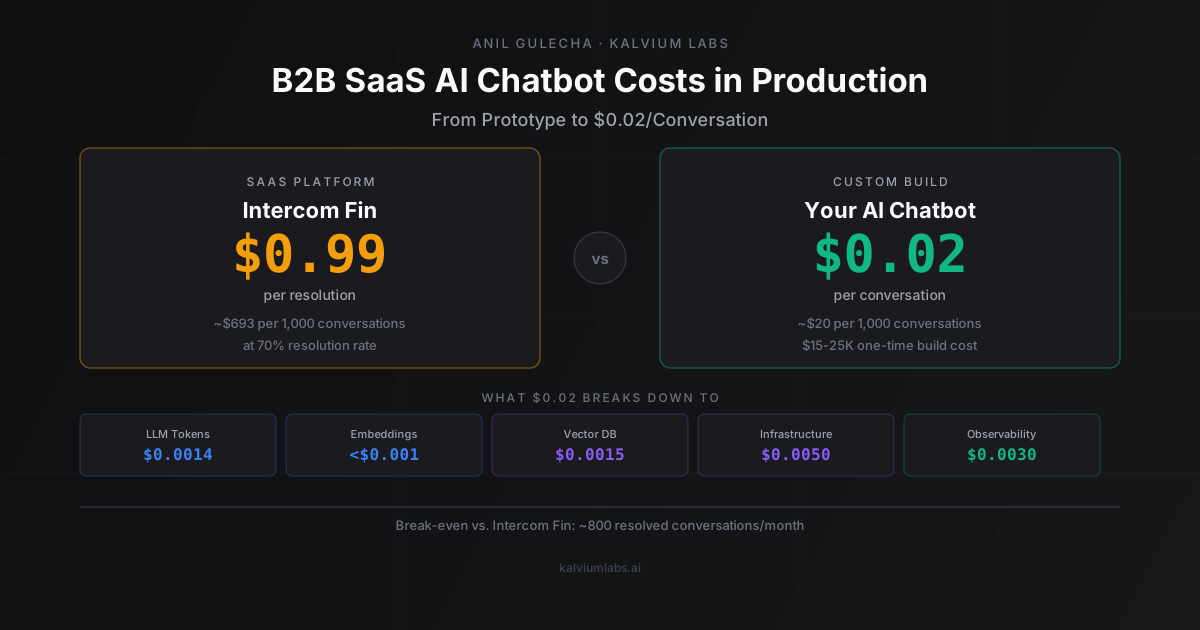
For more on this, read our guide on What a B2B SaaS AI Chatbot Costs in Production. The answer depends on five questions. Most founders answer two of them and skip the rest. We’ve worked through all five before every build-vs-buy recommendation we’ve given.
Why the $5K-$50K Range Is the Hardest to Reason About
Below $5K, SaaS almost always wins. The custom build cost doesn’t amortize fast enough, and the use case is usually well-served by an off-the-shelf option. Above $50K, the use case is typically complex or differentiated enough that SaaS doesn’t fit anyway, and the economics of custom are obvious.
The $5K-$50K middle is where the decision actually requires analysis. There’s a real cost model to run, real feature gaps to evaluate, and a real risk trade-off between build overhead and vendor dependency.
Here are the five questions we use.
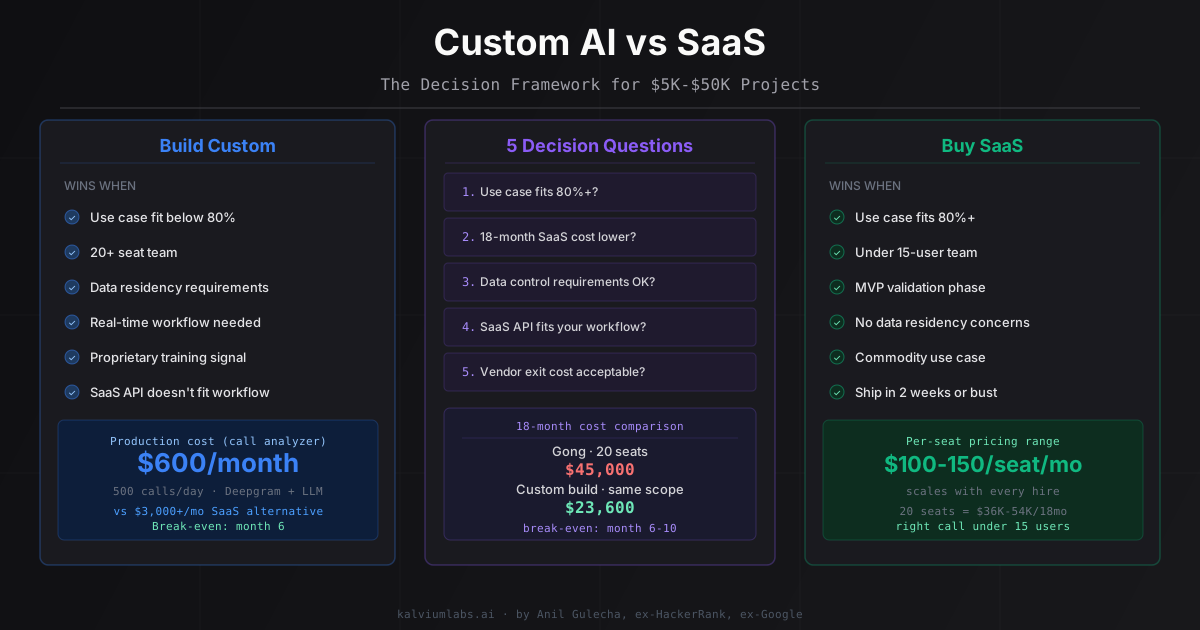
The Five Decision Questions
1. Use case fit: Does an existing product cover 80%+ of your actual requirements, not 80% of the marketing page claims?
2. Volume economics: At your projected call/query volume, does the SaaS cost exceed the custom build amortized over 18 months?
3. Data control: Do your data handling requirements conflict with the SaaS TOS, data residency policies, or training opt-out options?
4. Workflow integration: Does your workflow require real-time response, bidirectional state, or internal system integration the SaaS API doesn’t support?
5. Vendor risk: If the SaaS changes pricing, deprecates your tier, or gets acquired in the next 18 months, what’s the exit cost relative to your custom build cost?
Run these in order. Each one is a potential exit to “build” or “buy.” Most decisions land before question 5.
Use Case Fit: The 80% Line
SaaS AI products cover well-defined use cases well. Gong covers sales call intelligence for CRM-integrated teams. Intercom’s Fin covers support ticket deflection. Jasper covers marketing copy generation. If your requirements map to 80%+ of what one of these does out of the box, the configuration cost to close the gap is usually worth it.
The failure mode: founders assume configuration will close the gap when the product wasn’t built for their workflow at all.
We built a call compliance AI for an enterprise tech company whose requirements didn’t map to any existing product. Gong and Chorus score calls for sales coaching insights. They don’t score against custom regulatory language or flag specific misselling patterns against your own rubric. That gap isn’t configurable. Custom was the only path, and their specific rubric actually made the build cheaper: a targeted scoring model beats a general-purpose intelligence layer for a narrowly defined compliance problem. We shipped it in 2 weeks.
Our rule: if closing the gap requires changing how your team works to fit the SaaS rather than how the SaaS works to fit you, that’s your signal to evaluate custom.
There’s a second failure mode worth naming: founders who buy a SaaS, try to configure it for their use case, hit the 30% gap, hire a developer to fill it, and end up paying both the SaaS subscription and a developer indefinitely. That combination often costs more over 18 months than a focused custom build would have.
Volume Economics: The 18-Month Math
SaaS pricing models break into three categories with different break-even profiles:
Per-seat pricing. Gong runs $100-150/seat/month. For a 20-seat sales team: $2,000-3,000/month. Over 18 months: $36K-54K.
Per-API-call. Most AI APIs run $0.001-0.05 per call depending on model and use case. At 1,000 calls/day: 30,000 calls/month. At $0.01/call: $300/month.
Per-output. Content and analysis tools charge $50-200 per document or content output. At 50 outputs/month: $2,500-10,000/month.
Custom build costs look different:
- Initial build: $5K-$50K depending on scope (see the FAQ for how this breaks down)
- Ongoing infra: $100-500/month at startup scale for LLM tokens and hosting
- Maintenance: 1-2 engineering sprints per quarter for prompt updates, dependency upgrades, and monitoring
18-month comparison for a sales call analyzer (20-seat team). We ran this exact calculation before recommending custom for the Enterprise Tech Co. build:
| Option | Total (18 months) |
|---|---|
| Gong at $125/seat/month, 20 seats | $45,000 |
| Custom build ($20K build + $200/month infra) | $23,600 |
| Custom build ($15K build + $400/month infra) | $22,200 |
At 50 seats, the Gong number scales to $112,500. The custom build total stays near $23K, because infra costs don’t scale linearly with users.
That’s the core economic argument for custom at scale. The custom build’s 18-month cost barely changes with headcount. Per-seat SaaS pricing scales with every hire.
At 10 seats, the calculation flips. Gong at 10 seats is $22,500 over 18 months. A $20K custom build plus $200/month infra is $23,600. Not worth building at that scale, and you don’t have the usage signal yet to scope it correctly anyway.
Real numbers from our call compliance build: Deepgram Nova-2 for transcription at $0.04 per call, LLM scoring at per-call rates that put total infra at roughly $600/month at 500 calls/day. The SaaS alternative would have been $3,000+/month before hitting the compliance-rubric wall. Break-even was month 6.
Data and Integration Constraints
Two constraint types that are binary disqualifiers for SaaS regardless of feature fit:
Data control hard blocks. First: check whether the SaaS uses customer input for model training. Many consumer-grade AI tools and some B2B products do this under default TOS. If your queries or documents contain proprietary business logic, customer PII, or competitive positioning, verify the opt-out terms before you paste anything.
Second: if you have regulatory data residency requirements, check whether the SaaS offers a compliant hosting tier at your pricing level. Most don’t below enterprise tiers.
Third: if your proprietary data is the moat, putting it through a SaaS means giving the vendor your training signal. A content automation system we built uses keyword patterns and brand-voice calibration tuned to a specific audience and competitive positioning. Routing that through a general-purpose content tool would have commoditized the signal itself.
Workflow integration failures. “It has an API” doesn’t mean “it integrates with your workflow.” Before assuming integration is cheap, check: Does the webhook or callback model match your event-driven architecture, or do you need to poll? What’s the API latency SLA? If you need under 500ms for a real-time workflow, does the SaaS advertise that? What happens when their API is down?
For the call compliance build: every SaaS we evaluated required pushing completed recordings to their servers for async processing. Our client needed real-time flagging on live calls. That architecture gap wasn’t solvable with configuration.
We’ve seen this pattern enough times that we now build a short integration spike into our scoping process before committing to any SaaS dependency. The actual integration overhead usually emerges in sprint 2, after the vendor demo. Budget for it explicitly or you’ll discover it after you’ve committed.
Vendor Risk: The Costs You Don’t See in Year 1
Three things happen to B2B AI SaaS products over 18-24 months:
Pricing tier changes. The $49/month plan gets deprecated. The replacement “comparable” plan is $149/month. We’ve had two founder conversations specifically triggered by this: they’d built workflows around a SaaS tier that no longer existed, and neither had budgeted for the migration cost.
Underlying model changes. If the SaaS runs on an older model version, it’ll be updated as older versions get deprecated. That update changes output format, tone, sometimes reasoning quality. Downstream integrations that parse or display the output break. You get a Slack message from a confused user instead of a changelog from the vendor.
Acquisition or shutdown. B2B AI SaaS in the $50-200/month tier is still fragile. Tools that looked stable in 2023 have pivoted, been acquired at enterprise repricing, or shut down. If your product depends on their API, you’re one announcement away from an unplanned rebuild sprint.
Custom builds don’t eliminate these risks. They change who absorbs them. You control the model version. You control hosting. The exit cost from a bad situation is a migration sprint, not an emergency rebuild.
That’s not a minor distinction for a product where the AI layer is mission-critical.
The Hybrid Pattern: Cheaper Than Either Extreme
The most cost-effective path for most $10K-$30K projects is a combination: SaaS for commodity layers, custom for proprietary logic.
The call compliance example: Deepgram for transcription (SaaS), custom LLM scoring pipeline for compliance rubric evaluation (custom). Deepgram’s accuracy at $0.04 per call was better than building a transcription layer ourselves would have been. The custom scoring model was where the differentiation lived. Total infra at 500 calls/day: $600/month. All-custom-infra alternative would have run higher; all-SaaS alternative would have run $3,000+/month with a feature gap.
The content automation example: Astro plus Cloudflare for hosting and delivery (commodity), custom topic selection pipeline, quality gates, and SEO feedback loop (custom). The same architecture runs this blog at two posts a day with $0 in ad spend. The commodity hosting layer costs under $50/month. The value is in the custom logic on top, which is also why the impression curve keeps compounding over time.
On timeline: hybrid usually ships faster than pure custom. The commodity layer is done in a week. The custom piece is scoped to exactly what needs to be proprietary. We’ve shipped hybrid builds in 2 weeks where a pure-custom version of the same thing would have taken 6-8 weeks.
The pattern doesn’t always work. It fails when the “commodity” SaaS layer turns out to have its own integration complexity, or when the proprietary logic depends on guarantees the SaaS doesn’t provide. But for most use cases in the $10K-$30K range, it beats both extremes.
When SaaS Wins Outright
Worth saying directly: SaaS is often the correct answer. The cases:
- Use case fit above 80% and the gap is configurable, not architectural
- Pre-product phase, where you’re validating demand before the economics of custom are relevant
- Volume under ~300-400 calls/day, where the custom build cost doesn’t amortize in 18 months at realistic usage
- Data residency, security certifications, and pricing terms all work for your context
- You need to ship in 2 weeks and the custom scoping alone would take 4 days
The founder who shouldn’t build custom: one who’s building an MVP, has a $5K budget, and needs 4 features covered by a $29/month tool. Ship with the SaaS, validate the hypothesis, then evaluate custom when the 30% gap starts costing you revenue or compliance exposure. We tell founders this often, and they’re usually relieved to hear it.
The Decision Tree
Run this before the conversation gets emotional:
Step 1: Use case fit. Does an existing SaaS cover 80%+ of your actual requirements?
- No: evaluate custom.
- Yes: go to step 2.
Step 2: 18-month economics. At your projected volume, does the SaaS cost more than (build cost + 18 months of custom infra)?
- No: use the SaaS.
- Yes: go to step 3.
Step 3: Data and integration constraints. Do your data requirements or workflow architecture conflict with the SaaS?
- Yes: custom or hybrid.
- No: go to step 4.
Step 4: Vendor risk. Would a pricing change, model update, or shutdown require an emergency rebuild?
- Yes: compare the expected migration cost to the custom build cost. If custom costs less, build.
- No: use the SaaS.
At $5K budget: almost always SaaS. The build cost doesn’t amortize.
At $50K budget: depends on the tree. If you’re at $50K, the use case is likely complex enough that SaaS feature fit is questionable. Run step 1.
In the $10K-$30K range: the hybrid pattern beats both extremes most of the time. Build the proprietary layer, use commodity SaaS for everything else.
For a broader decision framework that covers different project types and timelines, the build vs buy AI decision framework is the companion to this post.
If the specific use case is a call analyzer, the build vs buy analysis for sales call analyzers walks through the same five-question framework with call-specific cost numbers.
FAQ
At what point does a custom AI solution become cheaper than SaaS?
It depends on the pricing model. For per-seat SaaS at $100-150/seat, the custom build break-even typically lands at 15-20 users over 18 months. For per-API-call pricing, it depends on your volume and what you’re comparing against. A focused custom build at $15K-$20K with $200-400/month infra beats most per-seat SaaS by month 6-10 at 20+ users. Run the 18-month math with your actual volume before committing either way.
What does a $5K vs $15K vs $50K custom AI project actually include?
At $5K-$8K: a focused AI feature added to an existing product. A scoring endpoint, an extraction pipeline, a classification model. 2-4 weeks to ship.
At $15K-$25K: a productized AI workflow. A call compliance analyzer, a content automation module, a document Q&A layer. 4-12 weeks to ship, including integration, evaluation, and basic monitoring.
At $30K-$50K: a full AI-powered application or a multi-model system with orchestration, memory, and evaluation infrastructure. 3-6 months. Infra costs run separately at $100-500/month depending on volume.
How long does a custom AI build take compared to SaaS implementation?
A focused custom AI feature ships in 2-4 weeks. A full AI product in the $30K-$50K range takes 3-6 months. Most SaaS implementations that go deeper than surface configuration take 2-6 weeks including data migration, auth setup, and team rollout. The SaaS time advantage is real for commoditized use cases. It shrinks as integration complexity grows. For compliance, data-residency, or real-time-workflow use cases, SaaS implementation time often exceeds the custom build sprint because the integration work happens regardless.
What are the risks of building custom AI that founders underestimate?
Three that come up consistently in year-2 cost reviews. Model deprecation: the model you build on gets updated or retired; budget for a prompt recalibration sprint every 12-18 months. Scope drift: the use case evolves, and the prompt or evaluation pipeline needs maintenance; plan for 1-2 sprints per quarter. Knowledge concentration: the team that built it moves on; force documentation and structured output logging from day one. None of these are disqualifying. They’re the overhead that SaaS offloads to the vendor. Factor them into the 18-month cost model.
Can I start with SaaS and migrate to custom later?
Yes, and that’s often the right path. Validate the use case with SaaS first, then custom-build the parts that don’t fit once you have production signal to scope against. The risk: teams build product features on top of SaaS data models, API contracts, and webhook flows, and the migration costs more than expected when those assumptions need to change. If you expect to need custom in 12 months, abstract the SaaS integration behind your own interface layer from the start. The swap takes a sprint instead of a quarter.
If you’re in the $5K-$50K range and trying to figure out whether to build or buy for a specific use case, book a 30-minute call. We’ll tell you honestly whether the math works for custom, and if it does, how long it would take.