Building an AI Team Is Like Hiring a Finance Function
Think about how your startup handles accounting.
At zero revenue, you’re in QuickBooks yourself, or your co-founder is. At $1M ARR, you hire a part-time bookkeeper. At $5M, you bring on a chartered accountant firm for compliance and auditing. Somewhere around Series C, if the complexity genuinely justifies it, you hire a full-time CFO.
Nobody hires a CFO at the idea stage. The logic is obvious: the cost-to-value ratio is wrong, and any founder who’s raised knows it.
But the moment a startup needs to hire AI developers, this logic evaporates. Founders who would never hire a full-time CFO pre-revenue go out and try to hire a $200,000-a-year senior AI engineer to validate a product hypothesis that might fail in month three. Or they sign an 18-month agency contract before seeing a working demo.
The model you use to hire your AI development team isn’t just a staffing decision. It’s a financial bet with compounding consequences, and getting it wrong costs more than most founders expect.
This post lays out three models honestly: full-time in-house team, agency, and AI product studio. What each actually costs (in real numbers), when each is the right choice, and where each tends to break down.
The Three Models
There are three ways to hire AI developers, and most founders treat them as equivalent options. They’re not. They’re stage-appropriate, and treating them interchangeably is where the expensive mistakes happen.
Model 1: Build an In-House AI Team. You hire AI engineers as full-time employees. They own the codebase, build for the long term, and report to you directly.
Model 2: Hire an Agency. You scope a project, sign a contract, pay by the hour or fixed-bid, and a third-party team builds it. They hand it off when it’s done.
Model 3: Work with an AI Product Studio. A hybrid: you get a dedicated pod of AI engineers working on your product, supervised by senior technical leadership, at a monthly rate. Not freelancers. Not a full-time team. Something that sits between.
Each model has a different cost structure, a different risk profile, and a different ideal use case. Let’s go through them in order.
Model 1: Full-Time AI Developers
The appeal is obvious. Your engineers know your codebase, they’re accountable to you, and they can’t bill you for context-switching between three other clients.
Here are the actual numbers.
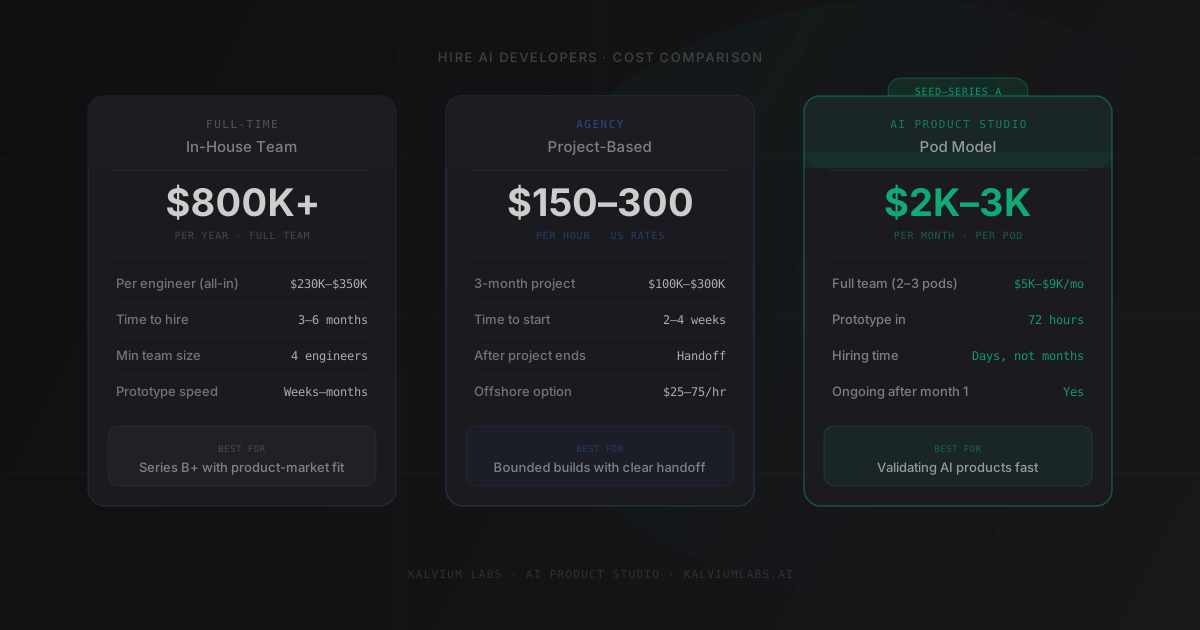
A senior AI/ML engineer in the US commands a base salary between $180,000 and $250,000 per year. Data from Levels.fyi consistently shows AI and ML roles at the top of the engineering compensation range, with total compensation (including equity) often exceeding $300,000 at mid-tier companies. Add employer taxes, health insurance, equipment, and recruiting fees (typically 15–20% of first-year salary for a senior hire), and the real annual cost of one AI engineer lands at $230,000 to $350,000.
That’s the cost of one person.
A functional AI development team for a product isn’t one person. You need at minimum: an AI/ML engineer for the model work, a backend engineer for infrastructure, a frontend engineer for the interface, and ideally a technical PM who can bridge product and engineering. Four people. Annual cost: $800,000 to $1.2 million, before you’ve written a line of product code.
The timeline to staff that team: 3 to 6 months, assuming you can attract talent, close offers, and onboard without someone dropping out mid-process. (Which happens more often than founders expect. AI engineers have options. You’re competing with Anthropic, Google, and every well-funded startup in your city.)
When this works: You’re Series B or later. You have product-market fit. The AI product is going to be central to your business for the next 3 to 5 years, and the complexity justifies full ownership. You have a technical co-founder or CTO who can evaluate candidates and manage the team without a babysitter.
When this fails: Pre-product-market fit. You’re paying $800,000 a year to figure out what to build, instead of spending $20,000 to prototype it, learn what actually works, and then staff up once you have confidence. The full-time model punishes you for learning.
There’s also a management dependency nobody talks about: if you don’t have a technical co-founder or CTO with AI experience, hiring full-time AI engineers is riskier than it looks. You won’t know if you’re getting good work until the codebase is entangled enough that switching costs are high. At that point, you’re stuck.
Model 2: The Agency
Agencies solve the hiring problem by selling you a team instead of asking you to build one. You scope a project, sign a contract, and a third-party team executes. No recruiting, no benefits, no equity.
The US agency market for AI development runs $150 to $300 per hour. A 3-month project with three engineers comes to roughly $144,000 to $288,000 (3 engineers × 160 hours/month × 3 months). At the high end of agency rates, you’re looking at $360,000 for a single project.
Offshore agencies price at $25 to $75 per hour. The math looks attractive. In practice, quality variance is enormous, and management overhead often falls entirely on the client.
When agencies work: You have a bounded, defined project with a clear handoff. You have an internal technical team that will own the codebase after delivery. You’ve already validated the idea and need execution, not exploration. You have $50,000+ earmarked for a specific, scoped build.
A clean example: an existing SaaS product that needs one new AI feature, like a document summarizer or a support ticket classifier. The feature is well-defined, the integration point is clear, and your team can maintain it after. Agency makes sense. Fixed-bid, 6-week engagement, done.
When agencies fail: When you’re asking them to figure out what to build, not just how to build it. Agencies are optimised for defined deliverables. “Build me an AI that makes our sales team more effective” is not a deliverable. It’s a problem statement. Agencies will happily write a proposal for it, charge you for a discovery phase, and deliver something that’s technically what you asked for but not what you needed. (And they’ll be contractually correct.)
There’s a particular failure mode with offshore agencies worth naming. The agency says yes to everything in the sales call, delivers a demo that works on clean data, and hands off a codebase that nobody on your team can maintain. The “AI” feature is often just an API call to OpenAI wrapped in modest business logic. Whether that’s worth $80,000 or $8,000 depends entirely on the agency’s honesty, which you won’t discover until after the handoff.
Model 3: AI Product Studio (The Pod Model)
This is the model most founders haven’t thought through carefully, partly because it’s newer and partly because quality varies so widely that “AI product studio” can mean almost anything.
The core idea: instead of hiring full-time or contracting one-off projects, you get a dedicated pod of engineers working on your product at a monthly retainer, supervised by senior technical leadership.
Think of it as a fractional AI team. You get the accountability of full-time without the fixed headcount costs. You get the specialisation of an agency without the handoff problem. The engineers working on your product are not switching between five clients. They’re building your product.
The cost structure is materially different from the other two models.
At Kalvium Labs, our staffing pods run:
| Pod Type | Monthly Cost |
|---|---|
| Frontend | $1,999/month |
| Full-Stack | $2,499/month |
| AI / Mobile | $2,999/month |
Each pod is one full-time engineer equivalent, which can be one dedicated engineer or fractional across specialists (for example, a third AI engineer, a third frontend engineer, a third backend engineer). All pods include fractional PM time.
A typical AI product needs 2 to 3 pods: one AI pod, one full-stack pod, sometimes one frontend pod. That’s $5,000 to $9,000 per month, or $60,000 to $108,000 per year.
For context: that’s less than the annual cost of one mid-level US engineer. And it’s a full team.
What a pod actually includes: engineering hours, PM oversight, architecture review from a senior technical lead, and the ability to scale up or down month to month. Not just a monthly invoice that buys you variable-quality output.
When this works best: Seed to Series A founders building their first AI product, or adding AI features to an existing product. Founders who don’t have an internal technical team that specialises in AI. Situations where you need to move fast, prove a hypothesis, and not burn runway on headcount before you know what works.
The 72-hour prototype model sits at the front of this engagement. We build something working before you commit to a longer engagement. You see AI running on your actual problem before deciding whether to invest more. That’s a very different risk profile than signing a 6-month contract on faith.
When this doesn’t work: If you need 24/7 availability, deep institutional knowledge built over years, or a team embedded in a complex legacy codebase that requires months of context. At that stage, you’ve outgrown the pod model. Full-time makes sense. That transition is a sign of success, not a failure of the studio model.
The Decision Framework
Here’s how I’d map the decision to your stage:
| Stage | Best model | Reasoning |
|---|---|---|
| Pre-revenue / idea | AI product studio | Validate before you staff up. Prototype for $5K–$8K, not $500K |
| Seed ($500K–$2M raised) | Studio or fixed-bid agency | Speed and cost matter more than ownership at this stage |
| Series A ($5M–$15M raised) | Studio pods + 1–2 in-house AI leads | Blend: external execution, internal oversight and architecture ownership |
| Series B+ ($20M+ raised) | In-house team | Complexity, scale, and institutional knowledge justify headcount |
The crossover point is roughly when you’ve validated product-market fit and you know the AI product will be central to the company for 3 or more years. Before that point, the pod or fixed-bid model gets you faster learning at dramatically lower cost.
One dimension founders underweight: technical management capacity. If you don’t have a CTO or technical co-founder who can evaluate AI engineers day-to-day, full-time hiring is riskier than it looks on a spreadsheet. You won’t know if you’re getting good work until the codebase is entangled enough that switching is painful.
External pods supervised by someone with a verifiable track record (a GitHub history you can actually inspect, products you can test, an architecture review process you can see) de-risk this considerably. You’re not betting on your own ability to evaluate AI talent before you’ve hired any.
What Doesn’t Work
A few patterns that look rational on paper and fail consistently in practice:
The “one great AI freelancer” model. You find a strong AI engineer on Upwork, pay $8,000 for a prototype, and it’s impressive. So you hire a second freelancer for the backend. Then a third for the frontend. Now you have three people who’ve never worked together, no PM, inconsistent architecture, and you’re the de facto project manager for all three. Every status update is a separate Slack thread. One of them disappears in week seven. (This happens more reliably than founders expect.) You’ve spent $40,000 and you’re back to where you started.
The full-time hire before product-market fit. You raise $1.5M, you want to move fast, you hire two senior AI engineers at $200,000 each. By month four, you’ve pivoted once, and both engineers are building something you didn’t plan in the original job description. Morale drops. One leaves. Recruiting starts over. At month nine, you’ve spent $450,000 in salaries and you’re still pre-revenue. A well-supervised pod would have gotten you to the same learning for under $80,000.
The paid discovery trap. Any agency that needs 4 to 6 weeks and $20,000 to $40,000 to tell you what they’ll build doesn’t have enough AI experience to assess your problem quickly. A team that has completed 20 AI projects can scope a proposal in a week. The extended discovery phase is a revenue model for the agency, not a methodology that benefits you.
The “we’ll add AI” general dev shop. You hire an offshore agency that builds web apps. They’ve added “AI development” to their service page. They assign your project to a full-stack developer who’s watched some Coursera videos on LLMs. The prototype works in the demo because it’s calling GPT-4 directly on clean test data. In production, it hallucinates on edge cases, the latency is 8 seconds, and there’s no evaluation framework to measure quality. You’ve paid for engineering, not AI engineering, and the distinction matters.
If you want a framework for evaluating whether an AI partner actually knows AI (versus just knowing how to present AI), the post on how to choose an AI development company covers the five-question evaluation process in detail.
And if you’re unclear on what you’re actually paying for when you hire an AI development team, including deliverables, ownership, and ongoing maintenance, AI development services: what you actually get breaks it down without the sales language.
The Real Cost of Getting This Wrong
The numbers above make the case, but the full picture is worth sitting with for a moment.
A startup that hires two full-time AI engineers at $200,000 each before achieving product-market fit, then pivots at month six, has spent $200,000 in salaries, probably $30,000 in recruiting fees, and 6 months of time. The engineers may leave during or after the pivot, which means the recruiting cost repeats.
A startup that spends $15,000 on a fixed-bid prototype, validates the core hypothesis in 6 weeks, and then engages a pod team at $8,000/month has spent $63,000 over those same 6 months. And they know they’re building the right thing.
The gap is $167,000 and 6 months of compounding. For a seed-stage startup, that’s not a rounding error. That’s survival.
According to the Stack Overflow 2024 Developer Survey, AI tool adoption is accelerating across the industry, but the skills gap between “using AI tools” and “building AI products” remains significant. Most agencies and freelancers are on the using side. You’re paying for the building side, and the price difference should reflect it.
FAQ
What does it cost to hire AI developers full-time in the US?
A senior AI/ML engineer commands a base salary of $180,000 to $250,000 per year. With employer taxes, benefits, equity, equipment, and recruiting fees, the all-in cost runs $230,000 to $350,000 per person annually. A functional AI development team (AI engineer, backend, frontend, and PM) costs $800,000 to $1.2 million per year. That’s before a single line of product code is written.
When should a startup hire AI developers full-time instead of using a studio or agency?
The right time is when you have product-market fit, when the AI product is going to be central to your business for 3 or more years, and when you have a technical lead who can hire, manage, and evaluate AI engineers day-to-day. Before that stage, full-time headcount is an expensive way to learn what you should build. The test: if the product hypothesis is still unproven, don’t staff it at full-time cost.
What’s the difference between an AI agency and an AI product studio?
Agencies are project-based. You scope work, they execute, they hand it off. Studios (pod model) are ongoing. You get a dedicated team working on your product month to month, with architecture oversight and PM included. Agencies optimise for delivering a defined scope. Studios optimise for building the right product over time, which matters more when the product direction is still evolving.
Can a pre-seed or seed startup afford to hire AI engineers without a large raise?
Yes, through the pod or studio model. A two-pod engagement (AI pod + full-stack pod) runs $5,000 to $6,000 per month, which is manageable for founders with $300,000 to $500,000 raised. Fixed-bid prototypes at $5,000 to $8,000 let you validate a hypothesis before committing to ongoing development at all. The full-time model requires a large raise specifically to fund headcount. The studio model doesn’t.
How do I know if an AI product studio is actually good, or just an offshore dev shop with better branding?
Ask to see the technical lead’s work, not the company’s portfolio. A real AI product studio has a named technical lead whose GitHub you can inspect, past products you can test, and an architecture review process you can see in action. Ask them: “Who decides between RAG and fine-tuning on my project, and can I talk to that person before signing?” If you get an account manager instead of an engineer, that’s your answer.
Building an AI product and not sure which model fits your stage? Book a 30-minute call and we’ll tell you honestly whether what you’re building fits our pod model, and if it doesn’t, which option actually makes sense for where you are.