The Gym Membership Problem
Here’s an analogy that keeps proving itself right.
Buying AI development services in 2026 is like buying a gym membership. The sales pitch is always about the outcome: you’ll be fit, strong, transformed. The brochure shows someone with abs. The tour shows you shiny equipment.
But what actually determines whether you get fit? The trainer. The programme. The accountability system. The nutrition plan. Whether anyone actually checks if you’re showing up.
Most AI development services sell you the gym membership. Shiny proposal. Impressive slide deck. “We’ll use advanced AI to transform your business.” Beautiful.
But what’s the programme? Who’s the trainer? What happens when the AI doesn’t work as expected? What does “done” actually look like?
Those are the questions this post answers.
What “AI Development Services” Actually Means in 2026
Let’s start by being honest about what’s out there.
Since ChatGPT launched in late 2022, the number of companies offering “AI development services” has exploded. Most of them are traditional software development shops that added AI to their service page.
There’s nothing inherently wrong with this. Every technology shift creates new service providers. The problem is that building AI products requires fundamentally different skills, processes, and infrastructure than building traditional software. And most of these new entrants don’t have them.
The Three Types of AI Service Providers
Type 1: Traditional dev shops with an AI page. They have 50+ developers. They’ve built CRMs, e-commerce platforms, mobile apps. Now they offer “AI integration” which usually means calling the OpenAI API and wrapping it in a UI. Fine for simple chatbots. Not fine for anything that requires custom models, RAG pipelines, or AI that actually needs to be accurate.
Type 2: ML/Data Science consultancies. They come from the pre-LLM world: recommendation engines, fraud detection, predictive analytics. Strong on traditional ML. Often struggling with the shift to LLM-based products because the engineering patterns are completely different. They’ll build you an excellent model. They may not know how to ship it as a product.
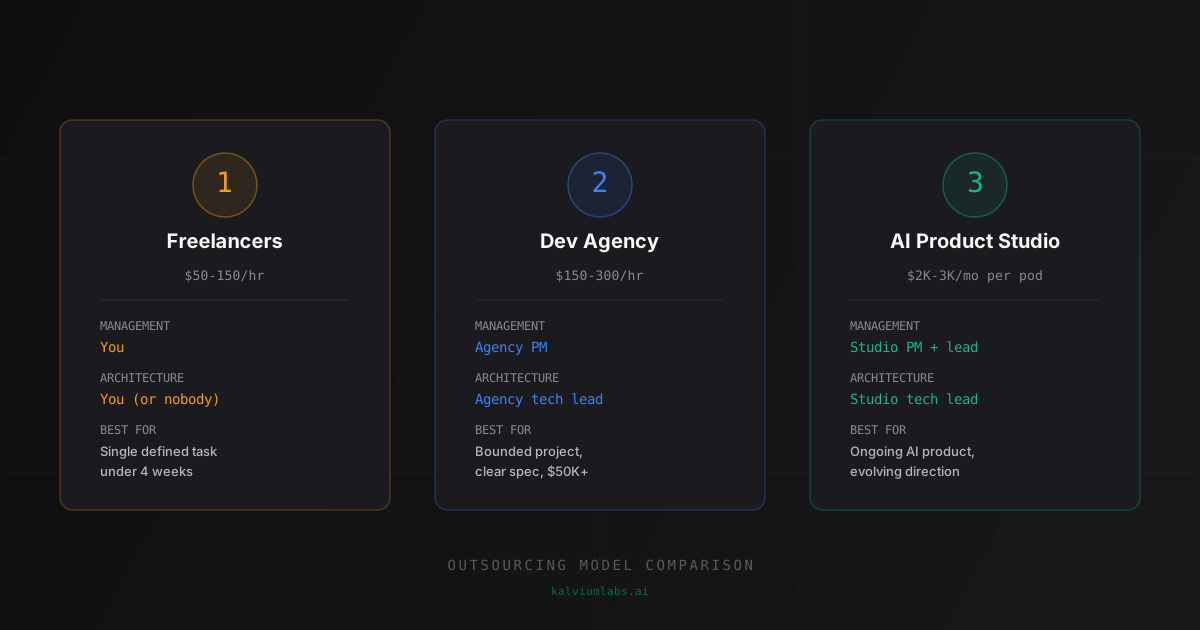
Type 3: AI product studios. A newer category. Small to mid-size teams (20-200 engineers) that specifically build AI-powered products. They understand the full stack: model selection, prompt engineering, RAG, evaluation, deployment, and the product layer on top. This is where the best work tends to happen, but quality varies enormously.
The type matters less than the capabilities. Here’s how to evaluate those. For broader context on what AI-native teams should know, the a16z AI Canon is the reference most serious practitioners have worked through.
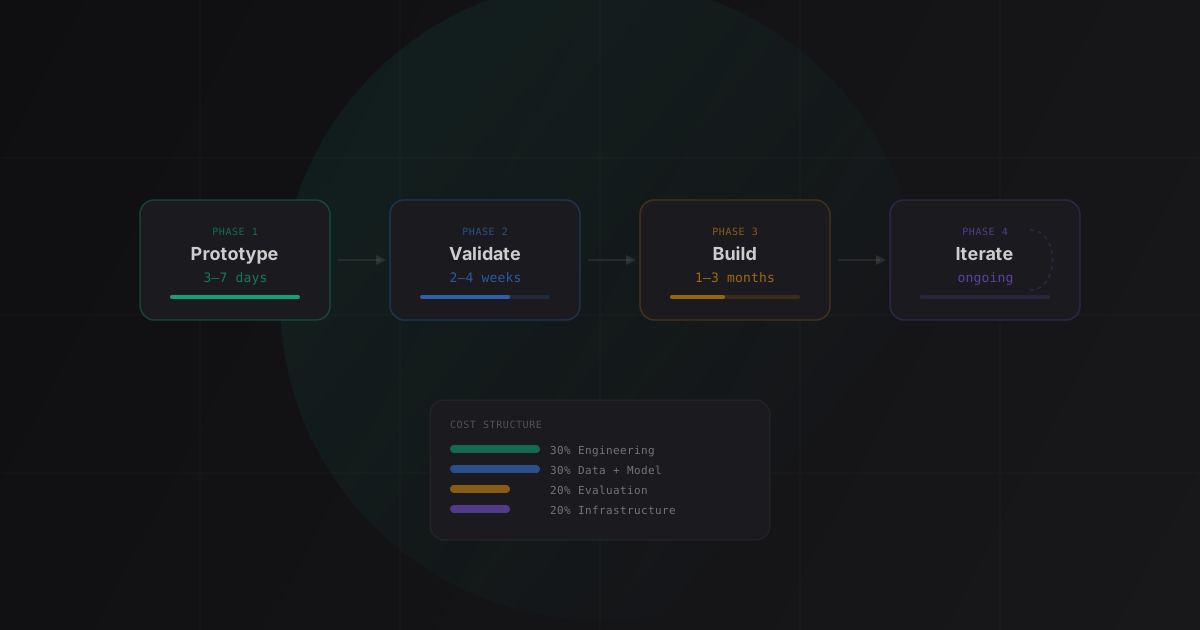
The Four Phases of a Real AI Engagement
A well-structured AI development engagement has four distinct phases. If someone is quoting you a single price for a single deliverable, they’re either oversimplifying or they don’t understand AI development. If you’re weighing whether to hire in-house versus use a service, settle that question first — the economics and risk profiles look very different depending on your answer.
Phase 1: Prototype (Days, Not Weeks)
What you should get: A working demonstration of the core AI capability — specifically a prototype, not a PoC or an early MVP. Not a mockup. Not a slide deck. Working code that you can interact with.
What this tells you: Whether the AI approach is viable for your use case. Whether the team understands your problem. Whether the output quality is in the right ballpark.
What it should cost: Some teams do this for free as a sales tool. Others charge $2-5K. Either is fine. What’s not fine is $15K for a “discovery phase” that produces a document instead of working software.
Red flag: “We need 4-6 weeks to scope the project before we can show you anything.” If they can’t prototype the core AI in a week, they probably can’t build it in a quarter.
Timeline: 3-7 days.
Phase 2: Validation (Weeks)
What you should get: The prototype refined with your real data. Accuracy metrics against your acceptance criteria. A clear understanding of what works, what doesn’t, and what the production version needs.
What this tells you: Whether the AI will actually work well enough for your users. This is where most AI projects succeed or fail, and it’s much cheaper to fail here than in Phase 3.
What it should cost: $5-15K depending on complexity. This is the most important phase for your money because it de-risks everything that follows.
Key question: “What’s the accuracy on my data, and what would it take to improve it by 10%?” If they can’t answer this with specifics, they haven’t done real validation.
Timeline: 2-4 weeks.
Phase 3: Build (Months)
What you should get: Production-ready software. The AI system integrated into a product with proper UI, error handling, monitoring, and deployment infrastructure.
What this tells you: Whether the team can actually ship. Prototypes and production systems are very different animals.
What it should cost: $15-50K+ depending on scope. This is where the bulk of the investment goes.
Key deliverables to demand:
- Working production deployment (not just code on GitHub)
- Monitoring dashboard (model performance, error rates, latency)
- Documentation (how to operate, update, and troubleshoot the system)
- Evaluation pipeline (automated tests that verify AI quality)
Timeline: 1-3 months for most projects. 3-6 months for complex systems.
Phase 4: Iteration (Ongoing)
What you should get: Ongoing support, model updates, performance monitoring, and improvement cycles.
Why this matters: AI systems degrade over time. User behaviour changes. Data distributions shift. The model that was 92% accurate at launch might be 78% accurate six months later if nobody’s watching.
What it should cost: $2-5K/month for monitoring and maintenance. More if you need active improvement work.
What most teams skip: This phase. They build it, deploy it, and move on. Six months later, the AI is hallucinating and nobody knows why.
The Real Cost Structure of AI Development
This is where most founders get surprised. AI projects have a cost structure that looks nothing like traditional software development.
Traditional Software Cost Breakdown
- 80% engineering (writing code, building features)
- 10% design
- 10% infrastructure and deployment
AI Product Cost Breakdown
- 30% engineering (building the product layer, UI, integrations)
- 30% data and model work (data preparation, model selection, prompt engineering, fine-tuning)
- 20% evaluation (building test suites, measuring accuracy, benchmarking)
- 20% infrastructure (GPU costs, API costs, monitoring, deployment)
The implication: If someone quotes you purely on “development hours,” they’re covering roughly 30% of the actual work. The other 70% (data preparation, model experimentation, evaluation infrastructure, and AI-specific infrastructure) either isn’t included or isn’t understood.
Questions to Ask About Pricing
-
“Does the quote include API/model costs during development?” Building an AI product means making thousands of API calls during development and testing. Depending on the model, this adds up quickly.
-
“What’s included for evaluation and testing?” A good AI team spends 20% of their time building evaluation pipelines. If the quote has zero hours allocated to this, they’re planning to ship without testing.
-
“What happens if the model accuracy isn’t sufficient?” This is the AI-specific risk. In traditional software, if you build the feature correctly, it works. In AI, you can build everything correctly and the model still doesn’t perform well enough. How does the team handle this? More iterations (more cost)? Model upgrades? A different approach entirely?
-
“What are the ongoing costs after launch?” API costs, hosting, monitoring, model updates. Get a realistic monthly estimate.
The Capability Checklist
When evaluating any AI development service, verify these capabilities. Not from their website — from a conversation with a technical person on their team, or from verified client reviews on Clutch.
Must-Have Capabilities
| Capability | How to Verify |
|---|---|
| RAG implementation | ”Walk me through a RAG system you’ve built. What embedding model did you use and why?” |
| Model selection | ”For my use case, would you use Claude, GPT-4, or an open-source model? Why?” |
| Prompt engineering | ”How do you handle prompt versioning and testing?” |
| Evaluation | ”How do you measure whether the AI output is good enough?” |
| Production deployment | ”How do you deploy AI systems? What does monitoring look like?” |
| Cost management | ”How do you optimise API costs in production?” |
Nice-to-Have Capabilities
| Capability | When You Need It |
|---|---|
| Fine-tuning | When you need domain-specific performance that prompting can’t achieve |
| Multi-modal AI | When you need to process images, audio, or video alongside text |
| Agent systems | When the AI needs to take actions, not just generate text — how we built a sales call compliance AI agent is a production example of what this looks like |
| Voice AI | When you need speech-to-speech interaction |
| On-premise deployment | When data can’t leave your infrastructure |
Red Flag Capabilities
If they claim all of these equally, they’re probably not excellent at any of them:
- Computer vision AND NLP AND speech AND robotics
- “Any AI model” without opinions on trade-offs
- “We can fine-tune any model” without discussing when fine-tuning isn’t the answer
What Good Looks Like
After evaluating dozens of AI teams (and being one ourselves), here’s what separates the excellent from the mediocre:
The excellent teams:
- Show you working AI before asking for a commitment
- Have named technical leadership that you can verify (GitHub profiles, conference talks, published work)
- Are honest about what they can’t do
- Talk about evaluation and accuracy before you ask
- Give you pricing ranges upfront, not after a paid discovery phase
- Have opinions about technology choices and can defend them
The mediocre teams:
- Start with a proposal and a timeline, not a prototype
- Use phrases like “harness AI” and “cutting-edge solutions” without specifics
- Claim to do everything AI-related equally well
- Can’t name which model they’d use for your project without “doing research”
- Require a paid discovery phase before they can estimate anything
- Have a team of “senior AI engineers” who were full-stack developers 18 months ago
The difference is usually obvious within a 30-minute conversation. Ask technical questions. The right team will have specific, opinionated answers. The wrong team will have polished, vague ones.
FAQ
How do I know if my use case is a good fit for AI development?
A useful test: if a skilled person could complete the task in seconds using only text, images, or audio, AI can likely handle it too. The higher-risk cases are those requiring strict numerical precision, zero-tolerance compliance decisions, or real-time outputs with no room for error. A 30-minute technical conversation will usually give you a clear answer without a paid scoping exercise.
What happens if the AI accuracy is not good enough after we build it?
This is the question most teams avoid, and the answer reveals how much real project experience they have. A well-structured engagement separates the validation phase from the production build, so accuracy problems surface early, at a fraction of the cost of discovering them after launch. If results fall short during validation, we adjust the approach, the model choice, or the data strategy before committing to the full build.
How do you protect our data and intellectual property?
All client data stays within your infrastructure or a designated secure environment, and we sign NDAs before any project discussion begins. Code ownership transfers fully to you on project completion. We do not use client data to train models or to inform work for any other client.
How long does a project take from first call to working product?
A 72-hour prototype gives you something you can interact with within days of a decision to proceed. A validated, production-ready product typically takes 6 to 12 weeks, depending on complexity, data readiness, and the number of integrations required. Projects with custom model work or multi-step agent systems can run longer, and we will tell you that upfront rather than after the budget is spent.
Do we need an in-house AI team to work with you?
No. Most of our clients come to us precisely because they do not have in-house AI engineers. We provide plain-language reporting, technical documentation, and a dedicated project manager who translates engineering decisions into business context. Having one decision-maker on your side who can give fast product feedback tends to cut timelines considerably, but deep technical knowledge on your end is not required.
Looking for AI development services for your startup? Book a 30-minute call. We’ll tell you honestly whether we can help and what a 72-hour prototype of your idea would look like.