Three weeks ago, we had 7 blog posts. Today we have 23, and 2 more ship every day. Most of them rank on Google already.
I’m going to tell you exactly how, because I think it’s weird when AI companies hide the fact that they use AI. We’re an AI product studio. Of course we use AI to run our content. The interesting part isn’t that we use it. It’s how the system actually works, where it breaks, and what still requires a human.
Why We Built This
The blog isn’t a marketing project someone assigned. It’s an SEO engine. We looked at Google Keyword Planner data and found that “ai development company” gets 6,600 searches/month in the US with LOW competition. “AI development services” gets 2,900. These are people actively looking for what we sell.
The math was simple: more posts targeting these clusters means more impressions means more clicks means more calls booked. But writing 2 quality technical posts per day with a small team isn’t possible manually. Not if you want each post to be 1,500-3,000 words of real technical content with code examples, benchmarks, and honest trade-offs.
So we built a pipeline.
The Stack
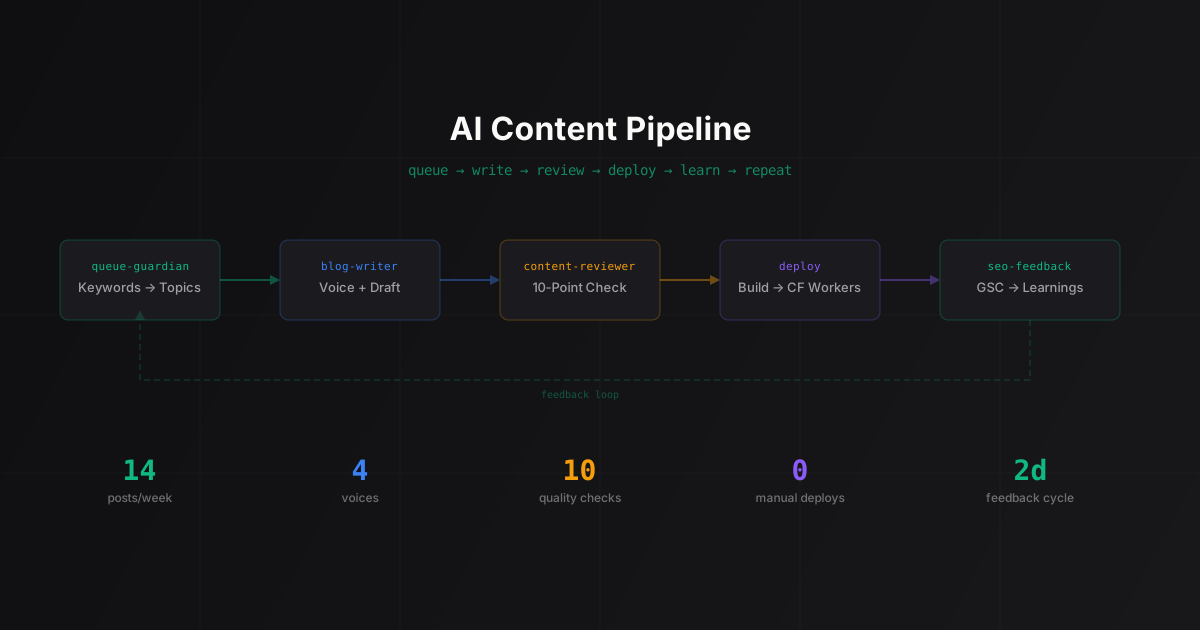
The whole thing runs on Claude-based agents with tool-calling, orchestrated through markdown skill files. No custom framework code. Just a chain of specialized agents:
Queue guardian. Monitors how many unpublished posts remain. When the queue drops below 5 pairs, it pulls keyword data and generates new topic briefs matched to our SEO targets.
Blog writer. Takes a topic brief (title, keywords, author, category) and produces a full markdown post. It reads the assigned author’s voice samples first, then 1-2 existing posts by that author to calibrate tone. The output includes frontmatter, TL;DR bullets, FAQ section, and a cover SVG.
Content reviewer. An independent agent that runs a 10-point quality check. It doesn’t know the writer’s intent. It checks for AI vocabulary tells (no em dashes, no filler words like “leverage”), verifies internal/external link counts, validates code snippets, and flags anything that reads like marketing copy instead of engineering content.
Deploy pipeline. Builds the Astro site, deploys to Cloudflare Workers, submits the URL to Google and Bing for indexing, and commits to Git.
All of it is defined in markdown skill files. No custom code. The agents read instructions and use standard tools: file read/write, bash, and git.
What the AI Actually Writes
The first draft. That’s it.
The agent generates a markdown file with the full post content. But here’s what happens before it goes live:
- Automated validation script checks frontmatter, word count, link counts, em dashes, blacklisted words
- Content reviewer agent runs the 10-point check independently
- If there are failures, the writer gets one revision cycle
- The build runs. If it breaks, the deploy stops.
What the AI doesn’t do: make up benchmarks, invent case studies, or fabricate client stories. Every benchmark in our posts comes from real tests or cited sources. The case study posts (like the call analyzer build) describe actual projects we shipped. The AI drafts from our real experience, documented in project briefs and voice samples.
We caught this early. In the first week, one draft cited a model benchmark that didn’t exist. The number was plausible, which made it worse. We added a rule to the content reviewer: every benchmark must have a source (our testing or an external citation) or get flagged. That draft got rewritten.
Where It Breaks
Three places, consistently.
Voice drift. After 10+ posts, the AI starts homogenizing the authors. Abraham’s posts start sounding like Anil’s. Dharini’s process posts get too technical. We counteract this by feeding voice samples and recent posts as calibration, but it’s an ongoing fight. We recently added structural fingerprints: Abraham’s posts should be shorter (1,200-1,800 words), use more lists, include debugging tangents. Anil’s should be longer (2,500-3,500 words), code-heavy, fewer subheadings.
Over-linking. The AI loves internal links. Left unchecked, every post would link to 5-6 other posts with perfectly SEO-optimized anchor text. A CTO reading 3 posts in a row would notice the pattern immediately. We capped it at 2 internal links and required 2+ external links (GitHub repos, official docs, research papers). Real engineers cite the ecosystem, not just their own blog.
Too clean. AI-drafted posts are too well-organized. Real engineer blog posts have asides, complaints about specific tool versions, “we still don’t know why this happens” admissions. We added a checklist rule: every post must include at least one rough edge. A debugging story, a tool-specific gripe, an honest gap in our knowledge.
The SEO Feedback Loop
Every 2 days, an automated job pulls data from Google Search Console and runs analysis:
- Which posts are getting impressions but no clicks? (Title/description problem)
- Which keyword clusters are rising? (Write more about those)
- Which posts are ranking on page 1 but below position 5? (Needs a content refresh)
This data feeds back into the queue guardian. When it generates new topic briefs, it prioritizes clusters that are gaining traction and avoids topics where we’re already saturating.
After 11 days of publishing, we had 1,312 impressions and 9 clicks. Not impressive in absolute terms, but the trajectory matters: impressions grew 257% from the first snapshot to the second. Our best query (“ai call analyzer”) hit position 3.8.
The LinkedIn Layer
Blog posts drive SEO. LinkedIn drives awareness. They’re separate but connected.
Abraham posts 3 times a week (Monday, Wednesday, Friday). Dharini posts 3 times (Tuesday, Thursday, Saturday). Each day, the system picks the best unused blog post for that person, generates a LinkedIn draft in their voice, and sends it straight to their Google Chat. Copy, paste, post.
A JSON file tracks which blog posts have been used for each person’s LinkedIn, so we never repeat. The LinkedIn drafts are written by a separate agent with different rules: no external links in the body (kills LinkedIn reach), hook in the first line, 400-600 words max.
We’re adding a weekly feedback loop where Abraham and Dharini report their engagement numbers, and the system analyzes which topics, hook styles, and draft formats perform best. That data feeds back into future draft generation. Haven’t run it yet, so no results to share.
Why We’re Telling You This
Because our GTM is our product demo.
We build AI products for startups. If we can’t automate our own content pipeline with the same agentic patterns we sell (tool-calling agents, multi-step workflows, feedback loops, human-in-the-loop review), why would anyone trust us to build theirs?
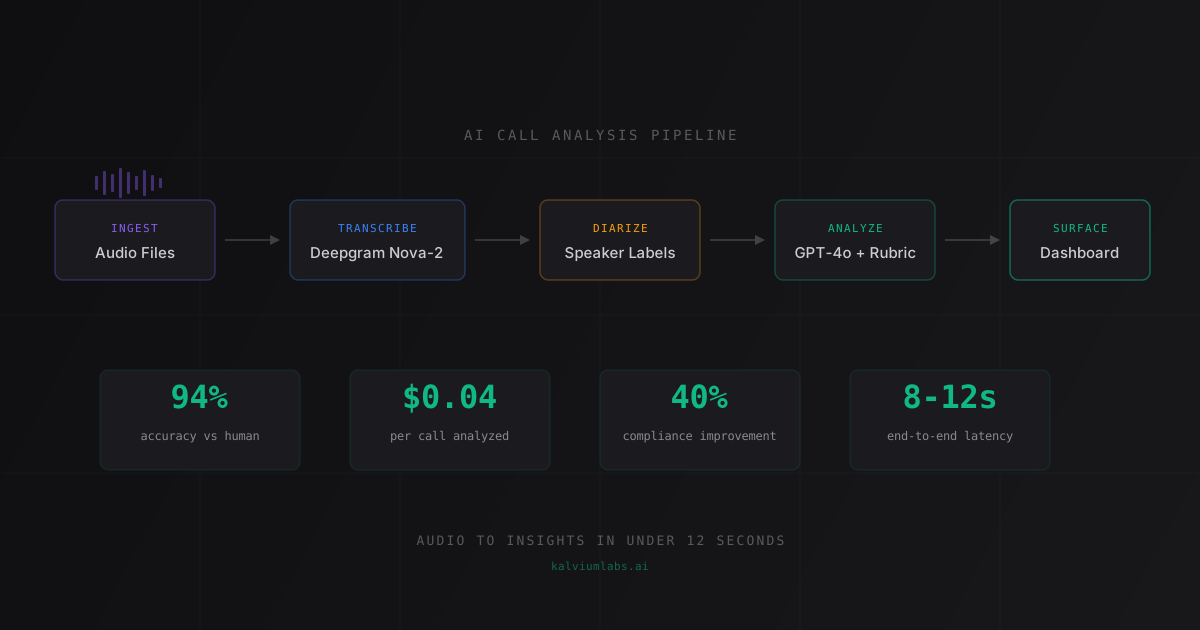
Every workflow we run internally becomes a proof point. The content pipeline uses the same architecture as the AI call analyzer we built for a client: ingest data, process it through an LLM, validate the output, surface results. Different domain, same patterns.
The system isn’t perfect. Voice drift is real. Some posts are stronger than others. The SEO data is only 3 weeks old, so we don’t know what the long-term ranking trajectory looks like yet.
But 23 posts in 3 weeks, all ranking, all technically accurate, all reviewed before publishing? That’s what an AI-native content operation looks like. And it runs on the same tools and patterns we’d use to build yours.
FAQ
Is the content actually good, or just high volume?
Read any post and judge for yourself. Every technical claim is verified. Every benchmark is cited or from our own testing. The posts that perform best on Google are the deeply technical ones (RAG production guide, vector database comparison) because they contain real experience, not summaries of documentation.
Don’t you worry about Google penalizing AI content?
Google’s policy is clear: they care about content quality, not content origin. AI-assisted content that’s accurate, useful, and has editorial oversight is fine. What they penalize is spammy, thin content produced solely to manipulate rankings. Our posts are 1,500-3,000 words of technical depth with cited sources. That’s not what spam looks like.
What tools do you use?
Claude (LLM with tool-calling), Astro (static site generator), Cloudflare Workers (hosting), Google Search Console API (SEO data). Each agent is defined as a markdown instruction file that specifies what to read, what tools to use, and what to output. No application code, no custom framework.
If you’re curious about building AI-powered workflows like this for your own operations, book a 30-minute call. We’ll tell you what’s realistic.