The question I got asked most at Dubai AI Week 2025 wasn’t “what is AI?” It was “how fast can you ship it?”
That’s a real shift. Twelve months earlier, most Gulf AI conversations were exploratory: what can AI do for a business like mine, should I be paying attention, what are other founders doing? That’s the language of a market that’s learning. In Dubai last year, it sounded different. Conversations were comparative: vendor A quoted 3 months, vendor B said 6 weeks, what would you build and what would it actually take?
That’s the language of a market that’s buying.
Kalvium Labs was named one of the Top 5 AI Startups at Dubai AI Week 2025. Dubai AI Week is the UAE Ministry of AI’s flagship annual event, and the startup track specifically features teams building for the Gulf market. I spent two days in conversations with Gulf founders at various stages of evaluating or building AI products. This is what I observed.
For more on this, read our guide on AI for the Gulf Market.
What Actually Came Up in Conversations
Before I get to what Gulf founders are buying, worth noting what they weren’t asking about.
Nobody asked about AI strategy in the abstract. Nobody wanted a whitepaper on generative AI trends. Questions were operational: specific builds, specific vendors, specific pricing, specific timelines. The theoretical phase ended somewhere around mid-2024 in Dubai.
Three categories of AI projects came up repeatedly in those two days.
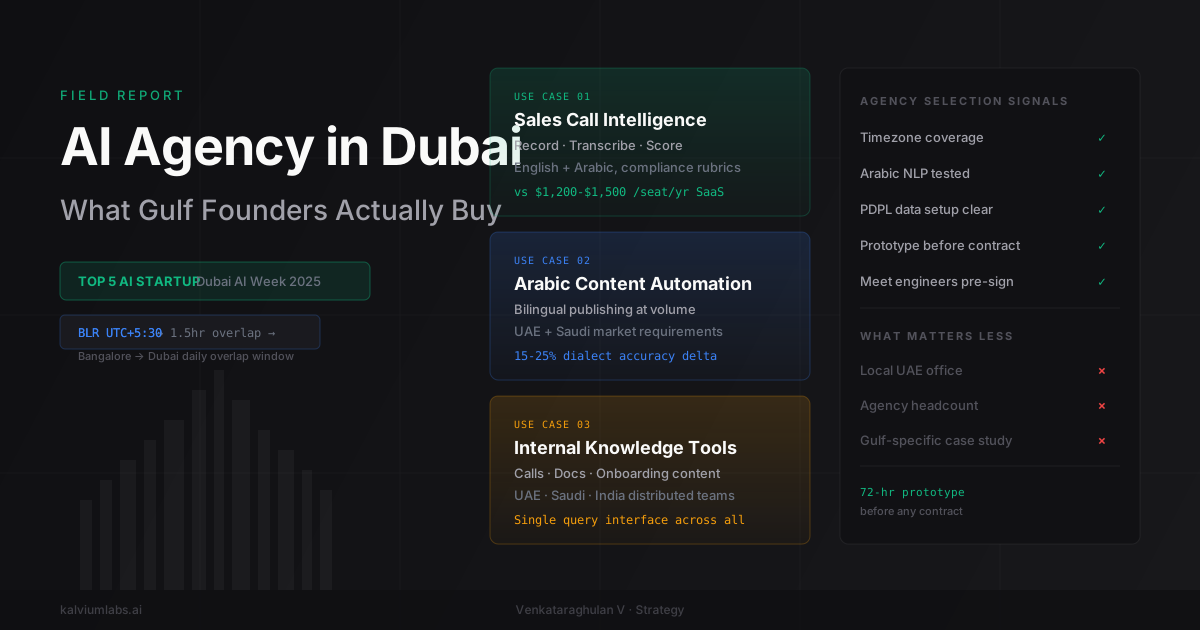
Sales call intelligence. Several UAE founders were comparing solutions for recording, transcribing, and scoring sales calls. The pattern was consistent: a 15-50 person sales team, calls happening in English and Arabic, a compliance or coaching requirement driving the purchase decision. Off-the-shelf SaaS (Gong, Chorus, Observe.ai) came up, but the question that surfaced repeatedly was cost at scale. At $1,200-$1,500 per user per year for enterprise call intelligence software, a 30-seat team is a $36K-$45K annual commitment. Custom builds that handle specific compliance rubrics started looking viable by comparison, especially when the vendor scoring criteria didn’t map well to the local regulatory context. We’ve built this kind of system before: see the call analyzer case study.
Arabic content automation. The second pattern: founders running content-heavy operations who needed to publish in Arabic at volume. UAE bilingual requirements, Saudi-first product launches, Arabic SEO for verticals where local-language content dominates search. The frustration was consistent. Off-the-shelf content tools are built for English with Arabic support bolted on as an afterthought. The outputs were grammatically correct but tonally flat.
Internal knowledge tools. Third: companies with distributed teams across UAE, Saudi Arabia, and often India who were trying to solve institutional memory. Call recordings nobody revisits. Product documentation spread across three tools. Onboarding content that goes stale in two months. The ask was a single interface that answers questions from all of it.
Three categories, three different underlying problems. But the evaluation process was similar across all: founders had done the research, narrowed to 2-4 options, and wanted to understand the build-vs-buy economics before committing.
The Gulf AI Agency Coordination Problem
Here’s the pattern I keep encountering in Gulf AI conversations, and it was sharper at Dubai AI Week than anywhere else.
Gulf founders are sophisticated buyers. They’ve read the benchmarks, know the model names, and many have CTOs who go deeper than that. The coordination problem isn’t technical literacy. It’s vendor evaluation.
The Gulf AI agency market is young. Most of the established agencies serving the region are general software shops that relabeled themselves as AI agencies in 2023 when the commercial opportunity became obvious. Some are excellent. Many are not. From the outside, during a sales conversation, the signal is hard to read. Everyone says the same things about LLMs, agents, and production-grade systems.
Three different founders asked me the same question in two days: “How do I know if this agency has actually shipped production AI, or if they’re learning on my project?”
(If you want the full checklist for evaluating AI agencies, we covered 12 specific red flags to watch for in vendor conversations. The Dubai conversations confirmed most of them.)
Honestly, you mostly can’t tell from the sales conversation alone. What you can do is ask for a prototype before the contract. Not a pre-prepared demo, but a prototype of your specific use case running on your actual data, in 72 hours. Agencies that have shipped production AI before can do this. Agencies that are learning on your project will tell you prototyping requires a signed contract and a discovery phase first.
That asymmetry in the sales process is the Gulf market’s biggest current problem. It’s not unique to the Gulf, but this market has less accumulated history of AI project failures than, say, a US market that has been through two or three agency waves. Founders here are earlier in the learning curve and more exposed to a costly first experience.
What Gulf Founders Need in an AI Agency
If you’re evaluating AI agencies for a Gulf project, here’s the comparison that actually matters.
| Factor | What matters | What doesn’t |
|---|---|---|
| Timezone | India-based: 1-2 hour overlap with UAE/Saudi business hours | US-based: 8-12 hour gap, mostly async |
| Arabic capability | Have they tested Arabic NLP on your dialect? | ”We support Arabic” (marketing claim, unverified) |
| Data residency | Clear PDPL setup: where data sits, how API calls route | ”We take data security seriously” (not the question) |
| Track record | A working prototype in 72 hours using your data | A 38-page proposal delivered in 24 hours |
| Team access | You can meet the engineers before signing | ”Senior engineers will be assigned post-contract” |
| Pricing transparency | Can they quote a range given your use case? | ”Pricing depends on discovery” (before any scoping) |
A few of these need more unpacking.
Timezone is a real variable, not a soft preference. UAE is UTC+4. Saudi is UTC+3. Most US-based AI agencies operate from an 8-12 hour gap. Async works for some phases of software development, but not for iteration-heavy AI product work where client feedback drives daily decisions. India-based agencies at UTC+5:30 have a 1-2 hour overlap with Gulf business hours from the morning start. That difference compounds across a 12-week project.
Arabic capability isn’t binary. Standard AI model benchmarks are English-heavy. Gulf Arabic (Khaleeji) drops accuracy by 15-25% on intent classification and sentiment tasks compared to Modern Standard Arabic. An agency that hasn’t specifically built for Arabic inputs will discover this midway through your timeline. Ask for a specific test on your use case before you commit. If they can’t run one, that’s the answer.
Data residency has teeth. UAE’s Federal Personal Data Protection Law (Federal Decree-Law No. 45 of 2021) and Saudi Arabia’s equivalent restrict cross-border personal data transfer. This affects any AI project processing Gulf user data. Before signing with any agency, ask: where does customer data sit during processing, is the LLM vendor PDPL-compliant, and what’s the data processing agreement setup? A capable agency answers this question in five sentences. An agency that hasn’t built for Gulf clients before will be figuring it out on your timeline.
What Doesn’t Matter as Much as You Think
A local UAE office. Several founders at Dubai AI Week asked whether we have a UAE office. We don’t. We’re in Bangalore. What we have is a delivery model that operates on Gulf business hours (the team starts early, with overlap by 9 AM UAE time), a 72-hour prototype model that makes evaluation fast, and engineers who have worked through the Arabic NLP and data residency questions before. Physical presence matters for some categories of enterprise procurement. For AI product development at the startup stage, it mostly signals sales infrastructure, not delivery quality.
For more on this, read our guide on What Gulf Founders Spend on AI Development in 2026. Agency size. A 200-person shop and a 20-person shop are not different in the way you’d expect for an early-stage AI project. What matters is how many people are on your project, who they are, and whether you can talk to them before signing. Small, focused teams ship faster on contained AI builds. Coordination overhead scales with headcount.
A Gulf-specific case study. Useful signal, but not a requirement. The technical patterns for a sales call intelligence product in UAE are largely the same as in the US or India. What changes is language, compliance context, and timezone. Ask for a relevant use-case case study and verify that the technical approach matches your problem, not just the industry label.
The 72-Hour Prototype Applied to Gulf Use Cases
The prototype-first model isn’t standard in the Gulf AI agency market yet. Most agencies default to a discovery-proposal-contract-build sequence. That sequence made sense for traditional software development. It makes less sense for AI projects where the key unknowns (does your data support this use case, what’s the latency on Arabic transcription, what does accuracy look like on your specific inputs) can only be answered by running something.
The reaction when I described our 72-hour prototype model in Dubai was consistent: surprise, then real interest, then practical questions. Can you show a working MVP of my sales call scoring system before I sign? Can you handle Arabic transcription in that prototype? What data do I need to provide?
The honest answer to the last question: not much. A sample of 20-30 calls and your scoring rubric, ideally. Within 72 hours, you’d have a working prototype scoring against your rubric on actual recordings, not a demo on canned data.
The founders who came back for a second conversation after that question were the ones worth talking to. The ones who didn’t were either shopping on price or not yet ready to actually build. That filter is useful for both sides.
What Actually Determines Gulf AI Project Success
After the Dubai AI Week conversations, the pattern for what makes Gulf AI projects succeed vs. stall is fairly consistent.
Specific outcome, not vague capability. “Build us an AI product” stalls. “Reduce the time our sales team spends on call review from 4 hours a week to 30 minutes, with flagging for compliance terms” runs. The specificity of the outcome drives every decision downstream: which model, what latency threshold, what accuracy is acceptable, when you’re done. Gulf founders who arrive with a defined outcome move 3× faster than founders who arrive with a general direction.
A decision-maker who can respond fast. Not necessarily an engineer, but someone who can make trade-off calls without a three-week approval chain. AI projects generate real decision points: this approach costs less but has 12% lower accuracy, is that acceptable? That question can’t sit in a queue for a week.
Willingness to ship something incomplete first. The Gulf founders who got stuck were usually waiting for a V1 that did everything the finished product would do. The ones who shipped fast accepted a V1 that did one thing well, learned from real users, and improved. This isn’t a cultural observation. It applies everywhere. It surfaces more visibly in Gulf conversations because the prototype-first model is less normalized there compared to Indian and US startup ecosystems, where a quicker iteration pattern is more common.
I don’t have a clean answer for one piece of the Arabic content problem: dialect-specific output quality. Gulf Arabic (Khaleeji), Egyptian Arabic, and Levantine Arabic are different enough in informal registers that a single prompt tuning approach won’t hold across markets. We’ve found this requires iterating specifically on each market’s content samples, not a generic Arabic-language tuning pass. That’s a real scope addition if your product targets multiple Arab-speaking markets.
FAQ
How do I find a reliable AI development agency in Dubai?
The most useful test is asking any agency you’re seriously evaluating to prototype your core use case in 72 hours using a sample of your actual data. Agencies that have shipped production AI can do this. Agencies that are learning on your project will cite a required discovery phase. Also verify: timezone coverage (India-based agencies have 1-2 hours of daily overlap with UAE business hours), Arabic NLP experience if your product is bilingual, and a clear PDPL data residency setup before any data moves.
What does an AI project typically cost in the Gulf market?
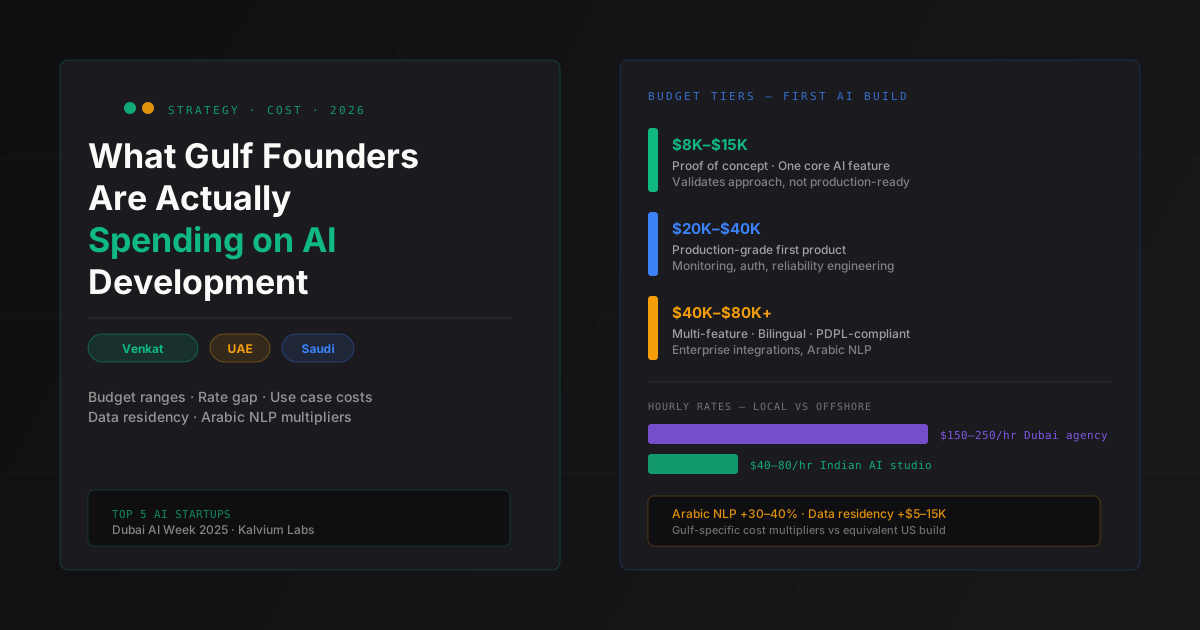
The technical cost is the same as other markets. Most contained AI use cases (call intelligence, content automation, internal knowledge tools) run $5K-$8K for a 2-4 week MVP or $15K-$25K for a 6-10 week production build. What varies in Gulf projects is the Arabic language tuning scope and PDPL-compliant data infrastructure, which typically add 15-25% to the timeline and cost estimate depending on requirements. See our services page for current pricing ranges.
Do I need an AI agency with a physical office in Dubai or Abu Dhabi?
Not for most AI development projects. What matters for Gulf work is timezone alignment (the ability to collaborate during Gulf business hours), Arabic NLP experience, and demonstrated understanding of data residency requirements. A Bangalore-based agency with Gulf-specific technical experience will typically outperform a generic agency with a Dubai address. Ask agencies directly: what time does their team start, what Arabic products have they shipped, and what’s their PDPL setup for UAE client data?
What AI projects are Gulf startups actually prioritizing in 2026?
Based on Dubai AI Week conversations: sales call intelligence (transcription, compliance scoring, coaching insights), Arabic content automation (bilingual product content, Arabic SEO content), and internal knowledge tools (surfacing answers from calls, documents, and internal systems). These align with global AI development patterns with Arabic language and PDPL compliance as the Gulf-specific variables.
How does UAE or Saudi PDPL compliance affect my AI project?
Both UAE’s Federal Personal Data Protection Law and Saudi Arabia’s PDPL restrict cross-border transfer of personal data. For an AI project, this affects where your data sits during LLM processing, whether your API vendor has a compliant data processing agreement, and how your data pipeline is architected. Before signing with any AI agency, confirm their specific setup: which LLM APIs they use for Gulf projects, how personal data is anonymized before leaving the region if needed, and what the contractual data processing arrangement looks like. A clear answer in under five minutes means they’ve done this before.
Building an AI product for UAE or Saudi Arabia? We’ve worked through the Arabic NLP, PDPL compliance, and timezone coordination questions before. Book a 30-minute call and in the first 15 minutes we’ll tell you whether your use case is a 72-hour prototype or needs more upfront scoping.