At Dubai AI Week 2025, the conversation that surprised me most wasn’t about a large enterprise deployment or a Saudi Vision 2030 mega-project. It was with a six-person SaaS founder from Abu Dhabi who’d budgeted $150,000 for an AI customer service integration and was three months in with nothing working yet.
The number wasn’t wrong. The vendor selection process was. He’d picked a local Dubai agency on the basis of proximity and a polished deck. Proximity turned out not to matter. The deck turned out to have been generated from a sales playbook that didn’t match anyone’s actual engineering capability.
I’ve seen the same pattern enough times across Gulf conversations to recognize it as a structural problem in the market, not a one-off misfortune. Gulf founders are spending real money on AI development in 2026. Many of them are spending it wrong. And the reason they’re spending it wrong isn’t usually budget size: it’s that the Gulf AI agency market is still opaque enough that buying on surface signals (local presence, conference visibility, impressive website) consistently beats buying on actual capability signals (working prototypes, verifiable case studies, technical architecture clarity).
This post is about the money: what Gulf founders are actually spending, what drives costs in the Gulf specifically, and how to calibrate the budget decision before you’re three months into a project that isn’t moving.
What the Budget Ranges Actually Look Like
Kalvium Labs was named one of the Top 5 AI Startups at Dubai AI Week 2025, which put me in conversations with Gulf founders across the UAE and Saudi Arabia who were actively evaluating AI development partners. I’ve written separately about what Gulf founders are actually buying at these events. This post is specifically about the numbers. Not every conversation included budget figures, but enough did to give a reasonable picture.
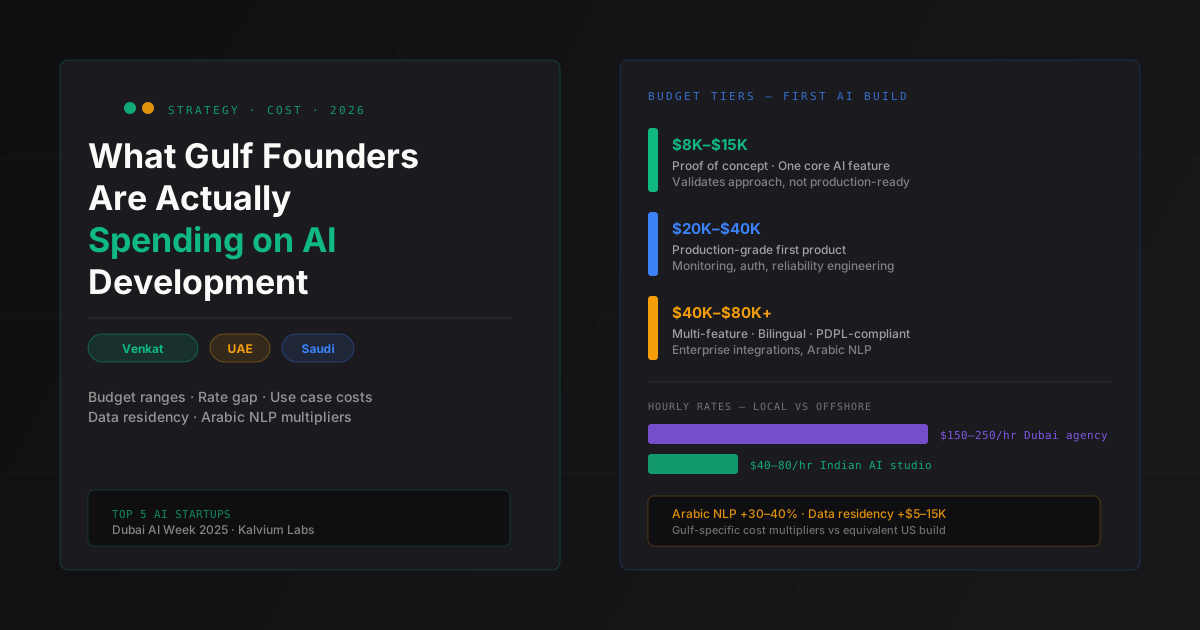
The range in 2026 for first-time AI builds:
Tier 1: $8K–$15K (proof-of-concept with production intent)
This is the correct first spend for most Gulf founders who are uncertain about whether AI will do what they think it will do. You’re not buying a finished product. You’re buying validation that the approach works in your specific context: with your data, your language requirements, your integration constraints.
A proof-of-concept in this range covers one well-defined AI capability (call transcription and scoring, content generation for one topic cluster, a simple query-answering chatbot against your internal documents) in a working but not production-hardened state. It’s demo-able to internal stakeholders. It answers the question “does this work?” not “is this ready to ship?”
If a vendor asks for more than $15K for a proof-of-concept, ask specifically what’s driving the cost above that. The answer tells you a lot. Legitimate reasons: Arabic NLP requires specialized pipeline work, data residency requirements need additional infrastructure, integration with a legacy system has high setup cost. Illegitimate reasons: “senior resource time,” “project management overhead,” vague architecture complexity.
Tier 2: $20K–$40K (production-grade first product)
This is the range for a first real AI product: something you put in front of users or customers, with monitoring, error handling, rate limiting, authentication, and enough reliability engineering that an outage doesn’t require a developer to manually fix it at 2 AM.
The lower end of this range typically covers single-language (English or Arabic, not both), one core AI feature, basic cloud infrastructure on a major provider (AWS, Azure, GCP), and a simple dashboard or API surface. The higher end covers bilingual support, more complex inference pipelines, or integration with existing SaaS products (CRM, ERP, document management).
This is where most Gulf founders underestimate cost. They budget for the Tier 1 number and then discover that production-grade is a different category of work. The gap between “it works in a demo” and “it works reliably when 500 users hit it simultaneously” isn’t a small increment. It’s a different build.
Tier 3: $40K–$80K+ (multi-feature with bilingual support)
This is where you’re building something with ambition: multiple AI-powered features, Arabic and English throughout, data residency compliance with UAE PDPL or Saudi PDPL, integration with enterprise systems, and a user-facing product that a non-technical founder could explain to an investor without wincing.
The upper bound on this tier is genuinely open-ended because scope is the primary driver. What doesn’t belong in this tier: uncertainty about what you’re building. If you don’t have a clear specification for what the product does, you will spend this budget exploring and end up with a fraction of the product you expected. Define the first version precisely before you start.
The Two Cost Multipliers Gulf Founders Miss
If you take a project that’s been scoped for a US startup and try to build it for a Gulf market, two things add cost that most founders don’t account for in the initial budget.
Arabic NLP and multilingual architecture
Arabic language support in LLM applications is not a toggle. Modern Arabic (MSA) in GPT-4o and Claude performs reasonably well on structured tasks. Gulf dialect Arabic (Khaleeji) drops accuracy 15–25% on classification and sentiment tasks compared to MSA. For a customer-facing application where the AI interprets what users are saying, that gap is real and has product consequences.
The cost implication: building bilingual (Arabic + English) UX with RTL layout switching, mixed-script input handling, and appropriate language-detection logic adds roughly 30–40% to frontend development time compared to English-only. Prompt engineering for Arabic language outputs adds iteration time. Testing Arabic-specific edge cases (numbers, dates, mixed script entries, dialect variation) requires Arabic-fluent QA capacity that’s not part of a standard engineering team.
I’ve seen Gulf founders budget $18K for a chatbot that works in English and discover the Arabic-capable version costs $28K. That $10K delta isn’t inefficiency. It’s the actual engineering cost of Arabic support.
Data residency compliance
The UAE Personal Data Protection Law (PDPL) and Saudi Arabia’s Personal Data Protection Law both restrict cross-border transfer of personal data. Most US-hosted LLM APIs (OpenAI, Anthropic, Google AI) don’t comply with these restrictions by default if your data includes personal information about UAE or Saudi residents.
The compliance options range from cheap to expensive:
- Anonymize or pseudonymize data before it leaves your jurisdiction (cheapest, affects some use cases)
- Use Azure OpenAI Service in UAE North or Saudi Arabia regions (available but adds infrastructure complexity)
- Use locally-hosted open-source models (most expensive path upfront, often justified for enterprise buyers)
A vendor who quotes you a price without asking about data residency requirements hasn’t thought through your compliance situation. In the Gulf, this is a deal-breaker question that should come up in the first conversation, not in sprint 4.
The Agency Rate Gap: Local vs. Indian
This is the part of the cost conversation nobody in the local Dubai agency ecosystem wants to surface.
Dubai and Abu Dhabi AI agencies charge $150–250/hour for senior engineering work. Some premium consultancies are higher. These rates are influenced by UAE commercial real estate costs, visa sponsorship requirements for expatriate engineers, and the general cost structure of operating in the Gulf.
Indian AI studios with genuine engineering depth charge $40–80/hour for equivalent technical capability. At Kalvium Labs, our full-stack AI pod (which includes a mix of AI, frontend, and backend engineers supervised by our ex-Google, ex-HackerRank engineering leadership) runs significantly below Dubai agency rates.
The quality equivalence matters: the argument for local agencies is usually “they understand the market” or “timezone convenience.” Both are real but quantifiable:
- Market understanding comes from conversations and discovery calls. Any agency willing to do a deep discovery call will learn your market context quickly. Arabic language capability is a real differentiator, but it needs to be verified (ask for examples, not claims).
- Timezone: UAE is IST +1.5 hours. Bangalore to Dubai is the smallest significant international timezone gap that exists. A 9 AM Dubai meeting is 10:30 AM Bangalore. The timezone argument is weaker for Indian agencies specifically than for any other offshore option.
For a $40K project, the rate gap between a $200/hr Dubai agency and a $60/hr Indian studio is $140/hr. At 500 engineering hours, that’s $70,000 in labor cost difference. The value you’d need the local agency to deliver to justify that gap is substantial. In most Gulf AI builds I’ve seen, it doesn’t materialize.
My filter: don’t choose based on geography. Choose based on who can show you a working prototype of your core feature in 72 hours. I’ve written more about 12 red flags to look for in any AI agency if you want the full checklist, but the prototype test is the fastest single question.
Specific Use Cases and Their Gulf Cost Reality
Not all AI builds cost the same. Here’s what the specific use cases I hear most often from Gulf founders actually cost in 2026:
Sales call intelligence and compliance scoring
This is the most common request I hear from Gulf enterprise tech companies. A system that transcribes sales calls, diarizes speakers, and scores against a compliance rubric for things like commitment misrepresentation or regulatory language.
Baseline range: $20K–$35K for a production system covering one language (Arabic OR English). Bilingual adds $8–12K. Integration with CRM systems (Salesforce, local alternatives like Bayzat or Zoho UAE edition) adds $5–10K depending on API quality.
The use case is well-defined enough that you should be able to get a specific scope and price from any capable vendor within one discovery call.
AI content automation in Arabic
Content automation for Gulf media companies, government communications, or B2C brands requires Arabic NLP pipeline work that’s materially different from English content automation.
Range: $15K–$30K depending on volume requirements, tone/brand calibration depth, and approval workflow complexity. An English-only content automation build sits at the lower end of that range; adding a multilingual pipeline (Arabic, for instance) pushes it higher because of the added translation and review layers.
Internal knowledge tools and search
“Employees should be able to ask questions and get answers from our internal documents” is the most common entry-point AI feature request across Gulf enterprise buyers. It’s also the most frequently underscoped.
Range: $12K–$25K for a working internal knowledge tool with reasonable accuracy. The variance comes from document volume, document quality (structured PDFs vs. scanned images vs. unstructured Confluence-style wikis), and integration requirements. Arabic document processing in particular is harder and more expensive than English: OCR accuracy on Arabic script is lower, and chunking strategies that work for LTR text need rethinking for RTL.
Voice AI for Arabic-speaking users
This is the most technically challenging category right now. Arabic real-time speech-to-text accuracy at Gulf dialect quality is not solved. Deepgram Nova-2 handles MSA adequately but struggles with Khaleeji. ElevenLabs Arabic voice synthesis exists but regional accent quality is mixed.
Range: $25K–$50K+ for a production voice agent handling Arabic, depending heavily on acceptable accuracy thresholds, the cost of errors, and how often human fallback is needed. Any vendor quoting below $20K for Arabic voice AI should be asked to demonstrate the dialect accuracy on a test set before you sign.
What the Budget Decision Actually Comes Down To
The Gulf AI market in 2026 is not yet at the efficiency point where you can pick a vendor from a directory, read some reviews, and get a predictable outcome. The market is immature enough that surface signals (conference presence, slick website, local office) have low correlation with actual delivery quality.
The two filters that work:
First: ask for a 72-hour working prototype. Not a proposal. Not a scope document. A working demo of the core AI capability you need, built against your actual use case. Every capable agency can do this. Agencies that can’t are telling you something important about their execution speed relative to their sales ability.
Second: ask for verifiable case studies with similar technical requirements. Arabic NLP work, data residency compliance, bilingual UX. If they claim to have done this, the project lead should be able to walk you through the technical decisions they made and why. “We’ve done similar work for clients in the region” without specifics is not a verifiable claim.
Kalvium Labs ran this process at Dubai AI Week: we showed working prototypes, answered specific architecture questions about Arabic language support and data residency, and named the engineering credentials behind the work (Anil Gulecha, ex-HackerRank, ex-Google, who built coding evaluation infrastructure at scale before building AI products). That combination of working product plus verifiable engineering pedigree is what serious Gulf founders responded to.
For any Gulf founder evaluating AI agencies right now: the budget ranges I’ve listed here are calibrated to what capable teams at reasonable rates are actually delivering. If a vendor quotes significantly above the upper end of a range, ask what’s driving the premium. If they quote significantly below, ask what they’re leaving out.
FAQ
How much does it typically cost to build an AI product in Dubai or the UAE in 2026?
For a production-grade first AI product, the range is $20,000–$40,000 with a capable agency. Local Dubai agencies typically charge $150–250/hour, which puts a 200-hour engagement at $30,000–$50,000 before infrastructure costs. Indian AI studios with equivalent technical depth charge $40–80/hour, making the same scope cost $8,000–$16,000 in labor. The right number depends on your specific requirements: Arabic language support, data residency compliance, integration with existing systems, and expected concurrent user load.
Why are Gulf AI builds more expensive than equivalent US projects?
Two reasons. Arabic NLP adds 30–40% to frontend development time and requires additional pipeline work for accurate language handling. Data residency compliance under UAE PDPL and Saudi PDPL adds infrastructure cost if you need to keep personal data in-region, which most US-hosted LLM APIs don’t handle by default. A US startup with English-only requirements and no data residency constraints will pay less for the same AI feature because those constraints don’t exist.
What’s the difference between a UAE-based AI agency and an Indian AI studio for Gulf projects?
Geography and timezone are the only structural differences. Engineering capability, AI depth, and project management quality vary by agency, not by country. The substantive questions are: can they demonstrate Arabic language capability with actual examples? Do they understand UAE PDPL and Saudi PDPL data residency requirements? Can they show working prototypes quickly? A Bangalore-based AI studio with genuine Arabic NLP experience and a 1.5-hour timezone offset is a better choice for a Gulf build than a Dubai-based agency that learned AI last year.
What AI use cases are Gulf founders getting the highest ROI on in 2026?
Sales call intelligence (compliance scoring and quality assurance), Arabic content automation, and internal knowledge tools are the three use cases where Gulf founders consistently see payback within the first year. Voice AI is the most technically challenging and least mature. The highest ROI comes from use cases where you have existing data: past call recordings, existing content, internal documents. The AI improvement compounds on that data. Use cases that require building a dataset from scratch take longer to show ROI.
How do I evaluate an AI development agency for a Gulf project without getting burned?
Ask three things: show me a working prototype of my core feature within 72 hours; show me a verifiable case study with Arabic language requirements or Gulf market context; tell me how you handle UAE PDPL and Saudi PDPL data residency. The first question tells you whether their engineering speed matches their sales claims. The second tells you whether their experience is real or aspirational. The third tells you whether they’ve thought through the compliance layer before you bring it up.
For more on this, read our guide on AI for the Gulf Market. Kalvium Labs was named one of the Top 5 AI Startups at Dubai AI Week 2025. We build AI products for Gulf founders from Bangalore, with a 1.5-hour timezone overlap and a 72-hour prototype model. Book a 30-minute call. We’ll quote specific costs against your use case, not against a hypothetical.