The question “how much does it cost to build an AI product” has the wrong shape. Founders ask it, agencies answer it, and both sides walk away with the same incomplete picture: a number that covers engineering labor and almost nothing else.
I had this conversation with a founder three weeks ago. He had a $40,000 build budget approved by his board. The product was a customer-facing AI agent for a mid-market SaaS. Our pod proposal landed at $48,000 over ten weeks, which he could justify. What he didn’t have a number for was the $3,800 monthly bill that would land in month four, when the agent went live to a few hundred users and started actually consuming tokens.
That bill wasn’t a surprise to us. It’s a surprise to almost every first-time AI founder.
The cost of an AI product isn’t a single number. It’s a build cost (one-time) plus an operating cost (monthly, compounding) plus a set of hidden categories that nobody mentions until they appear on an invoice. This post breaks all three apart, with real numbers from real builds, and gives you a framework for estimating the total before you sign anything.
The Two Costs Most Founders Conflate
When a founder asks “what does an AI product cost to build”, they’re usually asking two different questions at the same time and treating the answer as one number.
The first question is build cost: how much does it take, in engineering labor and one-time setup, to get the product working? This is the line item you can put on a board deck. It looks like a project budget. It has a start date and an end date.
The second question is operating cost: how much does the product cost to run every month after it’s live? This is the COGS line. It scales with usage. It hits your AWS bill, your OpenAI invoice, your Pinecone subscription, and your observability tool’s monthly statement. It compounds.
For a SaaS company, you don’t conflate these. You know the build cost of a feature is one number, and the AWS bill is a separate ongoing line. Software is intuitive that way. AI products break that intuition because the operating costs are unfamiliar, harder to predict, and weirdly variable.
A better question to ask any AI development partner: “What does it cost to build this product, and what does it cost to run it for the first 12 months at our expected user load?” If they only answer the first half, you have an incomplete proposal.
The Build Cost (And Why It’s Smaller Than You Think)
Engineering labor for an AI product MVP, at studio rates, is the most predictable cost in this entire equation.
A typical AI product build needs 2 to 3 pods over 8 to 12 weeks. At our pricing ($1,999 to $2,999 per pod per month), that’s $5,000 to $9,000 per month in labor, totaling roughly $30,000 to $80,000 for the build phase. Add design, integrations, infrastructure setup, and any one-time data prep, and the all-in build cost lands in the $30,000 to $100,000 range for most AI MVPs.
Where the build cost varies most isn’t model choice or framework selection. It’s how clean your data is and how integrated the product needs to be. A standalone AI agent that lives in its own dashboard is one cost. The same agent integrated into your existing SaaS with SSO, role-based access, audit logs, and a webhook into your CRM is another cost entirely. Integration work is where build budgets quietly double.
For a deeper breakdown of how studio pricing compares to agencies and freelancers, the studio vs agency vs freelancer comparison covers the structural differences and where each model fails.
The build cost is the visible part of the iceberg. It’s what shows up in proposals. It’s also the smallest line item you’ll see across the first 12 months, in most cases.
The Operating Cost That Compounds Monthly
Operating cost is where AI products get expensive in ways that don’t show up in any proposal.
Here’s what an AI product actually costs to run, broken down by category. These are real ranges from real builds, not theoretical maximums.
| Category | Early stage (under 1K users) | At scale (10K+ users) |
|---|---|---|
| LLM API tokens | $200-$1,500/mo | $3,000-$30,000/mo |
| Vector database | $0 (pgvector) - $300 (Pinecone) | $200-$2,500/mo |
| Cloud compute | $100-$500/mo | $800-$5,000/mo |
| Storage (S3, Postgres) | $20-$150/mo | $300-$1,500/mo |
| Observability (Langfuse, Helicone) | $0-$200/mo | $200-$1,200/mo |
| Speech, OCR, vision APIs | $50-$800/mo | $500-$5,000/mo |
| Email/SMS notifications | $20-$200/mo | $200-$1,000/mo |
| Monthly total | $390-$3,650 | $5,200-$46,200 |
These numbers assume a standard architecture: a hosted application, an LLM provider, a vector store for retrieval, observability, and the usual supporting infrastructure. They scale with usage in predictable ways, but the predictability disappears when usage is non-linear (which it almost always is in early-stage products).
The pattern that catches founders off guard: the build cost is one-time, but the operating cost compounds across 12 months. A $50,000 build with a $3,000 monthly operating cost is a $50,000 build with an $86,000 first-year total. The operating side is bigger than the build side by month nine.
The Token Bill Is the Cost Founders Underestimate Most
Of all the operating cost categories, the LLM API bill is the one founders consistently get wrong. The pricing looks small per call. It feels small per call. It compounds in ways that don’t feel intuitive until you see your first month’s invoice.
Let me run real math on a chatbot example, because abstract arguments don’t land here.
Assume a product with 1,000 daily active users, each sending 5 messages per day. Each message includes about 500 input tokens (the user’s message plus conversation history plus system prompt) and produces about 150 output tokens (the AI’s response). That’s a normal, conservative chatbot pattern.
Daily tokens:
- Input: 1,000 users × 5 messages × 500 tokens = 2.5M input tokens
- Output: 1,000 users × 5 messages × 150 tokens = 750K output tokens
Monthly (×30):
- Input: 75M tokens
- Output: 22.5M tokens
Now apply pricing. I’m using current OpenAI list prices for GPT-4o ($2.50 per 1M input tokens, $10 per 1M output tokens) and GPT-4o-mini ($0.15 per 1M input tokens, $0.60 per 1M output tokens) from OpenAI’s pricing page, and Claude 3.5 Sonnet at $3 input / $15 output per 1M tokens from Anthropic’s pricing page.
| Model | Monthly cost |
|---|---|
| GPT-4o | (75 × $2.50) + (22.5 × $10) = $412.50 |
| GPT-4o-mini | (75 × $0.15) + (22.5 × $0.60) = $24.75 |
| Claude 3.5 Sonnet | (75 × $3) + (22.5 × $15) = $562.50 |
Same chatbot. Same usage. Sixteen-times difference between GPT-4o and GPT-4o-mini for the same workload.
Now scale to 10,000 daily users (10x the load). The numbers go linear: GPT-4o jumps to $4,125 per month, mini to $247, Claude to $5,625. That’s the bill that lands in month seven when your product takes off. Nobody warned the founder about it because nobody priced it during the build phase.
Three things matter here. First, model selection on day one is a financial decision, not just a quality decision. Pick the smallest model that works. Second, prompt caching (now supported by both OpenAI and Anthropic) can cut input costs by 50% or more for chat workloads with repeated context. Use it. Third, the math above assumes no retries, no agent loops, and no tool calls. Real systems include all three, and they multiply token usage by 1.5x to 4x. Budget for that.
The Hidden Cost Categories Nobody Budgets For
Beyond labor and operating costs, there are five categories that don’t appear on most proposals but show up in real budgets.
Evaluation pipelines. The eval suite is the thing that tells you whether your AI product is getting better or worse with every prompt change. You need it. It’s not optional. And it costs money to build (engineering time) and money to run (API calls to score outputs, ideally with a different model than the one being evaluated). Budget 15 to 25% of your build cost for eval infrastructure, plus 5 to 10% of your monthly operating cost for the eval runs themselves. We learned this the slow way on an internal project where our eval pipeline cost more than the product itself for two months because we were generating eval questions with GPT-4o instead of GPT-4o-mini. Embarrassing, instructive.
Prompt iteration time. A production AI product is never “done” with prompt engineering. Models change. Edge cases appear. New failure modes show up at scale. Budget 10 to 20 hours per month of engineering time per major workflow for ongoing prompt iteration. That’s $1,000 to $2,500 per month of labor that doesn’t appear in any architecture diagram. We still don’t have a clean way to predict how much iteration a specific product will need. The honest answer is “more than you think.”
Re-architecture when usage 10x’s. The architecture that works at 100 users often breaks at 10,000. You’ll hit rate limits. Vector search latency will spike. The eval pipeline will become the bottleneck. The fix is usually a one-week sprint, but it shows up at the moment you can least afford it: when growth is happening and the team is busy. Budget a 2-week buffer in your year-one plan for one major re-architecture pass.
Migration costs. You will switch something during year one. We migrated a project from Pinecone to pgvector after the bill hit $480 per month at modest usage, then spent a week debugging index recreation when our embedding dimensions didn’t match. We migrated another project from OpenAI to Anthropic for a Claude-specific feature, then back partially when latency was wrong for the use case. Each migration is 1 to 3 weeks of engineering time. Plan for one.
Compliance and data residency. If your product touches healthcare, finance, or any user data in regulated regions (UAE, Saudi, EU), the cloud architecture choices have a cost. Specific cloud regions, BAA agreements, audit logging, and SOC 2 prep work range from $5,000 to $25,000 in year-one cost depending on the regulatory surface. This is rarely mentioned in early proposals because most agencies haven’t thought about it.
A Framework for Estimating Year-One Cost
Here’s the equation I use when a founder asks me to estimate total cost.
Year 1 cost = Build cost + (Operating cost × 12) + Iteration buffer (20% of total)
The 20% buffer absorbs prompt iteration time, one re-architecture pass, and the inevitable surprise (a model deprecation, a pricing change, a feature scope expansion). It’s not optional. Founders who skip it are founders who run out of runway in month nine.
Three real scenarios using this equation.
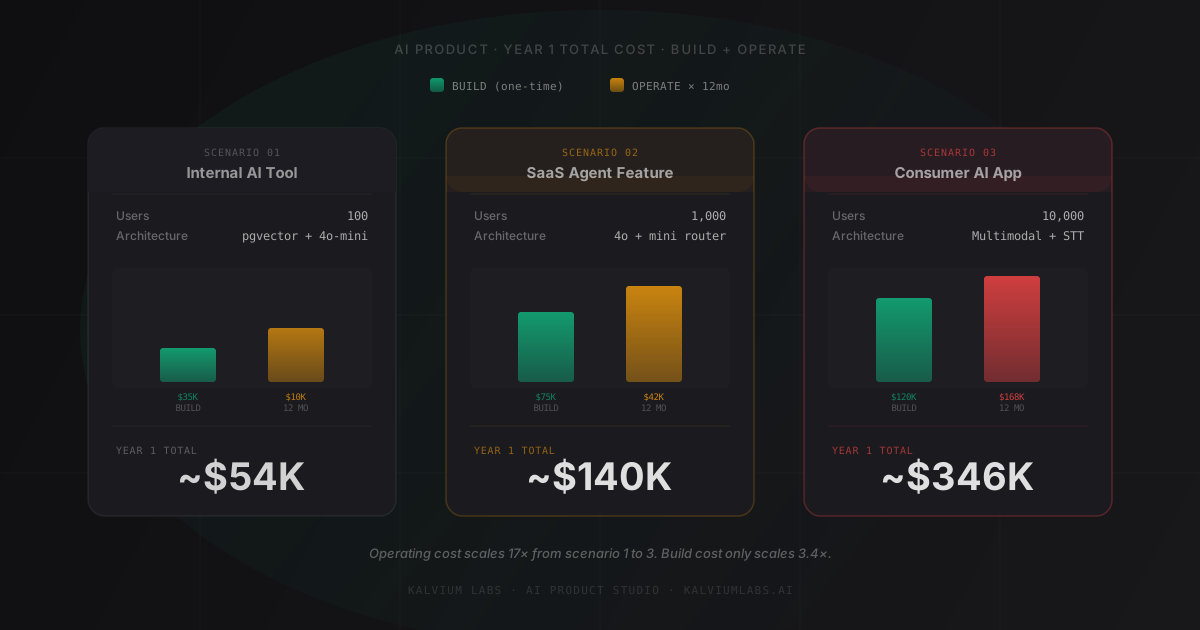
Scenario 1: Internal AI tool, 100 users, simple RAG
A document Q&A system for a 100-person company. Modest usage. Standard architecture: pgvector for retrieval, GPT-4o-mini for the responses, simple eval pipeline.
- Build cost: $35,000 (8 weeks, 1.5 pods)
- Operating cost: $800/month (mostly model API + cloud)
- Iteration buffer: $9,000 (20% of $44,600 sub-total)
- Year 1 total: ~$53,600
Scenario 2: SaaS feature, 1,000 users, agent workflow
An AI agent integrated into an existing SaaS for sales call summarization and CRM updates. Moderate usage. Architecture: pgvector + GPT-4o for the main reasoning + GPT-4o-mini for routing + Langfuse for observability.
- Build cost: $75,000 (10 weeks, 2.5 pods)
- Operating cost: $3,500/month (model API ~$2,000, infra ~$800, observability ~$200, vendor APIs ~$500)
- Iteration buffer: $23,400 (20% of $117,000 sub-total)
- Year 1 total: ~$140,400
Scenario 3: Consumer AI product, 10,000 users, multimodal
A consumer app with voice input, image generation, and persistent memory. High usage. Architecture: Whisper for STT, GPT-4o for reasoning, image API for generation, vector store for memory, full eval pipeline.
- Build cost: $120,000 (14 weeks, 3 pods)
- Operating cost: $14,000/month (model API ~$8,000, vendor APIs ~$3,500, infra ~$1,500, observability ~$500, storage ~$500)
- Iteration buffer: $57,600 (20% of $288,000 sub-total)
- Year 1 total: ~$345,600
Notice the pattern. The build cost varies by 3.4x across the three scenarios. The operating cost varies by 17.5x. Operating cost is the variable that dominates total cost as your product scales, and it’s the variable founders pay the least attention to during planning.
Where to Cut Cost Without Cutting Capability
If those numbers look high for your stage, here’s how to bring them down without compromising the product.
Use pgvector instead of a managed vector database. Postgres with the pgvector extension handles 90% of the use cases that founders default to Pinecone for, at zero additional cost (you’re already paying for Postgres). Switch to a managed vector database when you actually need horizontal sharding at scale, not before.
Use the smaller model for routing, the bigger model for reasoning. A two-model architecture (GPT-4o-mini routing to GPT-4o for hard cases) is the single highest-leverage cost optimization in modern AI products. It’s not always 16x cheaper because the hard cases still hit the expensive model, but a 60-70% cost reduction is achievable for most workloads with no quality loss.
Cache aggressively. Both OpenAI and Anthropic now support prompt caching for repeated context (system prompts, document chunks, conversation history). Cached input tokens are 50-90% cheaper than non-cached. For chat workloads, this is free money. For agent workloads, even more so.
Self-host observability. Langfuse has an open-source version that runs on your existing Postgres. Helicone has a self-hosted option. Both are free. The hosted versions are convenient at scale, but in year one, self-hosted is the right call.
Run your PoC on free credits. OpenAI gives $5 in free credits to new accounts. Anthropic offers credits for startups. Google has Gemini free tier limits that are generous enough to validate small prototypes. Use them. You shouldn’t be paying for tokens during the first week of building anything.
For more on the architecture choices that drive cost, our comparison of vector databases walks through the actual performance and cost differences across pgvector, Pinecone, Qdrant, and Weaviate.
What We Still Get Wrong
I’ll close with the honest part. We’ve been building AI products at scale for over a year now, and we still underestimate certain cost categories on new projects.
We underestimate prompt iteration time. Almost every project goes 20-30% over our planned iteration budget. The model that worked great in week three develops a new failure mode in week seven, and the fix takes a day, and that day wasn’t on the calendar. We’re getting better at building this into estimates, but our default is still optimistic.
We underestimate the cost of evaluation infrastructure on smaller projects. For a $40,000 build, spending $8,000 on evals feels like overkill, until the product hits production and you have no way to tell whether a prompt change made it better or worse. We’re now defaulting to a minimum eval setup on every project regardless of size.
We don’t have a great way to predict when a product will hit a “scale break”, the moment when the architecture that worked at 100 users stops working at 10,000. Sometimes it’s at 5,000 users. Sometimes at 50,000. The triggers (rate limits, latency, vector search degradation) are predictable, but the timing isn’t. We tell clients to plan for it. We can’t tell them exactly when.
The pattern we’re sure about: founders who ask the right questions at the proposal stage end up in better budget shape twelve months later. The right questions aren’t about the build cost. They’re about the operating cost, the eval infrastructure, the migration risk, and the iteration tax. Ask those upfront, and the year-one total stops being a surprise.
FAQ
How much does it cost to build an AI product MVP in 2026?
At studio pricing, an AI MVP build typically runs $30,000 to $100,000 for engineering labor, depending on scope, integration complexity, and whether the architecture is single-model or multi-agent. Add operating costs of $500 to $5,000 per month for the first 12 months at early-stage usage, plus a 20% buffer for prompt iteration and one re-architecture pass. Total year-one cost for most AI MVPs lands between $50,000 and $200,000. Where you fall in that range depends mostly on usage volume and model selection, not on the build budget.
What’s the biggest hidden cost in AI product development?
The LLM API bill at scale. Founders see early-stage token costs of a few hundred dollars per month and assume the line stays small. It doesn’t. A simple chatbot at 10,000 daily active users on GPT-4o costs around $4,000 per month in tokens alone, and that’s before any agent loops, retries, or tool calls. The fix is to architect with model selection and prompt caching from day one, not after the first surprise invoice. The second biggest hidden cost is evaluation infrastructure, which most founders skip entirely until production debugging makes it unavoidable.
How do I estimate token costs for my AI product?
Multiply daily active users by messages per session by tokens per message (input + output), then by 30 for monthly. Apply current model pricing from the provider’s pricing page. For a chatbot, expect 500-1,000 input tokens per message (including conversation history and system prompt) and 100-300 output tokens. For an agent with tool calls, expect 2-4x those numbers due to multi-turn reasoning. Always model your costs at 10x your current expected user count, not your current count, because that’s the bill you’ll actually pay if the product works.
Is it cheaper to fine-tune or to use prompt engineering with a bigger model?
For most use cases in 2026, prompt engineering with GPT-4o or Claude 3.5 Sonnet is cheaper than fine-tuning. Fine-tuning has upfront training costs ($500-$5,000 typically), ongoing hosting costs for the fine-tuned model, and the engineering overhead of maintaining a training pipeline. Prompt engineering has zero upfront cost. Fine-tuning starts winning when you have a high-volume, narrow workflow where token savings from a smaller fine-tuned model exceed the maintenance cost. Most products never hit that threshold. If you’re not sure, default to prompts.
When should I switch from a managed vector database to self-hosted?
Start self-hosted with pgvector. Switch to managed (Pinecone, Qdrant Cloud, Weaviate Cloud) only when you hit one of three triggers: vector search latency exceeds your latency budget at production load, your dataset grows beyond what a single Postgres instance can handle (typically 10M+ vectors with high-dimensional embeddings), or your team doesn’t want to manage the infrastructure. Cost is rarely the right reason to start with managed. Cost is usually the reason teams migrate back to pgvector six months later.
Trying to estimate the real cost of your AI product before committing? Book a 30-minute call. We’ll walk through your use case, model the operating cost at your expected user load, and tell you what year one actually looks like in dollars.