The most useful thing about having run an EdTech company before building AI for EdTech companies is knowing which sales pitches to ignore.
When I was evaluating EdTech AI tools at FACE Prep, I sat through dozens of demos. The vocabulary was consistent: adaptive learning paths, intelligent tutoring systems, personalized learner journeys, engagement optimization. The demos looked polished. The handoffs to operations were uniformly painful.
The problem wasn’t that the technology didn’t work. It was that the technology was designed for a different problem than the one I actually had. My problems were in content production, grading throughput, and infrastructure stability on exam day. The tools I was being shown were designed for learner-facing features: recommendation engines, chat tutors, progress dashboards.
That gap is the thing I most want EdTech founders to understand when they’re evaluating AI vendors. Most vendors learn EdTech from the product layer. Operators who’ve lived it learn from the operations layer. Those are two different curricula.
Why EdTech Vendors Pitch the Wrong Layer
EdTech product teams think in terms of the learner experience: engagement, completion, personalization, outcomes. That’s the right mental model for building a product. It’s the wrong mental model for identifying where AI creates value fastest.
The learner-facing layer is visible, demonstrable, and easy to build a slide deck around. “AI tutor that answers any question” makes for a compelling demo. “AI that compresses your content team’s production cycle by 90%” is less visually exciting and harder to show in 30 minutes.
For most EdTech operators, the second one is worth five times what the first one is worth. Content production is where the hours go, where the money goes, and where quality problems compound. I watched FACE Prep’s content team burn 60% of their time on work that AI now handles in minutes: drafting question variants, checking explanations for accuracy, formatting content to style guide specs, tagging topics and difficulty levels.
None of that was learner-facing. All of it was holding us back from publishing at the pace demand required.
The AI vendor pitching “personalized learning paths” was solving a problem I had in year three. I needed help with the problem I had on Tuesday.
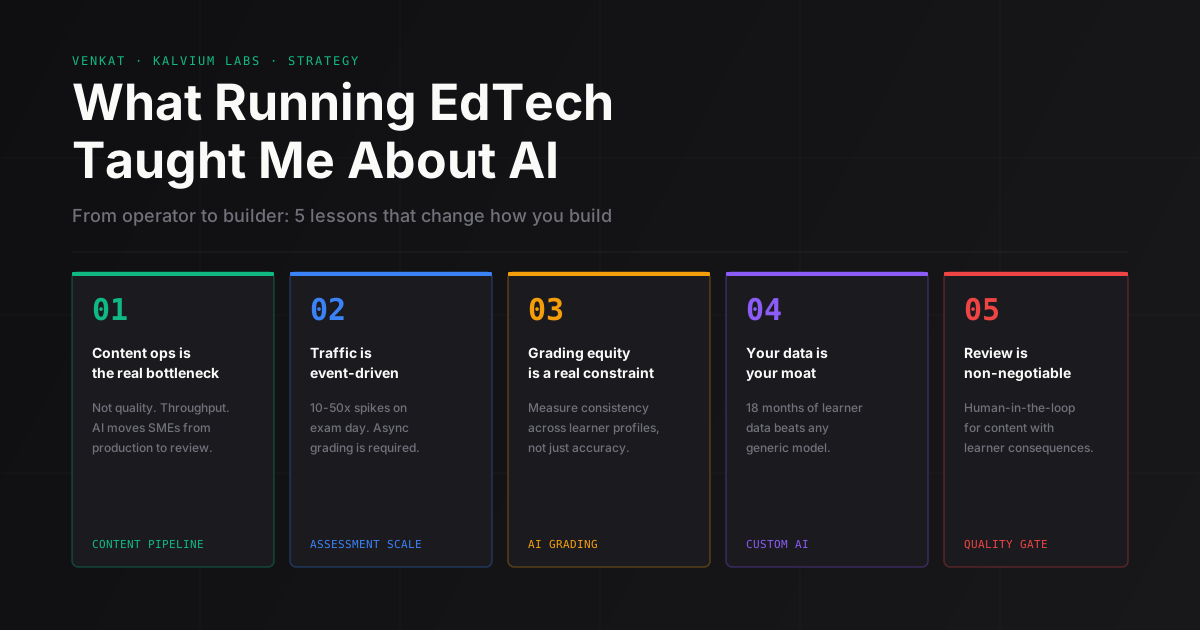
5 Operator Lessons That Shape How We Build EdTech AI
After years on the buying side and now on the building side, I have a clearer view of where the operator-versus-vendor gap shows up. These are the lessons I carry into every EdTech AI build.
1. Content ops is the real bottleneck
In EdTech, “we need better content” usually means “we need more content, faster.” The quality bottleneck is rarely about expertise. It’s about throughput. Your SMEs know what good content looks like. They can’t produce it fast enough because every item needs drafting, editing, accuracy-checking, formatting, and tagging before it ships.
AI changes this by moving SMEs from production mode to review mode. The pipeline generates a first draft; the SME decides whether it passes, needs revision, or gets rejected. That shift is a 4-5x productivity multiplier on content production even if the AI’s first-pass approval rate is only 70%. Getting a reject or a minor revision is faster than starting from a blank page.
The builder implication: the AI’s job in a content pipeline isn’t to replace SME judgment. It’s to give SME judgment something to react to. This shapes every design decision, from how you structure the generation prompt to how you build the review interface.
We’ve built this kind of pipeline for an EdTech provider and seen it cut course production from four weeks to one day. The full architecture walkthrough is here if you want to go deeper on the implementation.
2. EdTech traffic is event-driven, not growth-curve-driven
SaaS traffic grows along a curve. EdTech traffic spikes at exam time, cohort launches, and major assessment dates. The ratio between peak load and typical load in EdTech can be 10-50x, and the peaks are scheduled in advance.
This sounds like an infrastructure problem, but it’s also an AI architecture problem. If your grading model runs synchronously (student submits, API call fires, result returns in the same request), you’ve built a system that will queue-spike on exam day. The correct architecture runs grading asynchronously: submissions land in a queue, grading happens in workers that scale independently, results return when ready.
When we built a K-12 assessment platform that handled 150,000 concurrent users, the architectural choice that made it possible was separating the submission path from the grading path. Students could submit without waiting for a grade. The grade arrived seconds or minutes later depending on queue depth. No submission errors. Operations could monitor queue depth and add capacity ahead of spikes.
Most AI vendors who build grading systems haven’t designed for this pattern because most SaaS AI systems don’t need it. EdTech specifically does.
3. Grading equity is a real constraint
Automated grading has an accuracy problem that gets less attention than it deserves. Not accuracy in the “correct answer detected correctly” sense. Accuracy in the consistency-across-student-profiles sense: does a student from a rural school in Bihar get the same score as a student from a well-resourced school in Bangalore for the same quality of response?
AI grading systems trained on existing human-graded data inherit the biases in that data. If your historical grading was done mostly by SMEs from one educational background, the model will favor responses that look like what those SMEs approve. This isn’t theoretical. It’s a documented pattern in AI assessment research, and it matters practically for any EdTech platform with a diverse learner base.
The lesson isn’t “don’t use AI grading.” It’s “measure consistency explicitly, not just accuracy.” Run your grading model against a held-out set of responses that were scored by multiple human graders and compare variance. If two human graders disagreed, does the AI pick one systematically? That tells you where the bias sits.
This is the kind of operational insight you only get from running an assessment platform. It doesn’t come from a vendor demo.
4. Your historical data is your moat
Every EdTech platform with more than 18 months of operation has something no AI vendor can replicate: a labeled dataset of learner interactions. Which questions students got wrong on the first try. Which explanation formats improved second-attempt accuracy. Which content sequences correlate with higher final scores. Which difficulty-level calibrations turned out to be wrong.
This data is proof that your content works (or doesn’t). It’s training data for a grading model that understands your rubric. It’s the signal that tells a recommendation engine what a good sequence looks like for your curriculum.
Generic AI tools trained on the public internet don’t have this data. They can generate plausible-sounding content and apply general-purpose grading rubrics. What they can’t do is produce content calibrated to your students’ actual performance patterns, or apply grading criteria your SMEs have refined over years.
Custom AI built on your proprietary data compounds your competitive advantage over time. Every assessment cycle adds more signal. Generic tools can’t catch up because they don’t have your data.
The build decision often comes down to this: are you ready to invest in making your data work for you? If yes, custom usually wins. If your data is fragmented or unlabeled, the right first step is often building the data pipeline before building the AI.
5. The review cycle is non-negotiable
I’ve seen EdTech founders try to remove the human review step from AI content pipelines to go faster. The pattern is consistent: quality degrades, errors ship, learner complaints arrive, trust erodes, the review step comes back. The cost of removing it was higher than the time it saved.
The review cycle isn’t a limitation of AI capability. It’s the correct architecture for content with educational consequences. A wrong answer in a practice quiz doesn’t just give a student incorrect feedback; it can reinforce a misconception for months.
What AI changes is what review looks like, not whether it happens. The SME’s job shifts from “draft this explanation” to “is this explanation correct and consistent with our rubric?” That’s faster. It’s also better use of expensive expertise. But the loop stays.
Build the review interface as a first-class part of the content pipeline. The review UX matters: how easy it is to approve or reject an item, how well items are grouped for batch review, whether the interface shows the generation prompt alongside the output. These details determine whether SMEs can move at the speed the AI can generate.
What I Wish I’d Asked AI Vendors When I Was Buying
The questions I should have asked:
“Show me the operations workflow, not the product demo.” What does the content review interface look like? How does the grading queue behave when 10,000 students submit in the same two-minute window? These questions separate vendors who’ve thought about EdTech operations from vendors who’ve thought about EdTech products.
“What’s your answer for exam-day load?” If the answer is “we can scale our infrastructure,” that’s not an answer; it’s a cost number. The answer should be an architecture description: how submissions and grading are decoupled, how queue depth is managed, what the student-facing experience looks like if the grading queue gets deep.
“What does your review workflow look like for content errors?” AI will produce wrong answers. The question is what happens next. Is there a feedback loop from rejected content back to the model? Does the system log which generation prompts produce high reject rates?
“Have the people building this worked inside an EdTech company?” Not consulted for. Not interviewed operators. Worked inside, with accountability for outcomes.
This is where Kalvium Labs has a genuine edge I want to name directly. Anil built coding-evaluation infrastructure at HackerRank, which means his default mental model for a coding assessment includes sandboxed execution and test-case consistency. Rajesh runs Kalvium, India’s first AI-native engineering program, which means Kalvium Labs operates EdTech infrastructure every day.
That doesn’t mean we’ve seen every EdTech problem. But it does mean the questions we ask in a scoping call are different from the questions a generalist AI vendor asks. We ask about your exam-day peak load in the first meeting, not in sprint four.
The Decision That Matters More Than Build vs Buy
Most EdTech AI conversations arrive at “should we build custom or use a vendor tool?” That’s the right question, but it’s the second question. The first question is: what problem are you actually trying to solve, and where does it live in your operations, not your product?
If the answer is “we need to publish more content faster,” the build-vs-buy question is about pipeline design. You’re evaluating content generation quality, review workflow integration, and output format compatibility with your CMS.
If the answer is “we need grading that doesn’t break on exam day,” you’re evaluating infrastructure design: synchronous vs asynchronous grading, queue management, and latency guarantees under load.
If the answer is “we need to understand why certain content segments underperform,” you’re evaluating analytics integration: does the vendor tool expose the data needed to answer this question, or are you locked into their metrics?
Identify the operations problem first. Then the build-vs-buy decision has specific context, and the right answer is usually clear.
For a detailed breakdown of which EdTech AI use cases pay back fastest and the cost ranges for each, that guide covers stage-by-stage prioritization separately.
FAQ
How much does it cost to hire an AI development agency for an EdTech build?
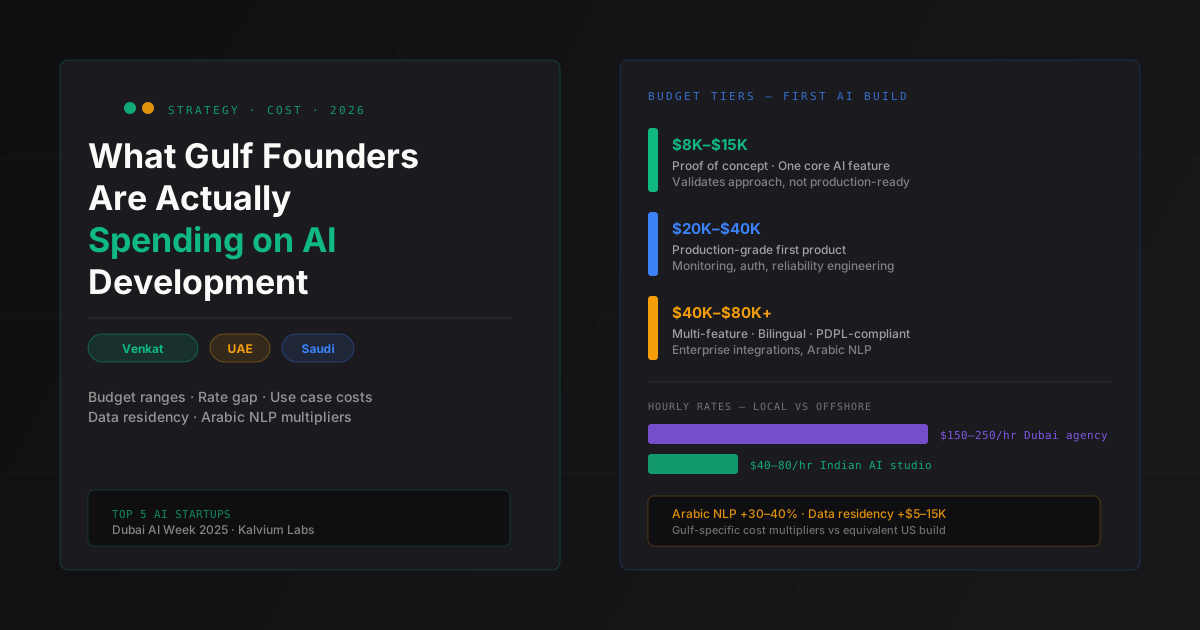
For a focused first build covering one core use case (content automation, assessment infrastructure, coding evaluation, or learning analytics), the range is $15,000-$50,000 depending on integration complexity and scale requirements. The higher end usually involves integrating into an existing LMS with API constraints, or building for exam-day concurrency from the start. A 30-minute discovery call typically narrows the range to a $5,000-$10,000 band before any proposal is written.
When is the right time for an EdTech company to invest in custom AI?
When you have a repeating operations problem that’s costing you people-time, money, or quality consistency. Content teams spending three or more days per module is a signal. Grading backlogs that delay student feedback by 48 hours is a signal. Assessment systems that need manual capacity planning ahead of exam seasons is a signal. The wrong reason to start: “our competitors are using AI.” The right reason: you can name the specific operation that would run measurably better if AI handled the repeatable part.
What’s the biggest mistake EdTech founders make when evaluating AI vendors?
Evaluating the demo, not the operations. Vendor demos show the product layer: the student experience, the dashboard, the recommendation output. They don’t show the review workflow, the exam-day failure mode, or the data feedback loop. Ask to see the operations workflow. Ask what happens when the AI generates a wrong answer. Ask how the grading queue behaves under 10x normal load. The answers to those questions tell you whether the vendor has built for EdTech operations or for EdTech product demos.
How long does it take to build an AI content pipeline for EdTech?
A functional first pipeline covering AI draft generation, SME review queue, and CMS export typically takes 3-5 weeks. Integration with your existing CMS or LMS adds 1-2 weeks if the API is well-documented, more if there are format or authentication constraints. A full production pipeline with logging, prompt versioning, and quality scoring takes 6-8 weeks total. These timelines assume clean access to your content schema and a clear definition of what “done” looks like for the first version.
Should I worry about AI content pipeline quality before I have a large content library?
Yes, but differently than you might think. The risk isn’t that AI quality is too low to be useful. The risk is that you don’t yet have enough labeled examples to calibrate what “correct for your curriculum” looks like. An AI that generates content calibrated to the public internet’s average educational content will need heavier SME revision than one calibrated to your style guide and rubric. Before building, define your rubric explicitly. If you don’t have one documented, that’s the first thing to build. The AI is only as consistent as the criteria it’s working from.
Kalvium Labs has built assessment platforms, course generation pipelines, and coding evaluation infrastructure for EdTech founders at seed through Series B. If you’re evaluating where to start or whether to go custom versus off-the-shelf, book a 30-minute call. We’ll tell you what we’d build given your stage and data situation.