Six months ago, a founder called me with the kind of problem that sounds like a good problem until you understand what happened.
His team had built a proof of concept for an AI-powered document review tool. Lawyers upload contracts, the system flags risks, suggests alternatives, and rates clause-level confidence. The POC demo ran beautifully: the CTO demo’d it to three senior partners, the output was coherent, the UI was clean, and everyone in the room agreed they were looking at something real.
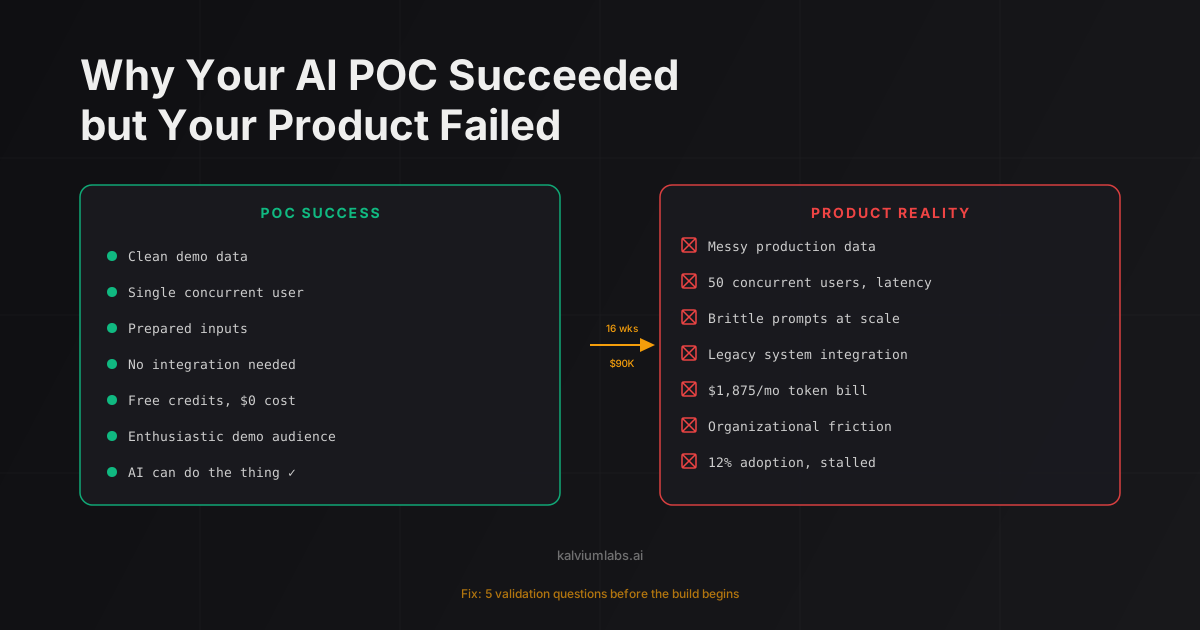
So they built it. Sixteen weeks, $90,000, three engineers. The product launched. Six months after launch, daily active usage was eleven lawyers, mostly the same three people who were in the original demo. The firm had 120 lawyers.
The POC had proven exactly what it claimed to prove: the AI could analyze a contract. What it had not proven was whether lawyers would actually change how they work, whether the confidence scores meant anything to someone with a 22-year practice, whether the system would hold up under real document volume, or whether anyone other than a tech-curious partner would bother learning a new tool. None of those questions were in the POC scope. All of them turned out to be product-killers.
This is not a unique story.
The POC Is a Technology Test, Not a Product Test
This distinction sounds obvious in retrospect. It is not obvious in the room when the AI is doing something impressive.
A POC answers one question: can the AI do this thing? Can it read contracts? Can it transcribe calls? Can it classify customer tickets? Can it generate reports? The answer, in 2026, is almost always yes. The AI can do the thing. The technology is real. The POC succeeds. (If you’re still unclear on the distinction between a POC, prototype, and MVP, this breakdown covers the differences with a clear framework for when to build each.)
The product questions are different. Will people change their workflow to use this? Will they trust the output enough to act on it? Does the AI work on their actual data, not the cleaned sample you used in the demo? Does it work at 3 AM on a Tuesday when the infrastructure is under load? What happens when it’s wrong, and how do users know it’s wrong?
POC asks none of these questions by design. That’s fine. The problem isn’t that POCs are too narrow. The problem is when teams treat a POC success as validation for all the product questions that were never asked.
I’ve watched this happen enough times that I can now categorize the failure patterns. There are six of them.
Pattern 1: Demo Data vs Real Data
The POC runs on data that someone prepared for the demo. Maybe it’s a sample of customer records, a set of contracts that were manually cleaned, a batch of call recordings with good audio quality, a collection of documents without edge cases.
Real data is different. Real data has inconsistent formatting. It has duplicates, nulls, encoding issues, OCR artifacts, non-standard date formats, and junk records that accumulated over years of human input. It has historical data that doesn’t match current business rules. It has documents in languages that weren’t anticipated. It has audio with background noise, cross-talk, and regional accents.
The AI that performed at 94% accuracy on the demo dataset might hit 60% on the production data. Not because the model degraded. Because the demo data was unrepresentative.
The fix is not complicated: before committing to a build, run the AI on a sample of actual production data, not a cleaned extract. We do this as a mandatory step now after getting burned on a document processing project where our chunking strategy worked perfectly on the sample and completely broke on documents with embedded tables and footnotes. One week of testing on real data would have caught it.
Pattern 2: Latency Tolerance Is Usage-Specific
Demos tolerate latency in ways that production users don’t.
In a demo, you click, you wait, something impressive appears. The 4-second response time is fine. You’re paying attention. You’re watching for the output. The wait is acceptable because you know what’s coming.
In a production workflow, 4 seconds is forever. If a lawyer has to wait 4 seconds for every clause analysis while reviewing a 50-page contract, the tool adds friction instead of removing it. If a sales rep has to wait 6 seconds for the next question suggestion during a live call, the tool is worse than no tool. The AI that impressed everyone in the demo becomes the AI that people stop using because it slows them down.
Latency requirements are not uniform. Internal document processing can tolerate minutes per document. Real-time call coaching cannot tolerate more than 1-2 seconds. Customer-facing chatbots have a ceiling somewhere around 3 seconds before users assume the system is broken. Batch analysis for overnight report generation has essentially no latency constraint at all.
The POC rarely tests under production latency requirements because the demo team is running on cleared cache, clean data, and a single concurrent user. The real system runs with 50 users, cold cache, real document sizes, and network latency from wherever the users actually are.
Before committing to a build, map the acceptable latency for the specific workflow this AI is replacing. Then test the POC against that latency under realistic conditions. This is the one test that consistently reveals structural architectural problems before the build starts.
Pattern 3: Prompt Brittleness at Scale
POC prompts are written for the demo inputs.
The team knows what kinds of requests are coming. The prompt is tuned for those inputs. The system prompt is carefully crafted to handle the ten scenarios that were tested. The output looks clean, structured, and consistent.
Production users do not send inputs that match the ten scenarios that were tested. They ask the same question five different ways. They include context that the prompt wasn’t designed for. They upload documents with structures the team didn’t anticipate. They use domain jargon specific to their sub-vertical. They make typos, use abbreviations, and send messages in the middle of a longer workflow the AI has no context for.
Prompt engineering has a dirty secret: prompts that work in controlled conditions often break in unpredictable ways in uncontrolled conditions. The failure mode is not that the AI refuses to answer. The failure mode is that the AI gives a plausible, confident, wrong answer. That’s the worst outcome: the system behaves as if it’s working while producing unreliable outputs that users can’t distinguish from correct ones.
The test for prompt brittleness is adversarial input testing before the build phase. Give the POC to five real users with no instruction, watch what they try, and see what breaks. The inputs that break the POC are the inputs you need to handle in production. If you can’t handle them, you don’t have a product yet.
We’ve started building a 30-input adversarial test set for every POC we hand off internally. It costs two hours and has caught production-killing failure modes on three out of five projects we ran it on.
Pattern 4: Integration Reality vs Integration Assumption
The POC lives in its own environment. It reads data from a file, writes output to a screen, and doesn’t touch any existing system.
The product has to integrate with what’s already there. The CRM that’s been running on-premise since 2019. The ERP system that the IT team won’t give you API access to. The sales tool that exports data in a CSV format that was designed before anyone thought about machine readability. The authentication system that requires a specific OAuth flow the AI vendor doesn’t support. The legacy database with normalized relationships that don’t map cleanly to the documents structure the AI expects.
Integration work is where POC timelines go wrong by 3-5x. We’ve seen it enough that we now budget integration separately from AI development, and integration routinely costs as much as the AI itself. In some projects, it costs more.
The deeper issue is that integration blockers often change the AI design. If you can’t get real-time access to the CRM, the AI has to work on batch-synced data instead of live data. That changes the latency characteristics, the accuracy, and the use cases it can serve. If the authentication flow adds two steps, the daily-use case might drop to weekly-use. The product that looked compelling with the POC assumptions doesn’t look the same when integration constraints are applied.
The right time to discover integration constraints is during the POC phase, not after the build budget is approved. A 2-day integration audit before the build starts is one of the most valuable things we’ve added to our standard process.
Pattern 5: The Cost Model Breaks at Scale
A POC costs almost nothing to run. The founder uses free credits. The team runs a few hundred test cases. The model bill is under $50 for the entire POC phase.
Then the product goes to 500 users, each using it 10 times per day. The token math compounds. For a workflow that uses GPT-4o and passes 2,000 tokens of context per request with 500 tokens of output, 500 users at 10 requests each is 10 million input tokens and 2.5 million output tokens per day. At current OpenAI pricing ($2.50 per million input, $10 per million output), that’s $25 per day for input, $25 per day for output, totaling $50 per day, or $1,500 per month.
That sounds manageable until you realize the product is monetizing at $29/month per user. At 500 users, revenue is $14,500/month. Token costs alone are $1,500. Then add infrastructure, storage, observability, support, and the engineering team. The unit economics don’t work.
The POC never revealed this because the POC never modeled the cost at scale. The demo team proved the AI works. Nobody modeled what the AI costs to run per user per day at production volume.
The fix is a cost model before the build: tokens per request (input and output), requests per user per day, target user count, model price, and a comparison against planned monetization. If the math doesn’t work at 100 users, it won’t work at 1,000. Find out during the POC phase, not when the first invoices arrive. For the full token math with real numbers across common model choices, the real cost of building an AI product breaks this down in detail.
Pattern 6: Organizational Friction Beats Technical Excellence
The hardest failure pattern to see coming from the POC is also the most common reason AI products die.
The AI works. The integration works. The latency is acceptable. The accuracy is good. And then adoption stops at 12% because the people who are supposed to use it didn’t ask for it, don’t trust it, haven’t changed their incentive structures to reward using it, and are evaluated by their managers on metrics that have nothing to do with whether the AI tool helps.
A legal AI tool that flags risky clauses is only useful if lawyers review the flags. But if lawyers are billed by the hour and the AI cuts their review time by 40%, using the AI reduces their billable hours. The incentive structure actively works against adoption.
An AI that summarizes customer calls is only useful if sales managers act on the summaries. But if sales managers don’t trust automated analysis of their team’s performance, the summaries get ignored. The organization needs to change how it manages the team before the AI creates value.
These are not technology problems. A better model doesn’t fix them. A redesigned UI doesn’t fix them. They require someone on the product side to map the change management requirements before committing to the build.
The POC never surfaces this because a POC doesn’t have real users in real organizational structures. The CTO demo’d it to partners who were excited. That is not a proxy for 120 lawyers who weren’t consulted, have existing workflows, and face incentive structures that the AI disrupts.
The Transition Protocol That Addresses All Six
The gap between POC success and product failure is not a technology problem. It’s a validation scope problem.
There are five questions I now insist on answering before recommending a build. Not a six-week study, not a committee review. Five questions, two to five days of structured testing, and a clear go/no-go decision.
1. Real data audit: Run the AI on 100 samples of actual production data, not demo data. What’s the accuracy? Where does it break? What’s the worst-case failure mode?
2. Latency test under load: Run the AI with 10-20 concurrent users against the production data size. What’s the p95 latency? Is that acceptable for the specific workflow?
3. Adversarial input session: Put the AI in front of 5 real users with no instruction. What do they try that breaks it? Can you fix those cases with prompt changes, or do they require architectural changes?
4. Integration audit: Document every system the AI needs to touch. Get an engineer to assess API access, data formats, authentication requirements, and data latency for each. What can’t be integrated? How does that change the product?
5. Organizational map: Who uses this tool daily? Who evaluates them? What incentive changes does adoption require? Who in the organization can make those changes?
If you can’t answer all five, you’re not ready to build. The POC proved the AI can work. These five questions determine whether your product will.
A Different Way to Think About It
Here’s the mental model I use when talking to founders after a successful POC.
A POC proves the technology is real. It doesn’t prove the product is real. Those are two separate claims that require two separate validations.
Most teams validate the technology and assume the product follows. It doesn’t. Product validation is harder, messier, and involves people who weren’t in the demo room. It involves workflows, incentive structures, integration constraints, cost models, and latency requirements that a clean demo deliberately avoids.
The good news is that post-POC validation doesn’t have to add months to the timeline. Done right, it takes one week. One week of structured, focused testing before the build starts can tell you whether the product will work or whether the POC success is concealing a product problem.
One week now, or sixteen weeks and $90,000 later. That choice is always available.
FAQ
Why do AI POCs succeed so often if products fail so frequently?
POCs succeed because they’re designed to succeed. The team controls the data, controls the inputs, controls the demo environment, and optimizes for a compelling 30-minute presentation. That’s the right goal for a POC. Products succeed under different conditions: real data, real users, real organizational friction, real cost constraints. The POC tests a subset of what the product needs to pass. Treating POC success as product validation is a scope error, not a technology error.
How long should the transition from POC to product build take?
The structured validation I described (real data audit, latency test, adversarial inputs, integration audit, organizational map) takes 3-7 working days. If you’re doing it right, you’re not adding months. You’re adding one week of targeted testing that either de-risks the build or surfaces a fundamental problem. If the validation reveals issues, it might take another 2-4 weeks to resolve them before starting the full build. That’s still faster and cheaper than building for 16 weeks and discovering the same issues in production.
What’s the most common failure pattern you see after a successful POC?
Organizational friction, by a wide margin. The AI works. The people don’t use it. Almost always, the reason traces back to incentive structures or workflow disruption that nobody mapped before the build started. Legal teams billed by the hour. Sales managers who don’t trust automated analysis. Ops teams whose KPIs don’t include AI adoption. The technology was never the bottleneck. The change management was.
How do I know if my POC data is representative of production data?
Ask your data team for the “worst-case” sample, not the average-case sample. Request the 10% of records that are most problematic: oldest imports, most inconsistent formatting, records that previously broke other systems, edge-case document types. If the AI handles those, you have a more reliable signal. If it fails on them, you know what to fix before the build. The POC team almost always uses the clean 80%, not the messy 20%. The messy 20% is where production AI earns its value.
Should every startup do a formal POC before building?
Not always. In 2026, the technical feasibility question has been answered for most standard AI use cases: document Q&A, call transcription and analysis, classification, summarization, report generation. For these, a 72-hour prototype that tests product assumptions is more valuable than a POC that tests technical feasibility. The POC made more sense in 2022-2023 when the technology itself was unproven. Now the technology is proven. The product is the harder question.
If you’ve completed a POC and want a second opinion before committing to the full build, book a 30-minute call. We’ll walk through the five validation questions and tell you honestly what we’d want to see answered before starting development.