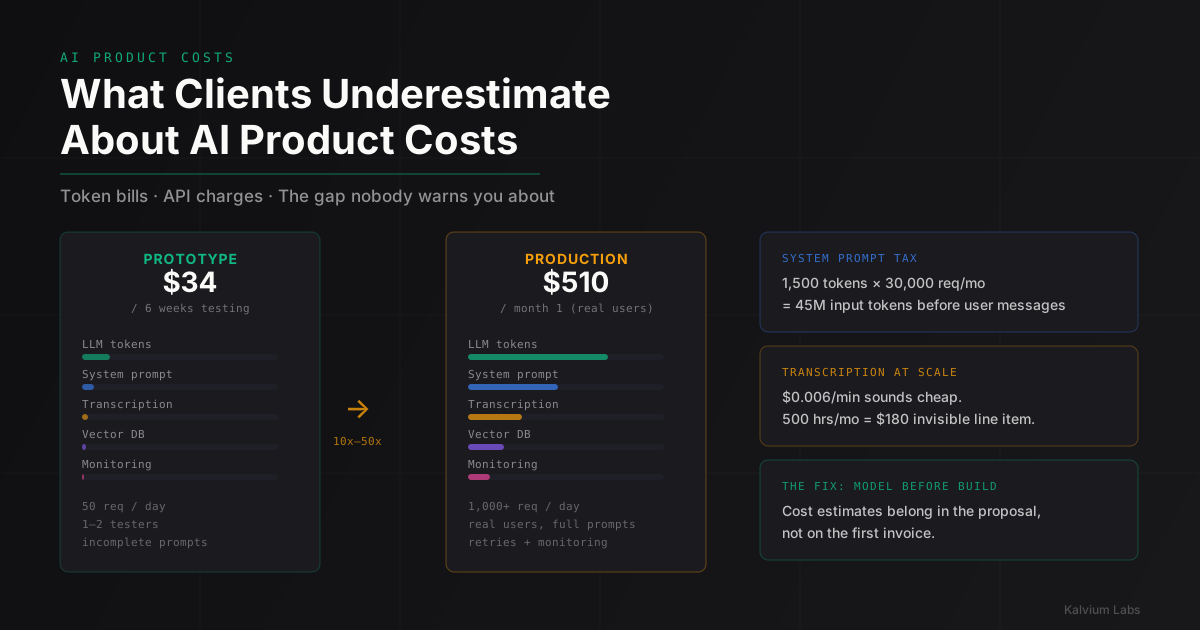
A founder I worked with last year described his prototype as “basically free to run.” He’d been testing it for six weeks and spent $34 in API credits. He was right that $34 was trivially cheap. He was wrong about what it meant.
Three months later, in the week before we launched the production version, I sent him the operational cost model I’d attached to the original proposal. He mentioned he hadn’t read that section because the prototype costs had made AI expenses feel like a non-issue. His first full month of production costs came to $510.
Not catastrophic. He was building a B2B product with real revenue. But $510 was $476 more than anything in his mental model, and surprises in the wrong direction erode trust faster than the number itself warrants.
This happens often enough that I now walk every client through the cost structure before we write a single line of production code. Not because $510 is scary, but because founders make better architectural decisions when they understand what drives the number.
Why the Prototype Cost Lies to You
The gap between prototype and production costs is almost never about the model you choose or the complexity of the code. It’s about volume and completeness.
During prototyping, you’re the only user. You send 30-40 messages a day at most, typically to test specific flows. Your system prompt is half-drafted. There’s no retry logic, no error recovery, no parallel request handling. You run a few hundred queries and look at the outputs.
In production, a modest-sized B2B application might handle 5,000-20,000 requests a day. Every request includes the full system prompt. Every retry counts twice. Every background job runs on real cycles. The test dataset that cost $34 to process costs $900 to reprocess when the client’s real corpus arrives.
The ratio isn’t fixed. For simple chatbots it might be 10x. For document pipelines with heavy preprocessing it can be 50x or more. When I build cost models for clients, I start from expected daily active users and work backward to token volumes, not forward from prototype spend.
The System Prompt Nobody Budgets
This is the cost item that surprises people most consistently.
A system prompt is the instruction block that tells the AI how to behave: its role, the context it needs, the constraints it should follow, the format of the output. For a well-specified product, that’s typically 800-2,500 tokens.
The thing clients forget: that prompt gets sent on every single request. Not once when you set it up. Every time a user sends a message.
Take a system prompt of 1,500 tokens. At 30,000 requests per month (roughly 1,000 requests per day, realistic for a mid-scale B2B product), that’s 45 million tokens per month in system prompt input alone, before any user messages, before any response generation. At GPT-4o pricing of $2.50 per million input tokens, that’s $112.50 a month from the system prompt line item alone.
Add user messages averaging 200 tokens and responses averaging 400 tokens, and the full input/output cost for that same traffic comes to roughly $270-400/month depending on the model.
Still manageable. But when a founder has been looking at a prototype bill of $8-12/month, the mental model shift takes a moment.
The two things I always check in the engineering design before we quote a production cost estimate: how long is the system prompt, and is there any caching in place? OpenAI prompt caching and Anthropic’s equivalent can cut repeated prompt costs by 50-90% for high-traffic use cases. Anil Gulecha, our CTO (ex-HackerRank, ex-Google), makes the call on whether the caching overhead is worth it for a given architecture. For anything above 20,000 requests/day, it almost always is.
The APIs That Don’t Come Up in Initial Conversations
Token costs from the main language model are the most visible line item. They’re also not the only one.
Transcription. Any product that handles audio runs transcription separately. OpenAI’s Whisper API costs $0.006 per minute. That sounds negligible. At 500 hours of audio per month (not unusual for a sales enablement or compliance product), it’s $180. We’ve had clients budget nothing for transcription and then discover it’s the third-largest line item in their infrastructure bill.
Embeddings. Converting documents or messages into vector representations costs tokens too, usually through an embeddings endpoint. The per-token rate is much lower than generation (roughly $0.02-0.10 per million tokens), but if you’re re-embedding a large corpus regularly, it accumulates.
Vector database. RAG-based products need somewhere to store and query the embeddings. Pinecone, Qdrant, and Weaviate all have free tiers that work fine for prototypes. Production usage, depending on corpus size and query volume, often lands in the $25-80/month range for a mid-scale deployment.
Monitoring and observability. Production AI products need logging. Not just for debugging, but for catching model degradation, tracking response quality, and managing costs over time. Tools like LangSmith or Helicone are free at low volumes. At higher traffic they’re $20-50/month. Worth it. But also not in most first-draft budgets.
None of these are large individually. Combined, they represent a real operating cost that clients sometimes discover only on the first invoice.
What Scaling Costs Actually Look Like
I find it helpful to show clients the numbers at three volume levels: current prototype traffic, expected launch traffic, and realistic growth traffic six months out.
Here’s an approximation of what a mid-complexity AI chatbot with RAG looks like across those ranges:
| Traffic Level | Daily Requests | Est. Monthly API Cost |
|---|---|---|
| Prototype | 50 | $5-15 |
| Launch | 1,000 | $80-180 |
| Growth (6mo) | 10,000 | $600-1,200 |
The numbers vary by model choice, system prompt length, average message length, and how much retrieval is happening. But the shape is consistent: linear growth in requests produces near-linear growth in cost until you implement caching and routing optimizations.
The architectural decisions that change this slope most significantly are: model tiering (using a cheaper model for classification and a more capable model only when needed), prompt compression (trimming system prompts without losing behavior), and caching (avoiding redundant processing of identical or near-identical inputs). All of these are architectural decisions, not implementation details, which is why we model the cost structure before engineering starts rather than after.
Where We’ve Gotten This Wrong
Last year we underestimated the operational costs on an internal knowledge base product by about 40%. The client asked question types we hadn’t anticipated during scoping, which produced much longer answers than our test cases. We’d estimated average response length at 300 tokens. Real usage was averaging 650.
That doubled the output token cost from our model. Combined with a larger corpus than expected (and therefore more frequent re-indexing), the monthly bill came in at $380 instead of the $220 we’d quoted as the realistic case.
We caught it in month two and renegotiated the maintenance arrangement. Not the best outcome, but it led to a process change: we now instrument token usage from day one of production and review it weekly for the first month. If the actuals are trending 25% above the model, we flag it immediately instead of discovering it on the invoice.
The review cadence matters because cost surprises aren’t just financial. They indicate that real usage is different from the usage you designed for, which usually means the product behavior needs a look too.
How We Build Cost Estimates That Don’t Blow Up
The process I run before every production engagement:
Step 1: Define the traffic envelope. What’s the expected number of daily active users? What’s the expected interactions per session? This gives a request volume estimate, which is the most important variable.
Step 2: Profile the token load. How long is the system prompt? What’s the expected user message length? What’s the expected response length? What’s the retrieval payload size if RAG is in the architecture? These give the per-request token cost.
Step 3: List the secondary APIs. Transcription? Embeddings? Vector DB? Monitoring? Each gets a rough monthly estimate based on expected usage.
Step 4: Model three scenarios. Conservative (current users, no growth), realistic (expected growth at three months), stress (10x traffic for a viral event). The realistic case is what I put in the proposal. The stress case is what I tell the client to plan for if anything goes unexpectedly well.
Step 5: Identify the top optimization lever. Is there one decision that would cut costs by 30% or more? Usually there is: a tiered model routing strategy, a caching layer, a prompt compression pass. I flag it as something we’ll implement if traffic exceeds the realistic scenario.
This process takes about two hours. It happens before the engineering proposal goes to the client, not after the system is live.
When to Worry and When to Stop
Most AI product costs at seed and Series A are manageable. For a B2B product with paying customers, $200-800/month in operational AI costs is a line item, not a crisis. It’s less than a single cloud server for many workloads.
For more on this, read our guide on AI Maintenance Costs in Year 2. Where costs become genuinely difficult:
High-frequency pipelines. If every document upload, every user action, or every database change triggers an LLM call, the costs scale with your data volume rather than your user volume. A product that processes 100,000 documents a day is a different cost structure from a product where 100 users each send 10 messages a day, even if the token count is similar.
Voice products at scale. Transcription is cheap per minute and not cheap per hour at volume. A product that processes 5,000+ hours of audio per month needs a purpose-built transcription infrastructure conversation, not just a Whisper API line item in the budget.
Long-context retrieval. Products that send large document chunks to the model on every query (rather than just the most relevant passages) can have 5-10x higher costs than their architecture diagrams suggest. Context window management is the most underspecified piece of most RAG systems I review.
For everything else: model the costs, understand the drivers, build in an optimization trigger point, and stop worrying. The goal isn’t zero AI costs. It’s AI costs that are predictable, proportional to the value delivered, and visible before they become surprises.
Venkat covers the broader financial picture in The Real Cost of Building an AI Product in 2026 if you’re looking at the full development investment, not just operational costs.
FAQ
Why do AI development services cost more in production than during prototyping?
Prototypes run at a fraction of real usage: usually one or two testers, a small test dataset, and incomplete features. Production means real users, full prompts, retry logic, monitoring, and secondary APIs. The token volume difference is typically 10x to 50x. Costs scale proportionally unless you’ve implemented caching, model tiering, or other optimizations designed for production traffic.
What’s the biggest hidden cost in AI products that clients miss?
System prompt tokens, consistently. Most founders don’t realize the system prompt is charged on every request, not once. For products with long instruction blocks and meaningful traffic, the system prompt can account for 30-50% of the monthly token bill.
How do you estimate AI operational costs before building?
The key variables are: daily request volume, average system prompt length, average user message length, average response length, and the list of secondary APIs (transcription, embeddings, vector DB). Build a simple spreadsheet with these inputs and the model’s published per-token pricing. Add 20-30% for retries, monitoring, and unexpected usage patterns. Run the model at three traffic levels: current, expected, and 10x.
When should I worry about AI API costs for my startup?
When costs are unpredictable rather than just high. A $400/month AI bill is fine if you modeled it. The same $400 bill is a problem if you expected $40. Build cost visibility into production from day one: log token usage, set billing alerts, and review costs weekly for the first month. Most cost surprises show up in the first three weeks of real usage.
Which architectural decisions most affect AI operational costs?
Prompt caching (cuts repeated prompt costs by 50-90% on high-traffic products), model tiering (use a cheaper model for classification or simple queries, a more capable model only for complex generation), and context window management in RAG systems (retrieve only the most relevant passages, not entire documents). These decisions are best made before engineering starts, not after the first invoice arrives.
Planning an AI product and not sure what the operational costs will look like? Book a 30-minute call and I’ll walk through a cost model for your specific use case, including the secondary APIs most people miss.