The term “Forward Deployed Engineer” first appeared in Palantir’s hiring pages over a decade ago. Since then it’s spread across OpenAI, Anthropic, Google Cloud, Salesforce, and dozens of AI-first companies. Search for it today and you’ll find guides written for people applying for the role.
This guide is written from the other side: for companies that want to deploy one.
At Kalvium Labs, we currently have forward deployed engineers embedded at Maersk, TradeLab, and Eternz. I’m writing this from the provider’s chair, not the candidate’s. What follows is what the model actually looks like, what it costs in India, and when it makes more sense than running a hiring process.
What “Embedded” Actually Means
An FDE isn’t a remote contractor who logs tickets from a distance. Embedded means:
- Working in your codebase, not a separate contractor repo
- Attending your standups, planning sessions, and retrospectives
- Shipping production code with your team, not alongside it from the outside
- In your Slack, GitHub, Jira, or Notion from day one
- Onboarding the same way a new hire would
The key structural difference from a full-time employee: the FDE is employed and managed by the deploying company, not by you. You don’t handle their payroll, PF contribution, health insurance, tax filings, or performance reviews. The deploying company handles all of that. You get the embedded experience without the HR infrastructure behind it.
That’s the whole model. Simple in concept, but execution depends entirely on the quality of the deployment pipeline.
How FDEs Differ From Staff Augmentation
Most founders and engineering directors I talk to conflate these two models. They’re different in ways that matter for what you actually get.
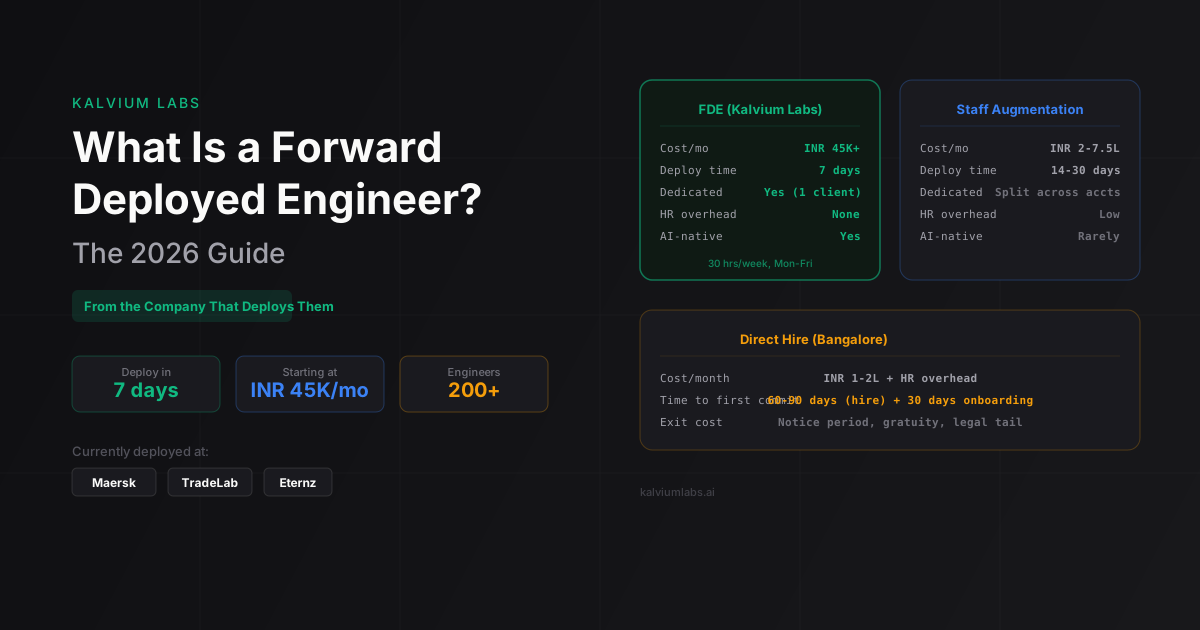
Traditional staff augmentation puts developers from a bench into your workflow. The developers are often split across multiple client accounts simultaneously. Screening is resume-level. The value proposition is additional capacity, not depth of integration.
FDE deployment differs in three specific ways.
Dedicated, not shared. An FDE works for one client at a time. When we deploy an engineer at Maersk, those 30 hours/week go entirely to Maersk. There’s no context-switching between accounts, no split attention across projects.
Integrated, not adjacent. FDEs are expected to understand your architecture, your deployment conventions, your team’s way of working. Not just pull tickets. The integration is part of the model by design.
Pipeline-trained, not generalist-sourced. Kalvium Labs FDEs come from India’s first AI-native engineering program. They’ve built LLM applications, RAG pipelines, and agentic systems as part of their training before their first client engagement. The technical foundation isn’t on-the-job; it was built before the job started.
That third point is the structural difference that makes our pricing possible. More on that below.
The Training Pipeline Behind the Pricing
A question we hear from GCCs and founders on almost every discovery call: “INR 45,000/month seems low for an AI engineer. What’s the catch?”
My short answer: there’s no catch, only an unusual supply-side structure.
Kalvium Labs is a product of Kalvium, India’s first AI-native engineering program (founded 2021). The same program produces the engineers we deploy. They’re trained on LLMs, RAG, agentic systems, and full-stack development from their first year of the program, not as electives or add-ons to a traditional CS curriculum. When we deploy an FDE, they’ve already built 5-8 production-adjacent AI applications as part of structured training.
The relevant contrast: a software engineer with 3 years of Java experience who completed a 3-month LLM course in 2024. That’s an AI-retrained engineer. Useful, but fundamentally different from someone whose first significant engineering project was an LLM application, built before they ever wrote a traditional CRUD app.
200+ engineers in our Kalvium pipeline means we have depth and supply. We’re not hiring from Naukri or LinkedIn at market rates and passing the cost to you. Our supply chain is internal. That’s why the unit economics at INR 45K/month are sustainable.
What an FDE Engagement Costs in 2026
Real numbers:
| Engagement | Monthly Cost (INR) | Time to Deploy |
|---|---|---|
| Kalvium Labs FDE (entry level) | 45,000 | 7 days |
| Kalvium Labs FDE (experienced) | 75,000 - 1,25,000 | 7 days |
| Direct hire, mid-level AI engineer (Bangalore) | 1,00,000 - 2,00,000 | 60-90 days |
| India staffing agency | 2,00,000 - 7,50,000 | 14-30 days |
A few clarifications on what these numbers mean in practice.
30 hours/week. Monday-Friday, 12 PM - 6 PM IST, plus scheduled team meetings outside this window. Most real engineering work doesn’t require 8 continuous hours per day of productive output. It requires focused, uninterrupted work on a single problem. 30 dedicated hours from someone working exclusively on your product generally outperforms 40+ diluted hours from someone splitting attention across accounts.
3-month minimum. Not arbitrary lock-in. Meaningful engineering work takes 90 days to establish: understand the architecture, build trust with the team, ship a few features that require real judgment about tradeoffs. In our experience, the 30-day check-in is when clients say “this is working” and the 90-day mark is when they ask to extend. After the 3-month minimum, engagements continue month-to-month.
Experience-based pricing. The INR 75K-1.25L range applies to FDEs with production deployment history, specialized skill sets (voice AI, agentic systems, specific frameworks), or domain expertise relevant to your industry.
No HR overhead on your end. No PF contribution, no gratuity, no notice period, no equity dilution. The FDE leaves your team cleanly if the engagement ends, with no legal tail for you to manage.
When FDE Deployment Makes Sense
Not every situation calls for this model. Here’s how I’d think through the decision.
Deploy an FDE when:
You need AI engineering capacity in less than 30 days. The typical GCC hiring process for a specialized AI engineer runs 60-90 days from job approval to accepted offer, and that assumes the role is approved and posted already. FDE deployment is live in 7 days.
You want embedded capacity, not a packaged solution. FDEs work in your codebase and understand your architecture. If what you need is a custom feature built into your existing system, that’s the right model. If what you need is a standalone tool delivered independently, a fixed-bid project might be better.
You’re evaluating whether to build a full AI engineering team. A 3-month FDE engagement gives you working proof: does AI engineering in this domain actually accelerate your product? What does the work look like? What skills do you need next? That clarity is hard to get from a hiring process alone.
You’re a GCC with an AI transformation mandate and a hiring cycle that doesn’t match it. HQ says build AI capabilities this quarter. HR says the specialized hire will take 3 months to close. FDE deployment is the gap solution that keeps the mandate on track.
Hire directly when:
The role is a 2+ year strategic position with meaningful equity upside. Engineers who are building career equity alongside financial returns have different incentives from deployed engineers. For long-term, architecture-level roles, that difference matters.
The domain knowledge required is so proprietary that external training pipelines can’t close the gap quickly. If the role requires 18 months of context in your specific product, you need someone building that context from inside.
You have the runway and HR bandwidth for a 90-day hiring process and want the long-term cost structure of a direct hire at scale.
For most GCCs and funded startups dealing with an AI capability gap in 2026, the FDE path closes the gap faster at lower cost with lower commitment overhead. The hire-directly path makes more sense once you’ve confirmed exactly what you need, often after an initial FDE engagement has helped you understand that.
What the First 30 Days Look Like
This comes up on nearly every discovery call.
Week 1. Codebase access, dev environment setup, documentation review. The FDE meets the team and maps the architecture. No production commits yet. This is intentional: a week spent understanding the system is worth more than a week of guesses dressed up as code.
Week 2. First bounded ticket. Something low-risk where the solution space is reasonably clear. The goal isn’t velocity; it’s validating that the integration is working and the FDE has enough context to make sound decisions.
Week 3. First production feature or fix lands. We check in with you on how the integration is going. Any friction in the workflow gets identified here before it becomes a pattern.
Week 4. Full working pace. Code reviews, standups, shipping. Most clients tell us the FDE feels like a full-time team member by the end of month one.
The first 30 days are planned, not improvised. We’ve run this process at Maersk, TradeLab, and Eternz. The structure is what makes the speed possible without the usual onboarding-induced chaos.
Why Indian GCCs Are Deploying FDEs in 2026
There’s a structural reason this model is gaining ground specifically with GCCs right now.
TeamLease Digital’s 2025-26 workforce report puts the AI talent gap in Indian GCCs at 38-42%. GCCs have HQ mandates to build AI capabilities and the budget to do it. The bottleneck isn’t money or intent. It’s hiring velocity.
The standard GCC hiring cycle for a specialized AI engineer runs 60-90 days, and that’s optimistic. Background checks, multi-round interviews, offer negotiation, notice periods for candidates currently employed elsewhere: the timeline adds up. FDE deployment bypasses all of it. The engineer is onboarded and writing code before the equivalent direct hire position finishes screening.
The model also de-risks the initial commitment. A 3-month engagement with no notice period lets a GCC prove the FDE model on one team before deciding whether to expand. If the fit is right, they scale to 3, 5, 8 engineers. If it isn’t, they’ve spent INR 1.35L and lost no IP.
The math at scale is where this gets compelling. Eight engineers at INR 45K/month is INR 3.6L/month total. Eight mid-level direct hires at INR 1.5L/month is INR 12L/month, plus hiring overhead, plus ongoing HR overhead per head. For GCCs building out AI capabilities over 12-24 months, the total cost difference is significant.
For a deeper look at the hire-vs-deploy math from the startup side, this post on hire AI engineers vs. agency for Series A companies walks through the sequencing logic. The GCC version has the same structure, different timeline pressures.
If you’re comparing FDE deployment to a full-time hire or a dev agency specifically, this breakdown of full-time hire vs. agency covers the cost decision from the founder’s perspective.
FAQ
What is a Forward Deployed Engineer?
A Forward Deployed Engineer (FDE) is a software engineer who works embedded directly in a client’s team. They use the client’s tools, attend the client’s standups, work in the client’s codebase, and ship production code as if they were a full-time hire. The key distinction: they’re employed and managed by the deploying company, not the client. The term was popularized by Palantir and is now standard across OpenAI, Anthropic, and Google Cloud.
For more on this, read our guide on FDE vs Staff Augmentation.
How much does a Forward Deployed Engineer cost in India?
Kalvium Labs FDEs start at INR 45,000/month for 30 hours/week, Monday-Friday. Experienced FDEs with specialized skills or production deployment history run INR 75,000-1,25,000/month. The comparable cost for a direct mid-level AI hire in Bangalore is INR 1-2L/month with a 60-90 day hiring timeline, PF contributions, and HR overhead on top.
How is an FDE different from a staff augmentation developer?
Three differences: (1) FDEs are dedicated to one client only; staff augmentation developers are typically split across accounts. (2) FDEs integrate at the architecture level, attending planning sessions and contributing to real technical decisions; staff aug developers typically execute scoped tickets. (3) Kalvium Labs FDEs come from a structured AI-native training pipeline, not a generalist developer marketplace. These differences compound over the course of a 3-month engagement.
How quickly can an FDE be deployed?
7 days from contract signing to onboarding start. The FDE is writing production-adjacent code by week 2 and shipping features by week 3. Compare that to 60-90 days for a specialized direct hire in India.
What’s the minimum commitment for an FDE engagement?
3 months. Month 1 is architecture onboarding and first features. Month 2 is full integration with the team and consistent shipping. Month 3 is where the productivity rhythm settles in and the work gets meaningfully complex. After the 3-month minimum, engagements run month-to-month with no lock-in beyond the current month.
Kalvium Labs deploys AI-native forward deployed engineers at Maersk, TradeLab, and Eternz. Engagements start at INR 45,000/month for 30 hrs/week. No hiring cycle, no notice periods, no HR overhead on your side. If you’re running a GCC or funded startup and need AI engineering capacity this month, talk to us on WhatsApp.