Three GCC engineering directors I’ve spoken to in the past month used the same phrase to describe their AI staffing approach: “We’ve done it before.” They meant staff augmentation, the model their procurement teams already had vendor relationships for. Cloud migration, backend development, QA automation. Drop developers in, buy hours, ship features.
None of the three had gotten what they needed for their AI transformation mandates.
Not because staff augmentation fails generally. It doesn’t. It fails at a specific thing: embedding AI capability deep into an engineering team that needs to think and ship differently, fast. And that specific failure mode is costing GCCs sprint time they don’t have.
What GCCs Are Actually Trying to Solve
India now has over 1,700 GCCs employing more than 1.9 million engineers across Bengaluru, Hyderabad, Pune, and Chennai. NASSCOM’s latest GCC landscape data consistently puts AI and ML roles as the fastest-growing category by headcount request inside these centers.
The mandate from HQ is common: accelerate AI adoption. The engineering gap is real. Specialized AI engineers who’ve shipped LLM systems, RAG pipelines, and agentic architectures to production take 60-90 days to hire in India when the role specification is genuine, not a relabeled Python developer posting. The 38-42% AI talent gap inside Indian GCCs isn’t primarily a sourcing problem. It’s a time-to-deployment problem.
So GCC engineering directors reach for the tool they know: the staffing vendor relationship they already have. And most of the time, they get generalist developers with “LangChain” on their resume and no production AI experience behind it.
Two models exist for this problem. Staff augmentation, which most GCC procurement teams have used for years. And FDE deployment, which most are still learning how to evaluate. They solve different problems, and picking the wrong one for AI transformation work is an expensive mistake.
The Staff Augmentation Model: What It Delivers and Where It Breaks Down
Staff augmentation has a real use case. When you need additional engineering capacity on a known problem (more backend developers for product feature delivery, QA engineers to expand test coverage, front-end developers for a design sprint), staff aug delivers predictably. The model is well understood: a staffing partner keeps a bench of developers, screens to your criteria, puts them in your Jira. You pay for hours. When the engagement ends, it ends.
Where it breaks down for AI transformation work comes down to three structural properties.
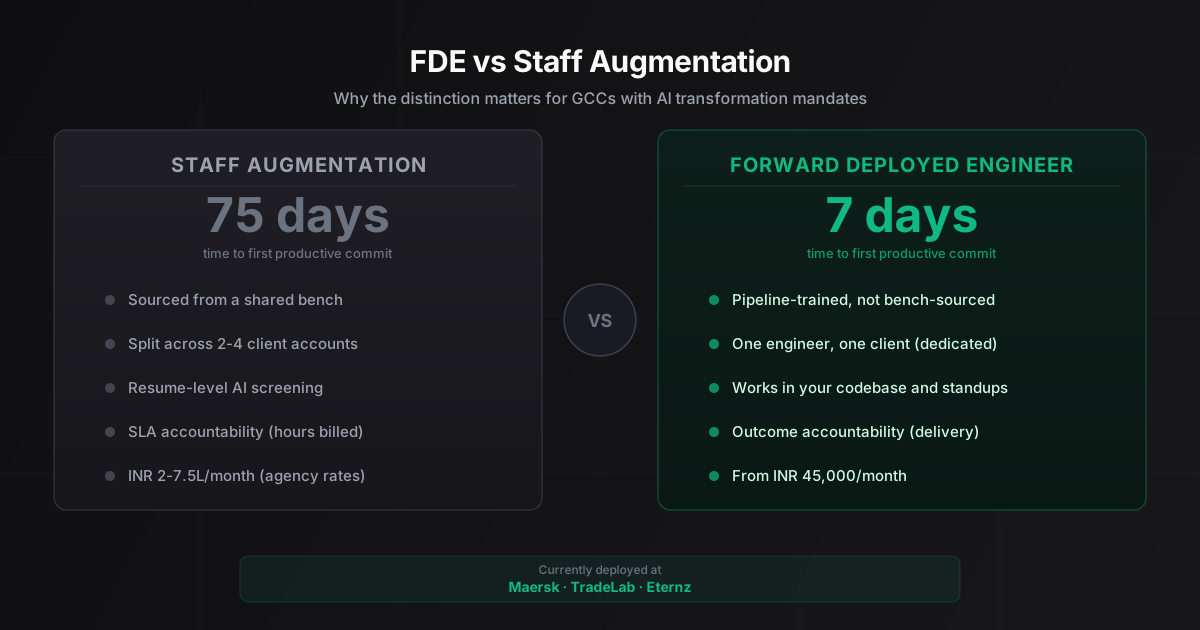
Shared attention. Most staff aug engineers work across 2-4 client accounts at the same time. That’s part of the economics for the staffing partner. An engineer splitting 10 hours a week across three clients doesn’t build context depth in any of them. Understanding your data architecture, your deployment conventions, the specific failure modes in your LLM pipeline, the way your product team writes requirements: none of that accumulates when you’re context-switching between accounts. For AI systems, where the debugging is non-obvious and the architecture decisions cascade through every downstream feature, shallow context is a compounding liability.
Resume-level screening. Staff aug screening qualifies “can do Python, knows LangChain.” It doesn’t screen for “has shipped a RAG system to production and debugged it under load.” For generalist development work, the difference doesn’t matter much. For AI work, it’s most of the job. The difference between an engineer who has read LangChain documentation and one who has debugged chunking strategies at 200 concurrent queries is invisible on a resume. It becomes visible in production, usually at the worst time.
Capacity vs. capability. Staff augmentation adds capacity to an existing workflow. The implicit assumption is that your workflow can absorb the developer and direct their work. GCCs with AI transformation mandates often don’t need more capacity in their current workflow. They need a different capability running alongside their existing teams, embedded closely enough to influence architecture decisions, model selection, and deployment patterns before those decisions are made, not after.
None of this is a criticism of staff augmentation as a model. It’s a product-fit problem. Using staff aug to deliver deep AI capability integration is like using a document store for streaming analytics. The tool isn’t wrong. The problem definition is.
What Forward Deployed Engineer Deployment Actually Looks Like
An FDE isn’t a better staff aug developer. The model is structurally different.
At Kalvium Labs, we have forward deployed engineers embedded at Maersk, TradeLab, and Eternz. What “embedded” means in practice:
- Working in the client’s codebase, not a parallel contractor repo
- Attending the client’s standups, sprint planning, and retrospectives
- Shipping production code through the client’s deployment pipeline
- In the client’s Slack, GitHub, Jira, and Notion from the first week
- Onboarding the same way a new hire would, with the same access and the same context ramp
The FDE is employed and managed by Kalvium Labs. The client gets none of the HR overhead: no payroll administration, no PF contribution, no performance review cycles, no notice period obligations when the engagement ends. The integration depth is what you’d expect from a direct hire, available in 7 days instead of 60-90.
The commitment is 30 hours/week, Monday through Friday, 12 PM to 6 PM IST (plus scheduled team meetings outside that slot). One engineer, one client. No split attention, no account rotation.
If that sounds close to what a direct hire delivers, that’s intentional. The structural difference is where the engineer comes from and who carries the management overhead.
The Three Differences That Actually Matter for GCC Delivery
When a GCC engineering director asks me why FDE over staff aug for AI work, I give three specific differences rather than a positioning answer.
1. Dedicated context, not shared capacity.
Every week an engineer spends in your codebase compounds. They learn where the technical debt is, how your data pipeline is structured, what your product team actually needs vs. what the ticket says, and which architectural shortcuts will create problems in month 3. Staff aug engineers split that context accumulation across multiple clients. An FDE accumulates it in one place.
For AI systems specifically, this matters more than it does for backend development. AI failure modes are subtle. An LLM pipeline that hallucinates on 8% of inputs isn’t broken in a way that shows up immediately in QA. The engineer who knows your data well enough to know what the model is likely to get wrong is the one who catches it before you’re explaining it to users.
2. Pipeline-trained, not generalist-sourced.
Kalvium Labs FDEs come from India’s first AI-native engineering program (Kalvium, founded 2021). They’ve built LLM applications, RAG pipelines, and agentic architectures as part of their core training before their first client engagement. Not as a hobby project. Not as an elective add-on to a traditional computer science curriculum. As the core of a program designed from the ground up to produce engineers who can ship AI to production.
Standard staff aug sourcing goes to whoever is available on the bench with matching keywords. If a GCC needs someone familiar with pgvector, the staffing partner looks for pgvector on a resume. Whether that engineer has debugged HNSW index behavior at scale, or handled embedding drift across a multi-tenant system, is unknowable from the resume. It shows up in production.
Our engineers have shipped 5-8 production-adjacent AI systems during training before we deploy them. It’s not a credential on a resume. It’s the actual technical baseline they arrive with.
3. Outcome accountability, not SLA accountability.
Staff aug contracts define SLAs: hours delivered, tickets resolved, response time. They rarely define outcome accountability. If the RAG system produces hallucinations on 12% of queries and the engineer hasn’t built an eval pipeline to surface that, the hours were delivered as contracted. The accountability stops at the deliverable specification.
FDE deployment is outcome-oriented by design. The FDE is embedded in your team’s sprint, working toward the same product goals, sitting in the same retrospective where the failures get discussed. If the AI feature doesn’t work the way the product requires, the FDE owns that alongside your team. The accountability is aligned with delivery, not with hours billed.
Cost Comparison: Staff Aug vs FDE vs Direct Hire for a GCC
This is where most GCCs make their first error: comparing only the monthly invoice number, not the full cost of getting an AI engineer productive.
Direct comparison for one specialized AI engineer (India, mid-level, 2026):
| Model | Monthly cost (INR) | Time to productive | Overhead |
|---|---|---|---|
| Direct hire (AI specialist) | 1,00,000 – 2,00,000 | 60-90 days + notice period | PF, insurance, HR admin, bench risk if project ends |
| India staffing agency | 2,00,000 – 7,50,000 | 15-30 days | Margins on base, typically split attention |
| Global platforms (Turing, Toptal) | 9,00,000 – 28,00,000 | 7-14 days | USD pricing, significant timezone friction |
| Kalvium Labs FDE | From 45,000 | 7 days | Zero HR overhead, one-client dedicated |
The INR 45,000/month starting point surprises most engineering directors. The question I get on almost every discovery call is: what’s the catch?
The answer is a structural supply-side difference, not a compromise on quality. Kalvium Labs is a product of Kalvium, India’s first AI-native engineering program. The same program produces the engineers we deploy. Their training is funded through the education program, not through client billing. When they arrive at a client engagement, their training cost has already been absorbed elsewhere in the model.
That’s why the economics work at a price point that would be impossible for a traditional staffing model where the staffing company’s margins sit on top of whatever the base engineer cost is. It’s not a discount on quality. It’s a different cost structure. (We cover the math in more detail in the full FDE vs. direct-hire comparison.)
The 3-month minimum engagement reflects what it takes to deliver real outcomes with an embedded model. A 2-week staff aug sprint doesn’t need context depth. A 3-month AI transformation workstream does.
The 7-Day vs 75-Day Timeline
For a GCC running a Q3 mandate, this is the most immediate constraint.
The median specialized AI hire in India, a genuine role and not a relabeled SDE, takes 75 days from job posting to Day 1. That includes sourcing, screening rounds, interviews, offer negotiation, and notice period. LinkedIn’s India talent insights consistently show 30-90 day notice periods at mid-senior levels inside established companies. A GCC hiring from Zepto, Swiggy, or a large IT services company should plan for 90 days from posting to first code commit.
FDE deployment starts in 7 days from a signed agreement. Week 1: access provisioning, codebase onboarding, first team meeting. Week 2: first production contribution. The 7-day number is from our current active deployments, not an aspiration.
For a 6-month AI transformation sprint, the difference between a 7-day and 75-day time-to-productivity is 2 months of execution runway. That’s the difference between hitting the Q3 target and explaining to HQ why it moved to Q4.
The 75-day timeline problem also compounds in a way that’s easy to miss. By the time the engineer starts, the requirement has shifted. The AI vendor that was in the evaluation phase is now the deployment decision. The architectural question that needed answering in month 1 got answered by whoever was available, not by the specialist who should have been in the room. The FDE model lets you have the right person in the room from week 1.
When to Use Each Model
I’m not arguing staff augmentation is the wrong model for GCCs. It’s the right model for specific scenarios. Here’s the decision framework we use when engineering directors ask which to deploy:
Use FDE deployment when:
- The work is AI-specific: LLM integration, RAG systems, agentic architectures, embedding infrastructure, AI feature development that requires production experience to get right
- The mandate is for the engineer to work inside your existing team, not on a parallel workstream
- Time-to-productivity matters more than minimizing the first invoice
- You want a minimum 3-month engagement with the option to scale, not an annual staffing contract with locked-in headcount
Use staff augmentation when:
- The work is generalist development where the problem is headcount, not AI specialization
- The engagement is for scoped project work where context depth isn’t the critical variable
- You have an established staffing vendor relationship you want to continue for non-AI workstreams
- The engagement is under 3 months and the ramp-up investment doesn’t make sense at that duration
In practice, most GCCs that understand the distinction end up using both. Their core engineering capacity augmentation stays with their existing staffing vendor. AI-specific work, particularly anything embedded into their primary product or data engineering team, goes through FDE deployment. The models coexist once the engineering director understands what each is actually optimized for.
There’s also a sequencing pattern we’ve seen: GCCs that start with 1 FDE to validate the model on a specific AI workstream, demonstrate the delivery, and then scale to 3-8 FDEs across different workstreams. That’s easier to get procurement approval for than asking for 5 new headcount in an AI specialty the procurement team can’t evaluate.
What the Embedded Model Looks Like in Practice
Without disclosing specific delivery details, the pattern across our three active FDE deployments at Maersk, TradeLab, and Eternz is consistent.
In each case, the company came in asking for a developer. What they actually needed was a developer who could onboard to their AI architecture, understand where the production system was fragile, and start improving it. That’s a different job description than staffing a headcount, and it’s the job the FDE model is designed for.
Maersk operates one of the most complex logistics and shipping AI environments in the world. Having an FDE embedded in that team means working on the same codebase, under the same production constraints, with the same engineering standards that Maersk applies to every engineer. Not reviewing from the outside. Shipping from the inside.
That’s the distinction that matters for GCCs. Not “FDE or staff aug” as competing vendors for the same headcount request, but “are we trying to add capacity to a known workflow, or embed AI capability into our core team?”
If you want a fuller picture of what the FDE model is before evaluating it against your staffing options, the 2026 guide to forward deployed engineers covers the model from first principles.
FAQ
What’s the operational difference between an FDE and a staff augmentation developer?
Staff aug developers are sourced from a bench, often split across 2-4 client accounts, and engaged for capacity on a defined project. An FDE works on one client account only, is integrated into your standups and sprint cadence, ships production code in your deployment pipeline, and is accountable for outcomes, not just hours. The model is closer to an embedded new hire than to traditional contractor staffing, without the HR overhead on your side.
How long does it actually take to deploy an FDE at a GCC?
7 days from a signed engagement to Day 1, based on our current active deployments. That covers access provisioning, codebase onboarding, and first sprint planning. For comparison, a specialized AI engineer direct hire in India takes 60-90 days from job posting to Day 1, including notice period.
What does a forward deployed engineer actually cost for a GCC?
Starting at INR 45,000/month per engineer for 30 hours/week. Final pricing depends on experience level, AI specialization depth (LLM-only vs full agentic systems), and domain familiarity. The engagement is 3-month minimum, then month-to-month. No INR 12-25 LPA direct-hire cost structure, no PF administration, no bench risk if the workstream ends.
Can a GCC scale FDE deployments as the AI mandate grows?
Yes. The pattern we see: start with 1 FDE on a specific AI workstream, validate the model internally, then scale to 3-8 across workstreams. Each FDE keeps the one-engineer-one-client allocation. You’re deploying N dedicated engineers into N workstreams, not buying a shared team that splits across everything.
What happens if the FDE isn’t the right fit for the team?
We replace them. The 3-month minimum is there to give the engagement enough runway to produce real outcomes, not to lock you into a specific individual. If the match isn’t working by week 3 or 4 (technically, communication style, team dynamics), we identify a replacement within the existing engagement terms. This is part of what makes the FDE model’s accountability structure different from standard staff augmentation.
Kalvium Labs deploys AI-native forward deployed engineers into GCCs and funded startups across India. Engagements start at INR 45,000/month for 30 hrs/week. Currently deployed at Maersk, TradeLab, and Eternz. If you’re running a GCC with an AI mandate and need engineering capacity this month, talk to us on WhatsApp.