A question that comes up in nearly every second discovery call since late 2024: “We had an AI feature built, and now we need to change the model. Why does the quote to make that change cost almost as much as the original build?”
The short answer is that AI integration services carry a second-year cost most proposals don’t show. The first year is the build. The second year is the cost of every architectural decision the first vendor made that assumed you’d stay on their stack forever.
This post is about five patterns that create that cost and how to avoid them before signing the first SOW.
Why AI Vendor Lock-In Is Different from SaaS Lock-In
SaaS lock-in is mostly a data portability problem. Export your CRM data, import to the new tool, rebuild your automations. Annoying, 2-4 weeks, predictable cost.
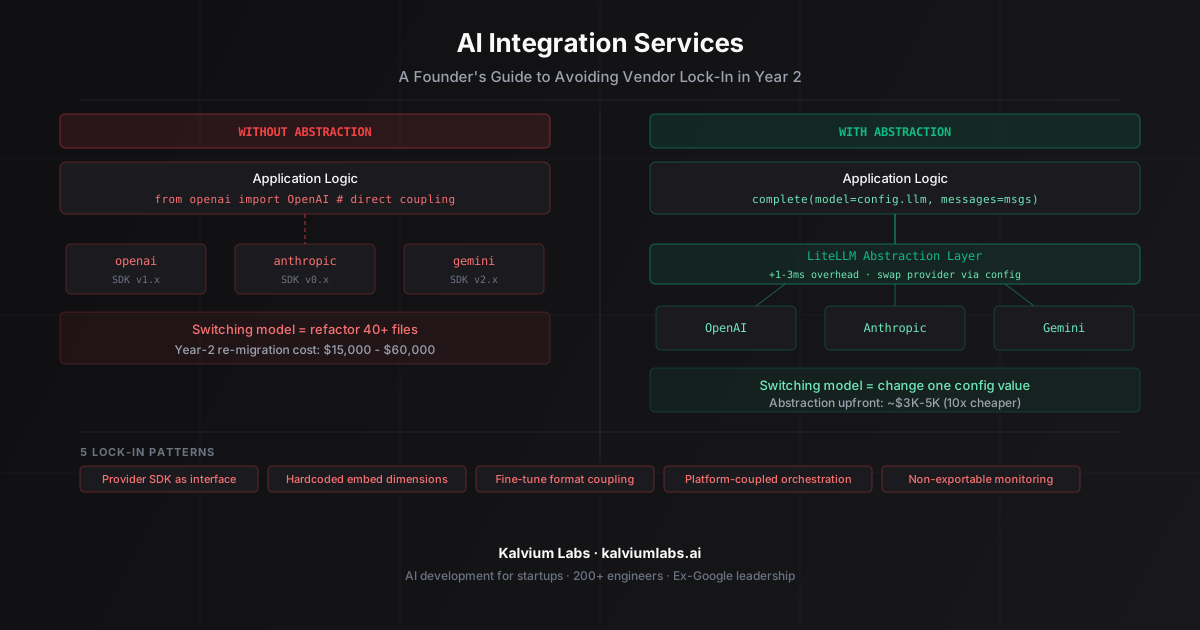
AI integration lock-in is an architecture problem. The coupling is in the code, not just the data. If your integration was built with OpenAI’s Python SDK as the direct interface to your application logic (not as a dependency wrapped behind an abstraction), every file in your codebase that calls the model knows it’s talking to OpenAI specifically. The model routing, retry logic, fallback behavior, token counting: all of it is provider-specific.
Switching providers means refactoring at the source, not at the edge.
The cost of that refactoring is what founders discover in year 2 when a cheaper model becomes available, when a better model launches for a specific use case, or when their first vendor raises prices without warning. We’ve seen this cost run between $15K and $60K depending on how deeply the coupling runs.
The Five Patterns That Create Lock-In
These aren’t exotic mistakes. They’re what happens when an AI integration team builds for delivery speed without building for future flexibility. Each has a fix that costs 1-3 days of upfront architecture work.
Pattern 1: Provider SDK as the Integration Layer
The most common pattern. Instead of building a thin abstraction over the LLM call, the team imports openai or anthropic directly into application logic. Every function that needs a completion knows which provider it’s calling.
# Locked-in version: every file that imports this is coupled
from openai import OpenAI
client = OpenAI()
response = client.chat.completions.create(model="gpt-4o", messages=messages)
When you switch providers, you find from openai import in 40 files. Each file has slightly different message formatting, slightly different error handling, slightly different timeout logic. There’s no single place to change.
The fix is a provider-agnostic completion function that wraps the provider SDK. LiteLLM does this out of the box, supporting 100+ LLM providers with a single API surface. The abstraction adds 1-3ms per call at high throughput. At sub-50ms target latency with tens of thousands of calls per second, you’d measure it. Below that volume, you won’t.
Pattern 2: Hardcoded Embedding Dimensions
Vector stores need to match the embedding model’s output dimension. OpenAI’s ada-002 and text-embedding-3-small both produce 1,536-dimensional vectors by default. Create a Pinecone index at dimension=1536 and everything works.
Now consider switching to text-embedding-3-small in compressed mode (512 dimensions, roughly 5x cheaper at comparable quality on most retrieval benchmarks) or to a locally-hosted model like nomic-embed-text (768 dimensions). Your existing index doesn’t work. You re-index everything.
For a RAG system with 100K documents, re-indexing means rebuilding the entire vector store: 4-12 hours of compute plus the cost of re-embedding the entire corpus.
The fix is two lines of config. Parameterize the embedding dimension at build time, and keep the vector store namespace separate per embedding model version. Two config lines vs. a weekend rebuild.
Pattern 3: Fine-Tuned Model in a Proprietary Training Format
Fine-tuning is the sharpest form of lock-in. The model weights live on the vendor’s infrastructure. The training data is formatted for their pipeline. OpenAI’s fine-tuning schema and Anthropic’s are different. Moving a fine-tuned OpenAI model to a Claude fine-tune requires rebuilding the training pipeline from the data conversion step forward.
In practice: fine-tune only when the use case genuinely requires it (specific terminology the base model gets wrong consistently, domain vocabulary not in the base model, output formats the model fails to hold without training), document the raw training data in a provider-agnostic format before conversion, and build the conversion pipeline as a separate artifact.
Most use cases don’t require fine-tuning. RAG and careful prompt engineering get you 90% of the way there without lock-in. Fine-tune only when you’ve measured the quality gap on a real eval set and found it large enough to justify the coupling.
Pattern 4: Agent Orchestration Tied to a Single Framework
LangChain, LlamaIndex, CrewAI, and similar frameworks have opinionated orchestration patterns. When they match your use case, they ship fast. When they don’t, you’re fighting the abstraction.
The deeper problem: these frameworks update frequently, sometimes with breaking changes, and they abstract over the LLM call in ways that make it hard to instrument what’s actually happening. Debugging a multi-step agent failure in LangChain requires understanding LangChain’s internal state management, not just your application logic.
We’ve moved several integrations off framework-coupled orchestration to direct async Python with explicit state management. The result is more code, but code that’s readable, testable, and instrumentable. For client work where the buyer needs to own the system after handoff, explicit beats magic.
This isn’t an argument against all orchestration frameworks. LangGraph is worth reaching for when you need explicit state machines with checkpointing for multi-step agents (see our LangGraph vs LangChain breakdown for the specific decision points). The point: don’t adopt a framework because it ships fast in week one if it creates a debugging and handoff problem in month six.
Pattern 5: Monitoring Tied to a Non-Exportable SaaS
LLM observability tools (Langfuse, Helicone, Braintrust) are useful. But if your entire production trace history lives in a SaaS with no data export path, you can’t switch without losing the evidence of how your system behaved under real load.
Before picking a monitoring tool, check one thing: does it export traces in an open format? OpenTelemetry is the standard. If not, you’re dependent on that vendor for every future audit of your production behavior.
The fix: instrument with OpenTelemetry traces from the start. Send them to whichever observability tool you prefer. When you need to switch, your trace data moves with you.
The Abstraction Checklist We Apply Before Writing Code
Before we start any AI integration engagement, we run through five questions. If we can answer yes to each, the integration is portable. If not, we document the lock-in explicitly and get a sign-off before building.
-
Can you swap the LLM provider by changing one config value? If the answer is “we’d need to update application code,” the integration layer is too thin.
-
Is the embedding dimension parameterized? If it’s hardcoded in the vector store setup script, it’s a configuration debt item from day one.
-
Does the agent orchestration have a documented escape hatch? Can you swap the orchestration framework without touching business logic? If not, document the dependency explicitly.
-
Can you export all production traces in an open format? If the answer is “we’d have to ask the vendor,” you don’t have the export.
-
Is your prompt storage separate from your application code? Prompts embedded in source code as string literals are the lowest-friction form of coupling. A prompt management layer, even just a YAML file with a version field, means you can iterate and audit without touching the codebase.
This checklist costs about 3 days of architecture work upfront. On our call analyzer build (transcribe + diarize + score sales calls against a compliance rubric, deployed for an enterprise client in two weeks), we ran through it before writing a line of integration code. The abstraction layer came in under 10% of the total project budget. Worth it at any reasonable estimate of the year-2 switching cost.
When Tight Coupling Is the Right Call
Abstraction has a cost. I’ve been arguing for it, but it’s the wrong call in some situations.
Provider-specific capabilities with no equivalent elsewhere. Claude’s extended thinking mode is genuinely different from other chain-of-thought approaches. Gemini’s native video understanding at 1 million token context. If your product’s core value depends on one of these, the coupling is worth it because there’s nothing to abstract over. Document it, set a quarterly reminder to check alternatives, and accept the dependency knowingly.
Volume under 1K calls per day. At low volume, the absolute cost of switching models is low regardless of coupling. An integration processing 500 calls per day isn’t worth 3 days of abstraction architecture. Build the simplest thing, ship it, revisit when volume justifies the investment.
Contractually guaranteed pricing and API stability. If you have a negotiated enterprise agreement with a provider that locks in pricing for 24 months with a stability commitment (no breaking changes for the contract term), the switching-cost argument weakens. You’re not going to switch for the contract term anyway. Build for today.
Founders who regret vendor coupling are the ones who neither documented the trade-off nor got a contractual guarantee. They assumed pricing and capability would stay stable. It didn’t.
The Contract Clause Most Founders Skip
If you’re signing an AI development contract with a vendor building on managed AI infrastructure (OpenAI, Anthropic, Google Cloud Vertex, Azure AI), there’s a clause most founders skip.
A data portability clause with three specifics:
Indexed data export. The vendor must export all vectorized documents (with source content and metadata) in a standard format, JSON or CSV, within 30 days of contract termination. If they can’t do this, either they don’t own the pipeline or the data is structurally coupled to their vector store configuration.
Prompt export. All prompts used in production must be delivered in a readable, versioned format. “Prompt is proprietary to our implementation” is a red flag, particularly for fine-tuned systems where the prompt templates encode your domain logic.
Fine-tuning data return. Any labeled dataset or training data you provided must be returned in its original format. You created the data. You should own the artifacts.
We’ve heard of founders losing access to years of labeled data when a vendor relationship soured. The data existed. The vendor had it. The contract didn’t require them to return it in a usable format. The legal cost to recover it exceeded the cost of rebuilding the training dataset from scratch.
A 90-day notice period for pricing changes and a 12-month API stability commitment are standard asks worth including in any multi-year engagement.
What Portability Actually Costs
Two numbers founders should know. For context on how these fit into the total picture, see our breakdown of what AI builds actually cost at $5K, $15K, and $30K scopes.
Abstraction upfront: 3-5 days of architecture work on a medium-complexity integration. On a $30K integration project, that’s approximately $3,000-5,000 of the budget. Most vendors don’t itemize it because it’s not visible in the demo, and it doesn’t help close the deal.
Rebuilding without abstraction: $15K-$60K. The range depends on how deeply the coupling runs (SDK only vs. embedding dimensions vs. fine-tuned model), how much data was indexed (re-embedding 500K documents is a different scope than 10K), and whether the orchestration framework is involved.
The ratio is roughly 10-15x in favor of upfront abstraction. The math is obvious once you’re on the wrong side of it.
FAQ
What does “AI integration services” actually include?
AI integration services cover connecting LLM capabilities (completions, embeddings, agents) to existing applications and data sources. A typical engagement includes building the LLM abstraction layer, setting up the retrieval pipeline (RAG or structured data query), designing agent orchestration if needed, deploying monitoring, and handing off the codebase with documentation. Scope ranges from a 2-week MVP (one feature, one model, one data source) to a 3-month production system (multi-agent, multi-model, multi-data-source with optional fine-tuning).
How much does an AI integration cost, and where does lock-in add to that?
A basic AI integration (single LLM feature, one data source, no fine-tuning) runs $5K-$15K with a competent team. A production multi-feature integration runs $20K-$50K+. Lock-in adds $0 to the initial cost if the vendor built with abstraction, and $15K-$60K in year 2 if they didn’t. That number doesn’t appear in the original proposal because the vendor won’t be the team rebuilding it.
When should we fine-tune vs. use RAG?
Fine-tune when your domain has specialized terminology the base model gets wrong consistently, you need specific output formats the model fails to hold without training, and you’ve measured the quality gap on a real eval set. RAG when you need fresh or frequently updated information the model can’t hold in context, you have large document collections too big for the context window, or you need per-query retrieval rather than baked-in knowledge. Fine-tuning and RAG aren’t mutually exclusive, but fine-tuning is the higher-lock-in choice. Start with RAG.
How do I know if a vendor has abstraction built in?
Ask directly: “If we need to switch from GPT-4o to Claude next year, what changes in your codebase?” A good answer names the abstraction layer and says “one config file.” A bad answer starts with “well, we’d need to update the API calls…” Ask the same about vector stores: “If we need to change embedding models, how much re-indexing is involved?” If they can’t answer these questions in the first technical discussion, they haven’t built for portability.
What’s the minimum viable contract clause for protecting against lock-in?
Two things: a data portability clause requiring export of all indexed content, prompts, and training data in machine-readable format within 30 days of termination, and a requirement that production integrations use open LLM interfaces (LiteLLM-compatible or equivalent) rather than provider SDKs embedded directly in application logic. Neither is unreasonable to ask for. Both are worth evaluating if a vendor resists them.
If you’re evaluating AI integration options and want to know whether the architecture your vendor is proposing will create lock-in: Book a 30-minute call. We’ll walk through the proposal, flag the coupling decisions, and tell you what the year-2 cost looks like.